Monthly Archives: November 2024

SRPG 105 – Guardian Recall (PSX) Finished

In the last post I had finished the first two of the five chapters, which are essentially the introduction. Now in the third chapter the two teams come together, and you can choose who to send out on each stage (or at least most of them). You will have to use every character at some point so I tended to send out my lowest level people.

The third chapter is essentially about getting into Tokyo, which has been sealed off by the enemies. Here we’re hoping to find the last of the seven dragon areas so that the seven dragons can be awakened. We get help from Jin Hitomi, a member of Egubado who has turned against them. The leader of Egubado is Ryuukihi, who is trying to crash a floating fortress into Japan to destroy it.

By the end of the chapter we’ve reached the area where the last dragon shrine is, but it is blocked by barriers that will require the party to defeat the 4 Egubado guardians. This is where the party splits into four teams. You can use the last stage of the third chapter to level a bit by retreating from the battle and trying again.

After beating the 4 guardians and entering the last area, the dragons awake and seven of the characters get upgraded guardians.

Now we can move on to the final stage — entering Ryuukihi’s palace and defeating her before she can crash it into Tokyo.

First we have to defeat the 4 enemy generals again, and then they combine to form the Nue.

The Nue has multiple parts that have to be defeated, but it’s not too bad. Unfortunately it seems that Nue can regenerate itself, so the seven dragon holders go into the palace to defeat Ryukihi while the rest of the team stays outside to hold off Nue.

In the last chapter, you have to alternate between the dragon people fighting grunt battles and repeated fights against Nue. As you progress, more and more dragon people get left behind to deal with enemies until you have only the two main characters — however, this stock anime trope is pretty pointless because the rest of the girls all show up for the last battle.

Outside, the last battle against Nue features stronger stats and also the ability to regenerate the parts — however, it doesn’t do this all the time, so you can just defeat each part as you go. There’s a hidden “master” at the back that has to be defeated to win the battle.

Finally it’s time to fight Ryukihi. She shows up first with a bunch of guardians, only one of which is the true one. When that’s done, the final form shows up. She also reveals her biggest cliche surprise — that she has to kill everyone in Japan to save Japan (sigh).

In the final battle you have to beat parts again, and then send some units to climb up the arms to reach the top. Only close attackers can handle it so it’s best to send your two strongest melee fights up each side. The rest of the girls can support from below (their spells can reach the top).

Once Ryuhiki is beaten she gives the usual “you’ll regret this some day” speech and then the game is over. The epilogue says what happens to all the girls, and even contains some canonical lesbian pairups.

Overall the game isn’t bad. I’m still not a huge fan of AI battles but for the most part, once you learn how everything works, you can predict the majority of what your guardians will do. The various stats and compatibilities with enemies mean that you can’t just march everyone forward and do whatever you want. The story is not the best, and there are probably too many characters to develop well (it might have been stronger if the only party characters had been the 7 dragon users so that each one could get more development).

Probably the biggest downside of the game is how slow it plays, but this can be alleviated with a speedup key on an emulator if that is how you are playing.

SRPG 105 – Guardian Recall Part 1 (PSX)

Guardian Recall (ガーディアンリコール 〜守護獣召喚〜), released 10/1/1998, developed by Agmix, published by Xing

This game was originally released for PC98 in 1996 as an eroge; the Playstation port is a complete (all ages) remake. I don’t know all the details of the original game but it sounds like both the battle system and the story were extensively redone.

The basic premise of the game is that all the characters can summon Guardian Beasts that actually fight for them (it’s basically Stands from Jojo). You can directly control your human people, but they can’t directly attack. All the attacking has to be done by the Guardians, who can only be controlled by AI settings. The AI system has more care put into it than some of the other AI-based games I’ve played, but in the end I think I just prefer to control my characters.

All of the main characters and non-grunt enemies are female, with no in-world reasoning (they don’t even try to explain it, I guess when it’s an eroge nobody cares).

The game takes place over 40 stages in 5 chapters. The first two chapters are parallel in time and can be played in either order, but after that you play the other 3 sequentially.

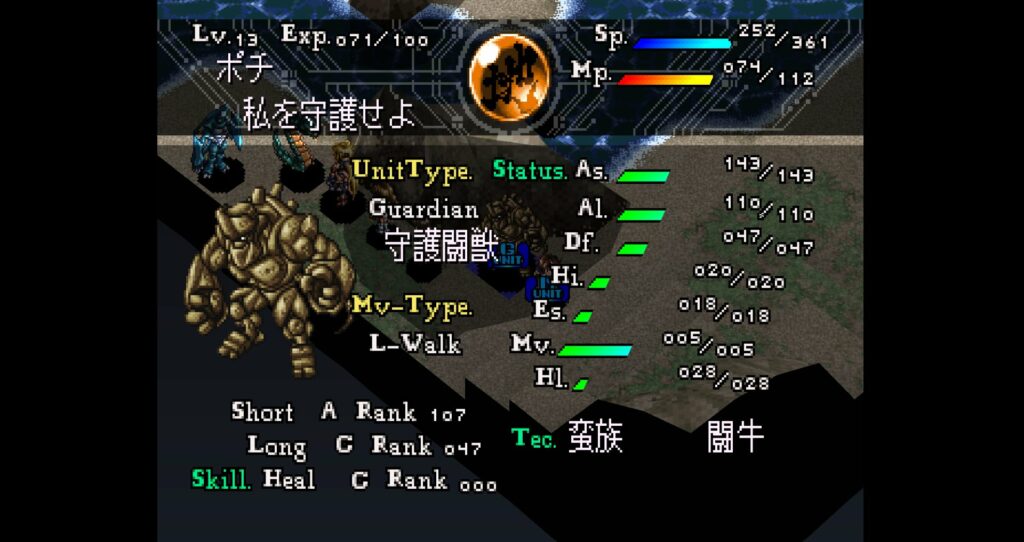
Each character has three main point pools, which they share with their guardian. SP is hit points. MP is used to issue commands to the guardians — when it reaches 0, you lose control over the guardian and it starts attacking randomly (I think you can still recall it though even when it does this). AP is for the spells that the human characters can use.

You choose your AI command from a list, that grows as you level up. The number is the amount of MP it uses per turn (which is increased if the guardian is far away from the human). The AI command not only affects how the guardian will act, but also will shift the stats of the guardian. The basic AI command is “protect me”, which will cause the guardian to stay near the human and only attack nearby units. Some of the other commands are “attack!” (which will send them out), “heal”, “move to a specific point”, and “don’t do anything.”

So you can’t guarantee that your guardian will do exactly what you want, but you can shift it to make it more likely. There is also a tendency for guardians to attack each other rather than going for the humans, although they will go for the humans in some cases.

The guardians have an elemental (of 8), and there is the standard compatibility chart between elements. They also have ranks in various types of attacks, starting with D (which means they can’t do it at all) up to S. The numbers after the rank show how the guardian will develop when they rank up (so in the picture above, Pochi is probably going to be Short S, Long C or maybe B, and Heal C at the next rank up). They also get some special abilities that activate in certain cases.

The game works on a typical player/enemy turn system. Each turn, each human character can do three things in any order — move, change AI setting, and either use an item or a spell. The guardian will act when you end your turn (or if you choose “carry out order” in the AI menu).

There are hidden items on the map (I don’t know why this is such a common thing in SRPGs, who decided this was a good game element?) You can also get a lot of bonus items from using the “talk” ability, either between your own characters or between you and the enemies. The ones where you have to talk to the enemies are often quite difficult to get because you have to maneuver your humans to the other humans without getting killed (or without killing the enemy), which can be tricky. I’ve found it not very worth it, although if the game gets harder later I might regret not getting more items.

Most of the dialogue is not voiced, but there are a fair number of anime sequences, some of which are rather long.

So far I have only played the first two chapters (16 stages). The story doesn’t develop a whole lot in this segment, it mostly just introduces the characters and the basic situation. The enemy group, called Egubado, is trying to cause chaos and possibly destroy Japan. I believe that they were the cause of a big earthquake in 1999 (this takes place in 2017 or so). Seven of the girls on your team were all born in 1999 and they get called by the Dragon Spirits — currently our goal is just to find all the dwelling places of those spirits and awaken them.

So I have 24 more stages.

One other issue with this game that gets brought up a lot is that it’s rather slow. You can fortunately turn off animations but even so it takes a long time for everything to happen, and load times are long. Duckstation is efficient enough that I can get a good emulator speedup, so it’s not as bad as it would be on a real console (this is why my rating system is unfair to Saturn games, but that’s another issue….)

SRPG 104 – Shining Force III Scenario 3 (SAT) – Part 2

Chapter 4 was pretty straightforward, I didn’t bother with the thief map because it seemed annoying (you have to turn on lights and do other things to make paths

At the end you fight two of the Rainblood enemies, which were portrayed as almost unbeatable in the previous chapters but they’re actually not that hard when you finally fight them.

Chapter 5 starts out with a fairly easy map and then there are several “trials”. For battle 19 the key is just to stay in the forest, that way not too many enemies spawn. But the forest is annoying because it’s hard to see your characters (or the enemies).

Battle 20 is a gimmick battle; there are statues that move around and switch direction, your goal is to block them with your characters so that they will move to surround Grasia. I’m not sure why this proves that you are worthy to use the innovator power, but I guess it does.

This unlocks a new set of promotions for everyone at level 20.

Battle 21 is vs. an ice mage who gets free attacks that are like the Valkyrie from earlier. It’s kind of annoying because you have to get rid of these ice crystals that she creates, but once you can have Julian or Grasia talk to her it ends the battle and she joins up (I didn’t actually use her).

I thought Battle 22 was one of the hardest battles; Garm gets multiple attacks and has a lot of HP. I had to escape several times before I could take him down.

Chapter 6 is basically defeated the remaining Rainbloods and also dealing with the brainwashed members of Medion and Symbios’ forces (who are much weaker than the enemies).

The final chapter is where I thought things really took a wrong turn. You now have control of all three parties, and the final battle is in two parts. The first part is a massive three-map battle where each party is taking on their own enemy force and you switch back and forth between them. I think this is intended to feel epic, but the unskippable battle scenes and general slow pace of the game made it feel tedious and boring to me, not epic.

Furthermore, you have to do a significant amount of grinding in the Hero’s Test to be able to take on the battles, which increased the feeling of sluggishness. Of course you can instead just try the battles and Return until you can beat it, but the game discourages this by making the massive 3-part battle just part one of the final battle; you then move on to the last battle vs Balzam and if you have to Return from this part you have to play the 3-part battle again.

Finally I had gone through the Hero Test enough to have a good three party setup, and I took on the final battles.

I don’t like how hard it is to see where everyone is in these forest maps.

In the final battle you have to first deal with three underlings of Balzam and then you can take him on. He has ~2400 HP so it’s a long slog of a battle but as long as you get all your guys bunched up together so his attack does less damage, it’s not too bad.

I was pretty disappointed in this game overall. It is without a doubt my least favorite Shining Force game. It’s too long, too slow-moving, and too tedious to play, with a story that’s difficult to follow and an interface that has barely advanced since the original 1991 Shining Force. The 3D maps also are more of a hindrance than a help; it can be hard to move your characters where you want them to be, and it’s not always easy to see where the enemies are. The graphics are not all that good, and the unskippable battle animations are a chore. My main feeling on finishing the game was that I’m happy there are no more Shining Force games in the list (except for the later DS remake of 1). I was never a huge fan of the series to begin with.

This is not only the end of the Shining Force series but also the end of the Saturn SRPGs. There are actually two more on the list (Farland Saga 2 and Device Reign) but I will be playing the Playstation versions of those games instead.

No post this week

I’ve been sick all week so I am not going to make a post — I’m at the end of SF3 but now I have to do a bunch of grinding just to get the parties up to the point where they can fight the last battles…not a particularly good way to end the game.

SRPG 104 – Shining Force III Scenario 3 (SAT) – Part 1

Shining Force III Scenario 3 (シャイニング・フォースIII シナリオ3 氷壁の邪神宮), 9/23/1998, developed and published by Sega

We’ve come to the final Saturn game I will be playing (there are two more Saturn SRPGs but I’ll be playing the PS1 versions of them). It’s also the last of the “traditional” SRPG-style Shining games, other than the remake of 1. I believe that there are some other Shining games that are SRPG-ish but I don’t know if any of them fully qualify under my rules.

I was not able to figure out how to get the carryover stuff to work in Mednafen so I didn’t get any of the “sychrony” stuff from the first two games.

On the whole, I feel like I am not as big a fan of the SF games as a lot of SRPG players. I don’t know if this is because I never had Sega systems as a kid so I have no nostalgic connection with them. III seems to be especially beloved among fans, and while I think it’s a good game, it’s not one of my favorites.

The main character this time is Julian, who appeared in scenario 1. The first few chapters take Julian’s story up to the point where Scenario 1 ended. I found SF3’s storyline very difficult to follow — I couldn’t keep track of the various factions and alliances, and the way you basically play the same time period three times leading up to the Scenario 1 ending didn’t work for me. I know the story is well liked and I think other people appreciated it more than I did, but I just found it clumsy. It also seemed to me like there was all this buildup of tension and suspense over the situation at the end of scenario 1, but in scenario 3 when all three groups reach that point the cliffhanger is solved instantly and you move on to the final “defeat the evil demon” part of the story.

The gameplay is the same as the other two scenarios so nothing new there. It’s the classic SF gameplay for the most part, so it’s enjoyable. I do feel that it is starting to show its age, though, and I wish that they had done a bit of refinement rather than essentially reusing the SF1 system. In particular, they should have added the ability to see who is acting next (maybe for at least the next 3-5 actions), and I would have preferred that the special abilities be MP-cost moves rather than just things that randomly activate on attacks. There are a lot of little issues (for instance, that bow people can shoot through walls) that make it clear this is basically a system that was developed in the early days of SRPGs and hasn’t really advanced much since then.

This may seem unduly harsh but my criticisms are based on the fact that the game does all the basic stuff right and is generally a fun game, but could have been a lot better if they had been more willing to update the old style gameplay.

Some notes on some of the battles:

Battle 3 – you have to face the Valkyrie shooting at you — you can have some NPCs to weather some of the hits but you’ll have to take some of them. This battle also has one of those ruins submaps. I found the ruins submaps a lot more annoying in this game compared to the first two scenarios so I ended up ignoring a lot of them.Y

Battle 4 – Another Valkyrie map. This time you can hide behind walls to avoid the hits, but you won’t be able to avoid everything. Grashia can use his spell to disable the Valkyrie when you get close (Grashia is a weird character, his only two spells for quite a while are Aura and a damage spell that is basically unusable because it takes all of his MP).

You can start using the mithril forging shop basically right from the beginning.

Battle 6 – You can defeat dragons with a new guy to get them on your team but they can’t level up and if they die they are gone for good. But the white dragon boss can be convinced by the character and he is a permanent character who is not bad at all.

Battle 8 – Here you have part of your force on the wall using the cannons. They can defeat the characters shooting their own cannons but eventually they have to destroy the door so that the boss will come out. At first I thought I could leave the cannons alone because they didn’t seem to do much damage, but it’s too much when they both attack the same person and then that person is also being attacked by the ground troops.

Melinda appears as an NPC but she is pointless, she just moves around but never attacks.

Battle 9 – The golems are annoying and it can be hard to avoid their attacks; in the end I had to rush a few characters up to the boss before everyone got taken out.

Battle 10 – You can avoid reinforcements by staying in the darkness away from the light but I didn’t bother, I just killed the reinforcements as they came.

Battle 12 – This has a weird ruin where the thief doesn’t open the chests unless you block him into a movement where he has to stop next to a chest. Rather than restarting the map to get this right I just moved on.

Battle 13 – You have to fight two bosses here, and you have to be careful moving to where Yasha is because it will trigger falling floors that will cut off the rest of your characters from moving. I was able to take out Yasha with bow people and flying units.

So now we have finally reached the end of Scenario 1 in terms of the story. Hopefully I will have the game finished by next week.