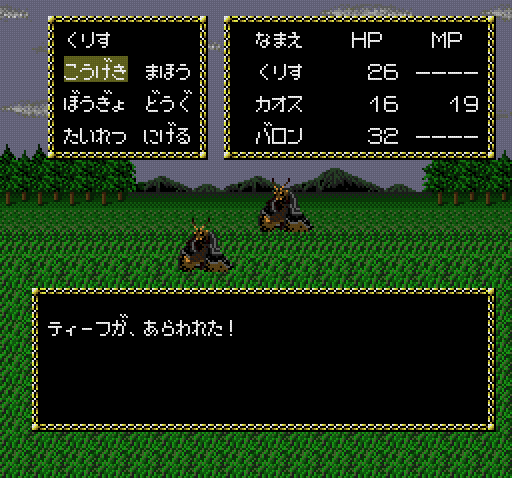
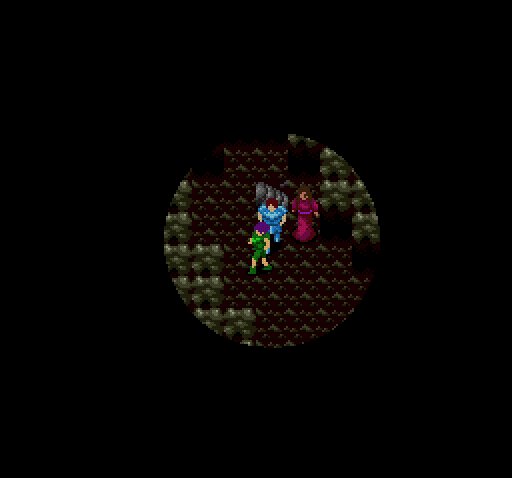
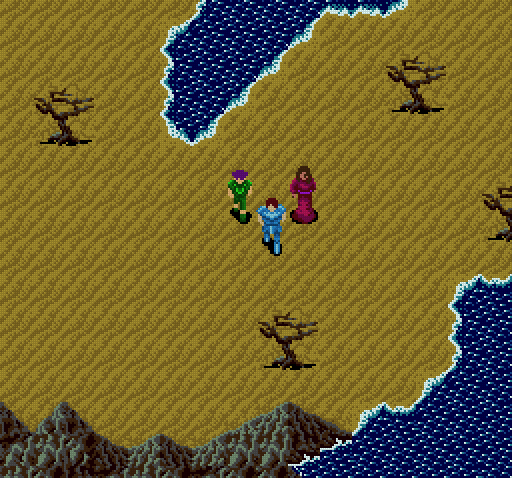
Jaseiken Necromancer (邪聖剣ネクロマンサー), released 1/22/1988, developed and published by Hudson
The PC Engine came out in late 1987 and was quite successful in Japan. I played most of the PC Engine CD RPGs already, but I didn’t play any of the non-CD games that came out on the “hu cards”. This is the first one, made by Hudson itself. It’s a pretty standard top-down command battle game.
The graphics are noticeably better (at least in terms of the technology) than the Famicom. Unfortunately we’re back to passwords — there was some kind of add-on that allowed for save games on certain HuCard games and the CD attachment had save memory inside it, but for games this early you only have passwords. Fortunately save states can substitute for that now.
I’m trying something new starting with the 1988 RPGs, going back to the way I had originally played the Super Famicom games. I’m attempting to find an instruction booklet and at least starting the game with no information outside of the instructions. From the instructions I learned that I would be able to choose 2 members out of a possible 5 to accompany the main character, and there was also the backstory and a world map. The backstory was simple and standard — find the Jaseiken Necromancer sword to defeat the evil than is plaguing the world. Other than that everything in the manual suggested just a normal old DQ-style RPG.
The first thing you do is head to the king and choose your party members. I chose Kaosu, who is a priest-like character, and Baron, who is a fighter-type character. The other choices are Raimu (a magician using mostly attack magic), Maisto (a fast character who also learns some magic), and Romina. The last character doesn’t say anything about her abilities except that she wants to go. (I later learned from a walkthrough site that she begins weak and is weak for most of the game but by the very end she is one of the most powerful characters.)
The first town doesn’t give a whole lot of information, just some vague information about a shrine nearby and a town where I should be able to get better equipment. So I started exploring.
I levelled up and bought all the best equipment in the first town, and I still wasn’t able to survive long enough to find anything; as soon as I passed the invisible line that brought on more difficult monsters I couldn’t survive enough fights to even see where a town or shrine was, much less reach it.
After enough frustration I decide to look at a walkthrough. The first thing I learned is that the companions are poorly balanced and some are much better than the others. I had managed to choose the worst possible party, primarily because the characters’ agility scores are too low so they miss too often. So I restarted the game and chose the magician and the “fast” character, which was supposedly the best party.
With this party I was finally able to make progress. I reached the other town and bought better stuff (including armor, which is not sold at the first town). They also had a wider variety of spells to buy, but since MP is so limited I didn’t buy most of them. The most important seemed to be heal, light, and anti-poison.
The main first goal is making it off the initial island, but the man in the shrine won’t let you pass without the “Burn Staff”. You get this from a man in the southern shrine, but first it has to be uncursed. Unfortunately the guy who tells you he will uncurse things can’t handle this, so sends you to his master. The master is in a cave, and needs you to find an item in the cave to do the uncursing. With all that done you can move on to the next place, which is a desert area.
That’s as far as I played. As long as you pick a good party, this is a decent RPG given when it came out. As usual it requires a ton of grinding to progress, but most games at this point are like that.
Ouka Houshin (央華封神), released 12/16/1999, developed/published by ESP, MediaWorks, and EXE Create
This is a game based on a tabletop RPG, by the same people who did Sword World and Record of Lodoss War. Those games were based on Western fantasy standards, whereas this game is based on Chinese mythology, and especially the Investiture of the Gods work that also provided the basis for Houshin Engi.
It’s the kind of SRPG that I’m not overly fond of; along the lines of the Dragon Force/Brigandine style of game. In contrast to those games this does have specific story battles, but for my taste there’s still too much repetitive fighting against random enemies that are emanating from castles or other structures. This is always my biggest issue with this kind of game.
I do like the graphics. The characters have a nice design, and fortunately they did not try the 3D polygon style that never works. The maps allow for enough rotation that you can see what’s going on, with the exception of the city maps which are very hard to navigate.
Music and sound: The music is appropriately Chinese-themed. The important story dialogue is voiced.
The story is pretty thin on the whole — there are so many characters that few of them are given any depth, and the story doesn’t really rise very far above “stop the evil people.” Your team is made up of sennin (basically Daoist sages who have gained magical powers through their austerity and other spiritual devotions) coming to Earth to deal with evil beings who are corrupting the world and trying to bring back some evil presence by hatching an egg. They needed a lot of characters because of the way the system works, but it may also have something to do with the source material. The left person in the first image above is sort of a main character, but even the main character isn’t really all that well developed.
The basic idea is that you need to cleanse the Yin energy from all the locations and restore the Yang.
The system involves an overworld map and battles.
The overworld map consists of a number of points, some of which are villages and others are caves/shrines/etc. The yellow places have been cleansed to Ying, and the blue are Yin. The lines coming out of them show connections between Yin or Yang points. You can make several different groups of out your characters and go around to the places (most of them also have Sage powers that can fast transport). If you go to a place that is Yin you may have to fight a battle first, then you can cleanse it. When you cleanse the right places you get the connection lines and this gives you toku, which basically acts as money. Enemies will come out of certain Yin places and try to recapture the areas, although if you cleanse enough places in an area (or maybe complete story events) the Ying level will turn to “MAX” and then the enemies cannot take it over anymore.
Additional places open up as you cleanse certain areas and complete certain story battles.
This all happens in real time, and your characters are not automatically healed after battle. So you do sometimes need to spend time waiting in order to recover their MP or HP.
The battles are pretty standard SRPG grid battles; characters have their own types of weapons with different ranges and areas, and there is a fairly complicated magic system that I never quite figured out — using the spells is easy enough but the way you learn them involves gaining levels but also something that you gain from cleansing the various places. But some characters learned huge amounts of magic while others learned almost none, and I was never entirely sure why this was.
On the whole the game was difficult to figure out, and this is partly due to things being needlessly complicated, and issues with the interface. The instruction booklet is not very clear on many parts of the game. I didn’t figure out how to buy things until near the end of the game (you have to use the power to go back to the clouds and then buy things from the sages), and even then how to equip things was not straightforward. I did eventually figure it out with a combination of the instruction manual and the game itself, but managing all the different groups wasn’t very fun either.
The map design is mostly generic; there are only a handful of actual story battles.
Finally, the balance. Without fighting a lot of extra battles (i.e. waiting for guys to come out) it’s hard to keep your levels even, and it’s much easier to just use a single group for most of the tasks, and have some side groups to deal with some of the generics. On the whole I didn’t find the game too challenging until near the end, when the unique enemies started having a lot more power and the ability to cast very damaging spells that sometimes hit the whole map (you can get these too).
But the final battle was a different story and a situation that has become familiar to me now. It represents a huge leap in difficulty; the boss has multiple places that you can damage it but they keep changing, and it has very damaging attacks. I looked at a video of the boss and they were much more highly levelled than me. So I thought I would grind a bit, but it turns out that once you get to the point where the final boss is revealed, you cannot fight any more battles, so you’re stuck with whatever team you have at that point (unless there was some way to train that I never figured out). So that’s where I stopped — I think this is the 5th or 6th game that I have had to stop on the final battle.
So as I said above, I still don’t really like this kind of SRPG.
Since I started this blog I’ve gotten a lot of spam comments, which the WordPress plugins deal with quite effectively for the most part. They are generally really lazy — some are just straight up “click here for X”. Others try to pose as legitimate comments but they do so in such a lazy, obvious way that the spam filter can catch all of them. Here are some examples:
Good post! We are linking to this particularly great post on our site. Keep up the great writing.
This article is both accurate and engaging. I’m impressed by how useful the whole website is.
Hi, just wanted to mention, I enjoyed this blog post. It was practical. Keep on posting!
These comments take advantage of the fact that you can leave a website in your display name when you post.
Today, though, I had this comment on the Elfaria II post which was initially not caught by the spam filter:
Of course once you see the display name and the e-mail address it’s obvious spam, but clearly this is an AI-written response. I think maybe I felt like something was off from the way it was written, but I nearly hit “approve” before I noticed the username.
When I looked in my spam folder I saw that these kind of comments had been coming in for a while now. Some examples:
That’s a really interesting bit of history about Shiozawa Kaneto’s involvement. It’s amazing how many different media tie-ins these older games had back then. (on Gate Keepers)
That’s a really interesting point about it being Sega’s only Master System RPG – I remember hearing about that back then, it’s amazing how different the console landscape was! (on Phantasy Star)
Absolutely, it felt like nothing else on the Famicom at the time. The world design and story were just incredibly immersive. (On Final Fantasy)
It seems like they started coming in around January of this year.
I’m not sure how effective this can really be because there’s no point in the spam comment if there isn’t a link to some kind of scam/honeypot, which makes it pretty easy to identify (even by a spam filter). I suppose if someone is running a larger blog where they don’t read all the comments it might work?
(My blog does not use AI at all for any posts or images.)
Wizardry (ウィザードリィ 狂王の試練場), developed by Game Studio, released by ASCII
The Wizardry series has enjoyed great popularity in Japan, much greater popularity than it ever had in the US. The last original Wizardry game came out in 2001, and by then the series was really coasting on its name value (the last game before that had been 9 years earlier). In Japan, there were roughly 25 Wizardry games released after 2001. CRPGAddict had a good guest blog post covering the history of the series in Japan.
By the time the first Wizardry game was released for the Famicom, the first three games were available for Japanese computers. The Famicom version is largely a faithful adaptation of the computer version — I see a number of sites saying that the maps of the later floors were different but I haven’t been able to find any confirmation of this. I looked at a number of sites (both Japanese and English) and I didn’t see any difference between the maps.
One interesting feature is that you can have the text either in English or Japanese. You can even do it in parts — you can have the monster names in English and the shop names in Japanese (etc). I guess this made the game easy to localize!
The dungeons have improved graphics from the original Apple II version — the full screen maps had already been done in the DOS port but the brick walls are new, I think. There is actually an option to switch it back to the wireframe original.
The Famicom version preserves the brutal nature of the original game, in which party death is permanent — if you get a party wipe you can’t reload a save, you have to start a new party. You can find your old party’s bodies in the dungeon and bring them back for recovery, but this is a difficult process and resurrection can fail. There were a number of ways to get around this regardless of which computer system you were playing on. For the NES, you can just reset the game as long as the battle has not ended yet, and then you can select the “restart an out party” option and you’ll be back before the battle. There is also an option to save your game to the “turbo file” accessory (this can be used to transfer your party to the other Wizardry games, but also just to back up your save).
One big issue with the game is that there is a bug where AC doesn’t work at all (for you or the enemies). This has been fixed with a fan-made patch, I think.
Instead, I will consider Wizardry in the context of the other games up to this point. This is the last game of 1987 and the 44th game in this “early RPGs” sequence. I think the games can be broadly divided into 4 categories and I’ll see if I can pick the best game from each one.
The first are the first person maze games like Wizardry. This also includes the two Deep Dungeon games, Megami Tensei, and I guess Phantasy Star although it’s not quite as traditional a maze-style game as the other ones.
The Deep Dungeon games are just flat out bad. Maybe if you were desperate when they first came out you could struggle through them, but you would have had to deal with the Famicom Disc loading crap on top of the low quality.
As I said when I reviewed it, I think Megami Tensei is quite impressive for the time it came out. Personally I would pick that as the best maze game for 1986-7 but I wouldn’t quibble with someone choosing Phantasy Star if it qualifies.
The second are the Dragon Quest style top down command-battle games. There aren’t too many of these either; even though DQ came out in 1986 it was a while before companies really started copying it. Other than DQ and DQ2, we have Glory of Heracles, Final Fantasy, and Momotaro Densetsu.
The third are top down action/adventure games. This includes Zelda, Hydlide, Adventure of Valkyrie, Magic Bell (Deadly Towers), Esper Dream, Marchen Veil, Seiken Psycho Caliber, Mirai Shinwa Jabas, Scherezade, Kalin no Tsurugi, Light of Indra, Minelvaton Saga, Dragon Scroll, and Outlanders. A lot of these games were shameless Zelda ripoffs or otherwise not very good. If Zelda counts as an early RPG-ish game that’s probably the top here but Esper Dream was a good candidate as well.
The last category are side scrolling action/adventure games. This includes Zelda II, Zombie Hunter, Getsu fuu maden, Chesterfield, Saint Seiya, Majo Densetsu II, Castlevania II, Romancia, Faxanadu and Debias. Some of these games didn’t have much in the way of actual RPG elements and to me none of these really stood out as worth playing (I did mostly skip Getsu fuu maden because it hardly qualified as an RPG but some commenters said it was a good game.
That leaves Cleopatra no Mahou, Zoids, Ultima Exodus, Haja no Fuin, Artelius, and Ginga no Sannin, which are hybrid games or ones that don’t neatly fit into the previous categories. None of those really grabbed me.
I was trying to think of an answer to this question: if I had to choose one of these games to play through to the end, which would I pick? Probably I would go with Momotaro Densetsu (just because it’s a traditional game series), Esper Dream, or Faxanadu (I was pretty far along anyway).
There are 20 games in 1988 so I’ll review them once I play them all. If you want to see the list it’s on the page for the early RPGs.
Gate Keepers (ゲートキーパーズ), released 12/16/1999, developed by ESP, published by Kadokawa Shoten
This is a franchise that started with this Playstation game but also had an associated manga, anime, and light novel. The anime was one of the last projects of Shiozawa Kaneto, who died suddenly during the creation (he only played a guest character in one episode).
This struck me as a pretty lazy harem product. Neither the plot nor the characters are particularly well developed, and the gameplay is not great either. It’s certainly much better than Seirei Shokan, but I can’t help feeling like they were mostly relying on the harem-series angle to get people interested in it.
The game begins with a vocal song and animated intro (I wouldn’t be surprised if this was reused in some form in the anime). There are other short animated sections as well. Aside from this, the graphics are serviceable.
I’m not necessarily the right audience for this but I’m not sure how much the girls in the game would appeal to harem-series fans.
They look OK but they have this 90s-anime feel to them that’s a bit outdated now.
The in-battle graphics aren’t bad either, although they can get in the way of seeing things — fortunately the game gives you a button you can push to temporarily take away all the graphics so you can see where everyone is, although even then I sometimes found it hard to tell exactly where I needed to move to attack a unit. On the whole I would say this is a decent example of this middle-late period of Playstation games.
For music and sound, there is a lot of voiced dialogue, and the seiyuu lineup is pretty good for the period. One thing that I never like is the lack of voice for the main character — I know this is normal in visual novels and this kind of game (I guess so you can imagine yourself as the lead?) But in all the animated sequences the MC does have a voice.
The story involves a group of “Gate Keepers”, who can call on things from some alternate world to essentially use magic. The main character is an average high school student who is recognized by this secret international organization that gathers Gate Keepers (who of course are all kids, at least the ones in this game) to protect the world against “Invaders”. Each Gate Keeper is associated with a different Gate which sets the type of powers they can use.
The basic story of the game involves efforts by the Invaders to take over the world, that then center on a human named Kageyama Reiji that is working with the Invaders. The game takes place in the late 1960s for some reason, and begins with a scene where Reiji uses his gate magic to kill a bunch of soldiers in the Vietnam War (and the suggestion I think is that this ends the war).
The main interest of the game, I suppose, is the different girls; of course you can develop friendship levels with them and get special endings (romantic, perhaps, although I didn’t get such an ending) with the girl you like the most. As usual, they represent a range of common character types — the shy, morose study girl, a few foreigners, an athletic girl, a child (sigh), an airhead, and such.
The system alternates between the battles and the conversation parts. For the conversation, the characters are all in a school — it’s a real school but it also serves to hide the command center of the Gate Keeper force, so that the GKs can all make it there in an instant if they need to. So you can choose where you want to go in the school to talk to the various girls. Sometimes they might not be there and then you go somewhere else (like the gym or nurse’s room). You might also get a choice of what to do. I don’t believe that going back to the same girl more than once ever does anything but I could be wrong.
You only have a limited number of places you can go (unspecified) before the alarm will go off to send you to the next battle
I didn’t look at a walkthrough to see what choices were good or what I should do. This ended up unfortunately with my highest friendship rating being the Chinese 11 year old (or something) above. Fortunately I did not get a high enough value to trigger the love scene, but I did have to hear from one of her classmates this very creepy dialogue about what is attractive about her. It sounded more like what a creepy adult would say about a child rather than what an actual 11 year old would say.
Once you beat the game you can access an extras menu that shows you a completion percentage which I guess measures how well you did with each girl, and the better you do the more extras (images and such) you unlock. I had 0% with every girl except that Chinese girl who had 66%; I guess I didn’t pick the right options for the others.
There are one or two battles per chapter (the whole game is pretty short, I finished it in 12 hours). Unfortunately you can only send out the main character and at most 2 girls (sometimes just 1). This is especially annoying because there are no free or side battles, so you pretty much have to concentrate on just sending out a core party. So you barely get to use any of the characters — I guess their idea is that you replay it several times (the save slot has a three-digit counter for how many times you’ve cleared the game), but I’m not going to do that. I generally sent out Jun (who has a gun) and Fei (the Chinese girl) because her gate attack could hit everyone on the screen.
Each character has their own weapon; you don’t equip anything but the weapons have different ranges and powers. The MC has both a gun and katana.
The system is player/enemy turn. You can move and act. The actions are attack, Gate, and jump (up to a higher area). The main character can also call in help to heal or status restore — this is unlimited but it takes the MCs turn and because you have so few characters you can’t rely on it to get you out of every jam.
To use the Gate powers, you first choose to open that character’s gate. You then see a number appear over the character — this is the remaining power of the gate. It goes down by 1 each turn, and then every Gate power you use takes some amount of energy (ranging from 0 to at least 5). Once it hits 0 the gate closes and cannot be opened again for that battle. Personally I would have rather seen a system where the gate energy can recover and be opened again — the system as it is seems too limited, especially in battles with multiple sets of reinforcements or when the enemies are spread all over the map. On the whole I think the battle system has good ideas, but the tiny party size and very limited use of the key power of the game makes it feel rather thin. Halfway through the game you get the ability to summon a mech by combining the power of the MC and one girl, but that basically reduces your party size to 2 because the girl you pick can’t do anything except move until the mech goes away.
If the MC reaches 0 hp it’s game over; if one of the girls reaches 0 hp you lose friendship value with them and they are out for that map.
The way the XP is done is weird. Enemies will often drop gems that give between 1 and 10 xp. 10 xp moves you up a level. But you have to get the gem before it disappears, and the last enemy you beat drops a gem but you don’t get it, even if it’s the boss and it gives you a 10 xp gem. Characters that did not join the battle get 5 xp for each one, which is not enough to keep them competitive.
For map design, there is some variety in the maps. Some of them are in the air like above (although it makes no sense because despite being in planes, everyone still retains their core attack types and ranges). Height and obstacles play a big role. There are a number of unique enemies with their own challenges.
The balance is not great. As I said above, the lack of any free battles means that if you didn’t focus all your XP on a few characters you are screwed. Moving up a level restores your HP — if it weren’t for this I think the game would be nearly impossible because all of the enemies in the game hit hard, from grunts to bosses. A lot of the grunts have their own powers and area attacks, and the bosses can sometimes hit from all the way across the screen. Losing even one character reduces your combat potential by 1/3 and so you can’t afford that at all unless you are almost done with the map.
The interface is fine, and I mentioned the extras above (the unlockable things from getting the friendship levels with the girls).
On the whole I wasn’t a big fan of the game. The harem part didn’t interest me, and the gameplay wasn’t good enough to make it interesting. The real problem, as I said several times above, is the severe limitations of the battle system.