Monthly Archives: October 2024

SRPG 103 – Oda Nobunaga-den (PS1)

Oda Nobunaga-den (織田信長伝), released 9/23/1998, developed and published by Koei

This is the fourth game in Koei’s “Eiketsuden” series. I previously covered the others: Sangokushi Eiketsuden, Sangokushi Koumeiden, and Mouri Motonari. Like the other games this first came out for computers and was then ported — this time there was no Saturn port, perhaps reflecting that the Saturn was nearing the end of its lifecycle. On the whole, I think this game is the weakest of the four in pretty much every aspect — it makes me wonder if the game was rushed in development, or whether they just were trying for a simpler approach that just didn’t work out.

The main character this time is Oda Nobunaga, probably the most iconic figure from the Sengoku period. He is known as a ruthless and ambitious general, and he defeated the Ashikaga shogunate and nearly unified Japan under his rule. But he was betrayed by one of his followers, Akechi Mitsuhide, and he committed seppuku in the Honnoji Incident. This dramatic scene has provided a lot of fodder for fictional treatment, especially since nobody knows for sure why Mitsuhide turned against Nobunaga. After his death, one of his retainers Toyotomi Hideyoshi completed Nobunaga’s goal of unifying Japan, and another one of his followers, Tokugawa Ieyasu, was the founder of the Tokugawa Shogunate that led during the Edo period.

I don’t believe the story of this game works as well as the others. Nobunaga got much closer to his goal than the heroes of the other three games, so the story basically follows history up until the Honnoji Incident. But after that, I felt like the story dribbled away into an anticlimax — the final boss was Hojo Ujiyasu, who was a significant figure in the Sengoku period but not someone of “final boss” stature. I think the writers were boxed into a corner with this, though: by the time Nobunaga died, he was close enough to unifying Japan that there weren’t any figures opposing him of appropriate stature to make a real final boss. With Mouri Motonari, they could pit him against Nobunaga, Hideyoshi, and Ieyasu, the titanic figures of the period. But I guess the writers were not willing to rewrite history to the point where Ieyasu would turn against Nobunaga, or anything of that nature.

Mouri Motonari was a completely linear game. This game does have some alternate battles but mostly it’s just different ways to get to the same point. The only major difference is that you can completely avoid the Honnoji Event by being nice to Mitsuhide.

The battles in general are much smaller than Mouri Motonari. Your team is also smaller on the whole. The types of characters are also reduced from the previous game; some of the classes like the mountain men and the sea pirates are gone. The characters also sometimes have abilities dependent on the specific person rather than their class. You can still upgrade at level 20 though.

The system is generally that of Mouri Motonari but it’s been streamlined and simplified in a number of ways. First off, the entire section between battles has been eliminated — you no longer can go around to the towns, and there is no arena to level up your characters. All you do is summon a merchant or a forger. The merchant only sells the most basic weapons and armor for the entire game. The forger can improve your weapons, but the system is not as robust as in the previous game.

The forger has a certain number of points they can use before each battle (50 in that screenshot). The forger also has a level in each type of weapon and armor, that will raise if they forge more, to a max of 3. To level up the guy enough to make the best stuff you will have to buy things for the purpose of just forging them, but each equipment only has 4 levels (although there is a branching tree where you can prioritize speed vs defense or hit vs damage). This means that you don’t get that many upgrades throughout the game.

The levels of the opponents in battle are based on the average level of your team. Because there is no arena or training area, you really need to make sure that you level up your characters fairly evenly throughout the game. My experience was that you can get through the majority of the game without doing this, especially because Nobunaga himself is such a powerful character. But the final battle is much more difficult than any of the ones before it.

I did not get a picture of it apparently, but the final battle has unlimited reinforcements, and you do need to protect your HQ from them. The boss is behind a chokepoint that has only one square of entry, and with the unlimited reinforcements you can’t survive with just Nobunaga. I tried twice and was not able to beat it, so this joins Langrisser IV and Shinseiden Megaseed in the list of games that I gave up on the final battle. This game is similar to L4 in the way that you have a good chance of getting stuck at the end if you don’t know the right way to develop your parties (in opposite ways — L4 you want to focus on getting the best people as high as possible whereas in Nobunaga you need a party that is as balanced as possible.)

So I didn’t particularly enjoy this game, even leaving aside the final battle — if I had been able to finish the battle I don’t think it would have changed my opinion much. All of the Eiketsuden games have flaws but this one had more than any of the others. Too many of the battles involved just a whole bunch of units coming at you at once, which makes it harder to do any kind of strategic planning (or level your lower level guys, who quickly get surrounded and killed).

If I had to pick a favorite of the four games, it would be either Koumeiden or Mouri Motonari. Koumeiden has a bad first chapter, but once you get past that it’s a good game. Mouri Motonari is too long, but the battles do feel satisfying to play in a way that they don’t in Nobunaga.

There was one more of these games, Cao Cao-den, but it was not ported to any consoles. So that’s the end of the Eiketsuden series for me.

Arabian Dream Scheherazade (FC)

Arabian Dream Scheherazade (アラビアンドリーム シェラザード), released 9/3/1987, developed and published by Culture Brain

This is the game that was released in English (2 years later) as The Magic of Scheherazade. I rented that game as a kid and enjoyed it, but it turns out that it was rather heavily modified from the original Japanese release.

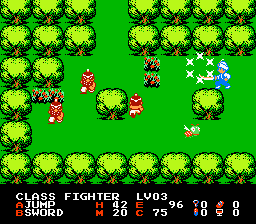
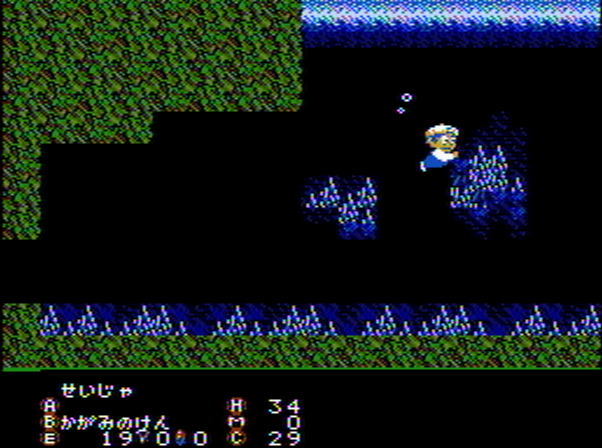
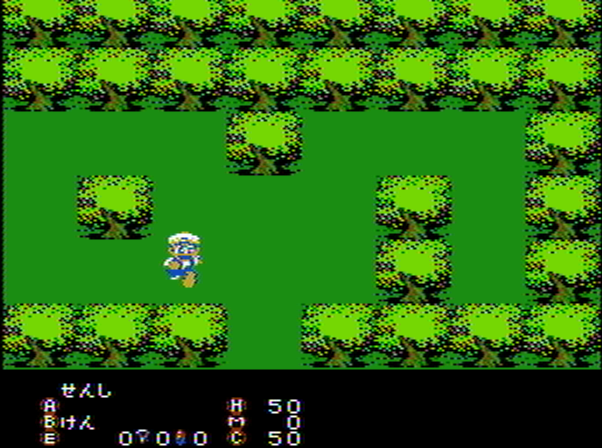
First off, the graphics were modified — as usual, the comical anime-style art for the protagonist was changed to a more “serious” style, and the stat display below is different as well.

Japanese original
English, courtesy of Wikipedia

There are two other big changes, besides some more minor ones. The English version uses a normal XP/level system, whereas the original Japanese version allows only one level up per chapter (5 chapters). You do this by gaining a certain amount of XP and then finding a trapped princess in a dungeon — these dungeons were completely removed from the English version. For the first chapter you need 400 XP for the level up, which would put you at level 4 in the English version.

The second change is that the field and dungeon maps were made considerably smaller and simpler to navigate. Some dungeons were removed entirely.

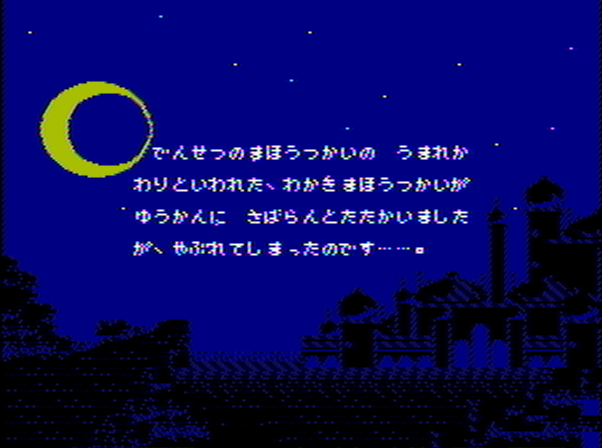
Here’s the backstory copied from Wikipedia:

Many years prior to the opening of the game, the land of Arabia was taken over by the malevolent demon Goragora and his army of minions. A magician named Isfa, harnessing the power of the blue star Airosche, vanquished the demons and sealed them underground. Peace briefly returned until the evil wizard Sabaron freed Goragora and the demons from their captivity and imprisoned the Arabian princess Scheherazade and her family.

The player character takes on the role of Isfa’s unnamed descendant, who unsuccessfully attempts to save his lover Scheherazade from Sabaron. As a result, the player’s memories are erased, his magical powers are sealed, and he is thrust into a different time period. He is quickly greeted by the catlike spirit Coronya, who possesses the ability to open a passage to travel through time. With this, the amnesic hero traverses through five worlds in order to regain his memories, learn new magic, recruit several allies, and defeat the demon overlords.

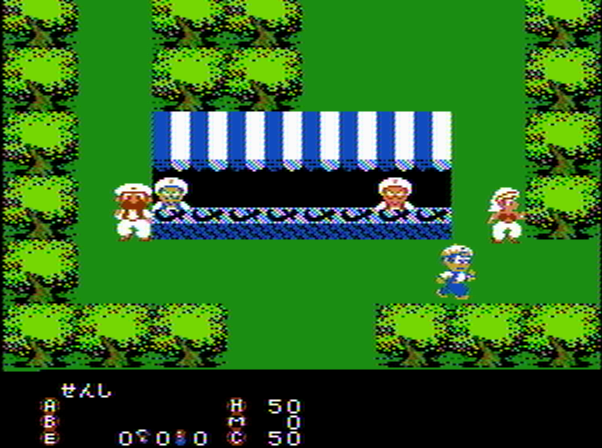
You begin near a town, which is helpful. One thing that is weird is that you have to hit select and then use the directional keys to pick what actions the A and B button will do. I couldn’t figure out at first why I was just jumping around but you have to assign “talk” to the B button. The townspeople give various advice, and you can buy some healing items but no weapon upgrades or anything of that nature. You also need to buy the “Magical Voice” item so that you can find hidden staircases on the map.

If you are playing this without help, probably what you want to do first is wander around and map the area, finding the second town and the various dungeons, and building XP and money. You can easily earn enough money to use the inn in the first town and buy extra breads (they’re much more expensive in the second town).

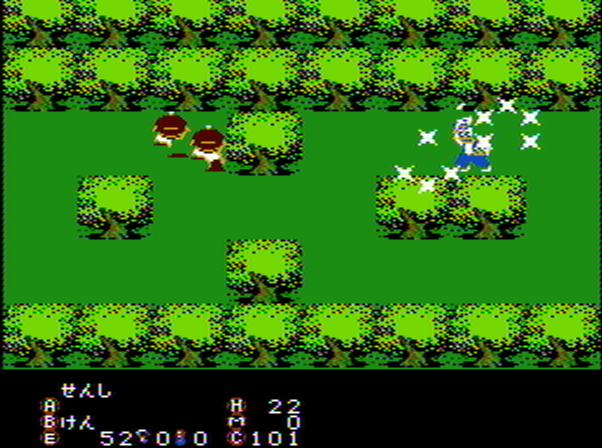
One other strange aspect to this game is that you sometimes fight RPG-style turn battles. Here you can use some companions.

These battles are kind of pointless; I feel like they just put them in to make it seem like the system is more varied and complex, but they could have been left out. Eventually if you hit 400 xp (which is a lot) you want to find the dungeon with the fairy that can increase your level, and let you use the Rod (which you start with in the English version). Finally, you have to locate the door to the past (each chapter has a “past” version) and go back there.

That’s the extent of what I played. Given the time this came out, I don’t think it’s a terrible game. The English version is much friendlier to play and is probably overall a better game, despite the greatly reduced map content (although maybe that’s a good thing?) The Japanese version follows the pattern of many of the games from this period where it’s really hard to even get started because of how confusing the areas are and such — it’s not as bad as some of the games where you can barely even play it, but it’s one of those games where you will not feel like you are making much progress at all for a while.

SRPG 102 – Houshin Engi (PS1), Finished

I’ve always been clear on my dislike of the “main character 0 hp = game over” system, but I was surprised to find that I didn’t mind it in this game. I think I know why. In most of these games, the main character is not that much more powerful (sometimes not at all) than the other characters, so the “0 hp = game over” just puts a huge disadvantage on him for no benefit. In the worst examples I’ve seen of this the main character is hard to use at all because of the danger of the game over.

However, in this game the main character has a very important advantage over the others: he can call in a reinforcement character if one of your initial characters dies. The character you call in is placed at the head of the turn order and can act immediately. So protecting the main character has some purpose beyond just avoiding the game over. I still think maybe it would have been better if you just lose the reinforcement ability if the MC dies, but I didn’t really mind it the way it is; it also adds strategic weight because you are only ever allowed 5-6 characters at most on the field at once, so it can be an important decision whether to use the MC’s reinforcement ability or heal himself.

To say more about the abilities, there are four types of weapon and four types of magic. The spear has long range and also a number of attacks that hit multiple people. All the other ones have various kinds of status effect abilities in addition to the basic damage. Sword has probably the best raw attack, the multi-hit moves. I found that my favorite weapons were the sword and bow.

The magic has healing, one that has buff/damage moves, and one that focuses on manipulating the terrain. The terrain manipulation is a big part of the game; many attacks will also cause terrain sinking in addition to their damage, and there are a lot of moves that can raise or lower the area. Some maps require you to do this to reach enemies who are up in towers, but other times it just makes it easier to move around or to get height on the enemies.

You can use the peach items to give anyone any skill you want, although you would not get enough peach items to customize every character. I didn’t really bother with this and just used the peaches to raise the skill caps for the skills the characters already had.

I found the progression through the game fairly smooth. You want to keep your guys relatively equal in levels because of the reinforcement system, but also there are a couple of places in the game where you have to split your team into multiple groups or use specific characters. Make sure you always have a save in a place where you can access the Daoist caves, that lets you buy items and train levels.

I apparently didn’t get any pictures, but my least favorite levels are the ones that involve these stones you have to defeat to pass. They can hit strong range attacks, and often the terrain is quite annoying. The worst part of the game is this stretch of 13 maps where you have to use one character at a time (if one dies you can bring out the next one) to progress. It’s not excessively difficult, just a bit tedious.

The storyline is relatively basic — once you get to Zhou and get them to join up in your attempt to fight Shang, the rest of the game is just travelling back to Shang and fighting various demons and enemies along the way. Once you reach Shang you defeat all of Daji’s underlings and then face Daji herself.

First she appears with the king, but once you beat the king she retreats and then you have to fight her true Youma form.

She’s pretty easy, but then you have to move to the true final battle, against one of those chaos demons that will destroy the world figures. The rough part about this is that once you get into the final chaos battle you can no longer bring in reinforcements so you’re stuck with whatever party you had when you beat Korisei.

He is fast, and uses attacks that hit everyone on the board and cause status effects. He killed most of my party but I managed to defeat him with only 2 characters left, both near death. I may have had more success if I stopped trying to level everyone earlier than I did, but in the end I was able to finish it.

Zhou then takes power and Taikobo goes off to train by himself (pursued by some potential love interests).

Overall this was an enjoyable game. The characters are varied and interesting to use, and it’s fun to play around with all the potential abilities. The large team is usable because of the reinforcement system, but would offer replayability as well because you can try to emphasize different people or different types of abilities. It’s not perfect — I wish there weren’t so much emphasis on the hidden items on the map, and there are maybe a few too many filler maps. But on the whole this is one of the stronger games of 1998.

SRPG 102 – Houshin Engi (PS1), Part 1

Houshin Engi (封神演義), released 9/10/1998, developed and published by Koei

Houshin Engi is the Japanese title of the 16th century Chinese novel usually translated as Investiture of the Gods. It’s very loosely based on the fall of the Shang dynasty and the rise of the Zhou, but has a lot of mythical and fantastical elements and many of the characters are fictional. There was a popular manga based on the story running in Shonen Jump from 1996-2000, and I feel like it was not a coincidence that Koei chose to bring out this game during the time. This game is not based on the manga — I cannot find enough detailed information on the novel’s plot to know for sure, but my impression is that this game is also a very loose adaptation of the novel and is mostly an original story.

The game came out in 1998 and then there was a second version (“aizouban”) released in 1999 with minor improvements; I played that version instead.

The basic setup is the same as the novel — the last King of Shang has been bewitched by his concubine Daji. Daji was already known in historical records as the evil, sadistic woman who had caused the downfall of the Shang dynasty, and after that was thought to have been an evil fox spirit. In the novel, Daji is killed and replaced with a fox spirit that then uses magic to control the King, and this is how the game works as well.

The main hero character is Taikobou, a name for Jiang Ziya. He is also a historical figure who assisted in the defeat of Shang, but in legend (and later in the novel) he becomes a Daoist apprentice of a Kunlun mountain master. In the game, the master sends Taikobou to Earth to investigate a disturbance, which turns out to be Daji’s enchantments.

The characters in the game are a mix of historical figures and characters from the novel, and it’s possible there are characters original to the game as well (I don’t have enough information to track down each character and find out).

The game is divided into five chapters and a total of 53 maps. I believe that you play all 53 in order with no alternate paths. Between most maps you can access a “camp” where you can do the usual equip/save/etc, but you can also visit the Daoist retreats. This allows you to do training battles for XP, but also to challenge the various Daoist masters in 1-on-1 combat to win items. I haven’t managed to beat any of these yet.

Each chapter starts with a small voiced sequence (it’s not actually animated, it’s still pictures). Some of the dialogue has voicing. One welcome feature is the furigana on the Chinese words and names:

They appear every time the name/word is used, which is helpful in remembering the unusual words.

I only played the first 16 stages this week, so I’m not making very fast progress. The first battle of chapter 3 (stage 17) requires you to split your party across two battles and use most of the characters, and I need to do a bit of training before I can handle the battles. The story so far is still more or less in the early stages. Taikobo finds out that Daji is a fox spirit bewitching the king, and gets thrown in prison. There he meets Kouhiko, who was once a follower of the king, but his wife was killed by Daji’s machinations. After escaping, Taikobo and Kouhiko head to the Zhou lands to seek help in fighting against Shang. Most of the stages so far are just gathering various allies who have their own grudges against Shang, and being opposed by a number of underlings of Daji, particularly the three women who serve under Daji. Meanwhile Daji is being commanded herself by Tongtian Jiaozhu, a brother of Taikobo’s master.

One of the chief antagonists is Bunchu (Wen Zhong) who is one of those classic “honorable warrior who is fighting for the wrong side”; at the moment he has been tricked into thinking that Taikobo is leading an effort by the Daoists to overthrow Shang so they can rule instead.

By the end of chapter 2, we’ve reached Zhou and are trying to get them to join us, but first we have to take care of some other enemies they are fighting.

The battle system has a smattering of typical features from different games. There is height and facing. Turns are speed based. There’s elemental compatibility (in the above screenshot it’s wood vs fire, if one has a specific advantage the element will glow).

You get a lot of characters and it might seem annoying at first because you’ll have 18 but will only send out 4 or 5 on a battle. However, if one of them dies, Taikobo can bring in another one from your stock. (If Taikobo dies it’s game over).

Each character gains normal experience, and also experience in weapon and magic levels. Each character has a maximum in each, with a * indicating max level. You earn peaches after each stage that you can use to increase people’s maximums (or even let them use a new ability they can’t use). Each level will grant a new power in that type of weapon or element.

There are also special powers that are individual to some characters, and also these magic shell items that can be used with particular weapons to do additional powers as well. So there’s a lot of variability with each character, and they do change noticeably as they level, which is something I always appreciate in a game.

I’ll stop there for this week — I’m not even sure I will finish this game by next Saturday but we’ll see. I’ll write more about the abilities and characters next week.