Category Archives: Other games

Sigma Harmonics (DS)

Sigma Harmonics (シグマ ハーモニクス), released 8/21/2008, developed by Think Garage and published by Square-Enix
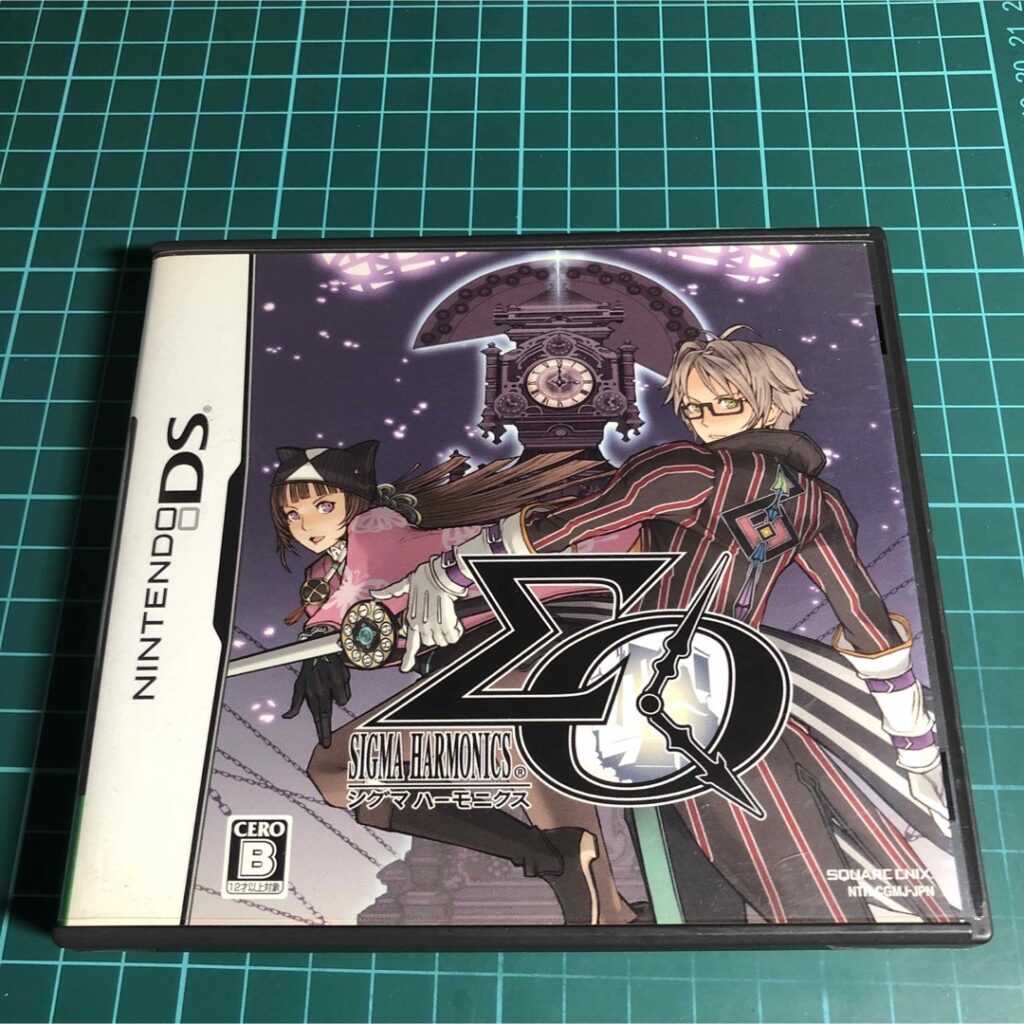
I came up with “DS game” as a random choice so I chose this based on several recommendations from people in the comments. Because it relies so much on the stylus I had to play it on a real DS, so I’m just going to have to pull random screenshots from the Internet (mostly IGN and Famitsu, you can see in the watermarks)

The game’s selling point is that it’s a blend of adventure-murder mystery, and RPG style gameplay. You find clues and solve several mysteries, while also fighting RPG battles along the way.

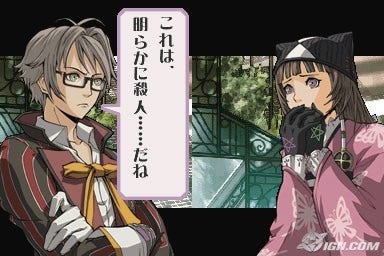
The two main characters are Sigma and Neon, high school students who are in families that traditionally have certain powers and responsibilities to deal with demons in the alternate universe version of Tokyo that the game takes place in. Sigma can do some time travel and use music to influence the world, while Neon uses cards and divine possession to fight enemies. The two of them come home one day and find that no one remembers them, and that the Great Clock that had imprisoned the demons has been opened, causing changes to the timeline. The game takes place over six chapters, plus two bonus chapters that can be unlocked if certain conditions are met. Each chapter seems to have a mystery you need to solve.
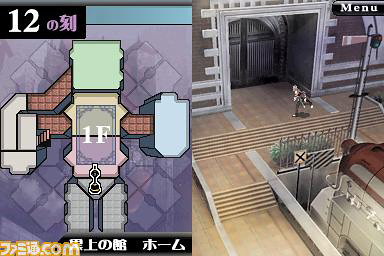
The adventure part of the game involves going around the Kurogami Mansion and using Sigma’s music ability to find clues to the mystery of that chapter. The first chapter’s mystery takes place 50 years in the past and involves the poisoning death of Ume, the mother of Shizuma who was then head of the Kurogami clan. After seeing the scene where she dies of poison, you then go around and find clues. There are two types of clues to uncover. The first are just hints that will give you small pointers to the solutions. The second are scenes you can watch, that will give you tiles like “Wine” or “Yoshiko was in the kitchen” that will be used later in the solution section. You can also use the Clock to return to earlier times that day to see additional scenes.
Once you have uncovered the necessary clues, you will be able to do “Super Reasoning” where you insert the tiles on a grid to answer questions about the incident. So for chapter 1, the first question is “Was the killer in the dining room?” then if you pick “yes” you are asked “What are two paradoxes in that idea?” Once you put those two in, you are asked “Was the poison in the food?” You pick “yes” and you get asked “Why didn’t anyone else die?” and so on.
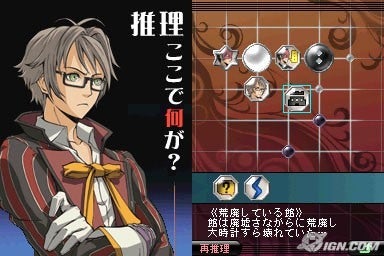
You get no immediate feedback on whether your guesses are right or not. Regardless of how right or wrong your ultimate answers are, you will be taken to a final area where you fight a boss. The boss’ power is weaker the better your answers were, and then you get a rating for how well you answered the questions. One of the requirements for unlocking a bonus chapter is to get at least A rank for all the stages.

On the RPG battle side, you fight random encounters as you explore the mansion for the adventures. The battles are done by Neon vs enemies, with Sigma just acting on the sidelines to direct Neon. Neon spins around the battle while the enemies attack with a real time battle system. You have three separate meters that fill up, once one fills up you can use one of the action cards you have in that space. The actions can be attack in a specific direction, attack some enemy, followup attack, heal, All attack, etc. Sigma can also change the battle song to change the speed at which the various meters fill up, and Neon can switch “class” to get different abilities.
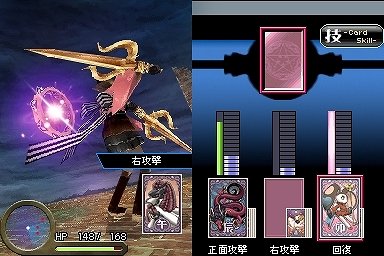
Battles give you XP to level up, and you will sometimes get SP that enable to you to get new jobs. The battle system is decent.

My main issue with the game (and why I only played it for the first chapter) is that I don’t think the two systems mesh together well. And I think the reason for that is that they’re almost entirely separate — fighting the battles doesn’t help you investigate the mysteries at all, and almost nothing you do in the investigation part helps you in the fighting part. So it felt like I was constantly being pulled out of the investigation part by these random encounters that didn’t help me. I honestly would have preferred it if they had entirely separated the two — have the investigation by itself, then once you’ve done the “super reasoning,” go to a dungeon where you do the RPG battle part.

Starting in the second chapter they also have this (virtually) unbeatable enemy that wanders around the map, blocking your ability to do the investigations for no real purpose.

I’ve gotten mixed information about how Japanese players responded to the game. It apparently sold well and Famitsu gave it a 31/40, but there are reports that it was being sold in used game stores for 500 yen soon after its release. I’ve seen this happen before and it’s basically an indication that a lot people bought the game but then quickly sold it, resulting in a glut of copies of the game in the used stores that not many people are buying.

Suikoden III (PS2)

Quick note first off — updates may be sporadic this month, but I will be back to weekly updates in August.

As I’ve mentioned, the games I’m playing between SRPGs are a combination of random selection and choice. Basically I first “roll” for the category and then choose the game I will play from that category. In this case the category was a game that I have bought, but not yet played (or else I haven’t finished it). I chose Suikoden III. I bought the whole Suikoden series quite some time ago, but so far have only played the first 2. I played those so long ago that unfortunately I didn’t remember that much about them so a lot of the references in S3 were lost on me.

Probably a lot of you reading this are familiar with this series. It’s inspired by the Chinese novel Shuihuzhuan (“Outlaws of the Marsh”, “Water Margin”, and other translations). In Japanese this novel is called Suikoden, and has been a massive influence on Japanese literature and pop culture for centuries — a surprising number of common tropes in anime and video games can be traced back to Suikoden. In Japan, this game series is actually called 幻想水滸伝, meaning something like “A Fantasy Suikoden”.

A defining feature of the series is that each one has 108 total recruitable characters (based on the 108 “heroes” of the original novel). At least in the first three games, if you manage to get all 108 it unlocks a true ending or something of that nature. I don’t remember exactly how it worked in the first two games, but here they are especially generous in not locking you out of any of the optional characters (with one exception, but it would be hard for someone to make the wrong choice there even if they weren’t using a walkthrough — not only do you have to choose a cowardly option but the game makes you confirm like 3 or 4 times that you really do want to be a coward and leave innocent people to die)

Another common thread of the game are the Runes, that you equip on people to allow them to cast magic. Most of the runes are copies of the 27 “True Runes”, which are much more powerful and are said to control the destiny of the world.

Here’s my thoughts on various aspects of the game:

Graphics

This is the first PS2 entry, so of course the overall graphics are improved…on the other hand, they went for a 3D look that to me just isn’t as good as the old sprites. It’s not as bad as some of the garbage that appeared on the Saturn and PS1, at least.

The movement is also 3D, but without a controllable camera. I never like this, and S3 has some bizarre choices — in particular, there are way too many places where you exit a screen in one direction and then everything is changed around for the next screen so that you have to reorient yourself to avoid just going back to where you came from.

The battles are also way too slow. One nice thing about S1 and 2 was how battles were sped up by having multiple people act at once. This is sort of true in S3 also but too many battles involve very long animations to the point where it can take forever to watch them play out.

Gameplay

Broadly speaking this is the same system as S1 and S2. They added a new skill system.

Juggling all the characters can be rough, though, especially given how difficult it is to change and develop them. In order to upgrade weapons, switch Runes, and level up skills, you have to visit 4 different places, and many towns don’t have all 4. I feel like they should have put in some system where, at least in your main castle, you could manage your whole team from one location, using all the services you’ve gotten in the town. It could even be a recruitable “manager” character or something like that.

One change in this game is that your six characters are divided into three pairs. The pairs can sometimes do a combo attack, or if one of the characters is a mount, the other character could ride it for some extra attacks. You can only use magic for one character, and the other of the pair will have to attack.

There are also a lot of area effect spells, which hurt your characters as well as the enemies. This was a poor decision given that you cannot control the locations of the characters on the battle — if you cast one of those high damage AoE spells, the other member of the pair will run up and attack the enemy, and get caught in the blast with no way to avoid it. Spells also now can take more than one round to cast, and can be cancelled by enemy attacks. However, upgrading the relevant magic skill will also increase the casting speed for the character.

The “war battles” are back, which have some kind of strategic element to them. However, they are very poorly implemented in this game and are a definite low point. One issue is the very slow pace of the unit combats, where you just watch them fight without inputting commands. But also, virtually every one of them is essentially just defending or trying not to die until you reach a certain turn — apparently they can all be won if you know what you are doing, but none of them are set up to make that easy.

Story

The story is fine. It is a lot more developed than the first two games, although it still has the issue that with 108 total characters it’s hard to develop them all. This time they used a chapter system where you play through several chapters with 3 (or 4) main characters. The events occur simultaneously so you will see the same events from different perspectives.

This system comes with some of the same issues I’ve had with other games of this type — first, you often find yourself going through the same locations over and over again with different characters (this is exacerbated by the large amount of backtracking in the game). Second, developing multiple parties at once is not necessarily as satisfying as a single one for me, although I suppose it combines well with the large number of recruitable characters in general.

My impression is that the story overall is more satisfying for people who remember S1 and S2 better than I do, but it was serviceable. (Although I really am sick of the “destroy the world to save it” motivation of villains)

Endgame

I made it to the final dungeon, but I have not cleared it yet.

Before this, there is one final war battle. This is the only war battle in the game that you are actually required to win by defeating the enemies, and it’s rather difficult — it’s especially annoying because up to this point, you can clear all the war battles without really getting into the system that much because you aren’t required to beat many enemies (or even any at all) to win. And to require you to come to grips with the battle system for just this one battle near the end of the game is a bit annoying.
I was telling someone this on discord, but I think these kind of difficulty spikes at the end of the game can be good or bad depending on how you are feeling about the game as a whole. If you like the system and game overall, then having these final difficult battles provides a good conclusion, forcing you to use your characters to their full potential (or at least more than usual) to win. On the other hand, if you are merely tolerating the system and are looking forward to the game being over, it’s frustrating to be suddenly faced with battles right at the end of the game that are considerably more difficult than anything else. I don’t think it’s ever good game design for the majority of the game to be pretty easy but then suddenly have one hard battle at the end, but it’s especially annoying if you aren’t liking the game that much.

So for now I’ve put this aside to play Puyo Wars; I don’t know if I will come back to it. I might not.

Overall I agree with the general feeling that this is not as good as the first two entries. It’s by no means a bad game, but I think I would have had more fun if I had been able to speed up everything on an emulator!

Kuroi Hitomi no Noir – Cielgris Fantasm

黒い瞳のノア~Cielgris Fantasm~

This is a game I added to my SRPG list because I thought it might be the same kind of “Simulation”RPG style game as the Atelier series. While the game is clearly following off the success of Atelier Marie, it’s much more of a regular RPG in an unusual style, rather than a simulation with RPG elements. Ultimately the game is pretty smooth and easy, but also has a lot of wasted potential — there was a sequel for WS or GBC planned but it was cancelled.

The game begins with a story opening — Noir and her friend Destin live in the rural village of Shamul. They are exploring one day when they accidentally unseal the Dark Lord, who turns Destin to stone but for some reason leaves Noir alive. She is visited by the goddess Nil, who grants Noir magical powers. Noir decides to go on a journey to find out how to save Destin.

The game has a calendar system, although the only things that take time are travelling and resting the night. At the beginning there is no clear purpose to the system, but eventually Noir learns that if she does not save Destin within 3 years, he will be permanently lost.

At first there’s not much to do except travel around and accept jobs from the inns.

The jobs are mostly of three types: beating a monster in the area, escorting someone to another town, or delivering a package to another town. The jobs all have time limits. As you travel around to the different towns, you will start seeing event scenes with various characters — Bernal the adventurer, Duran the priest, and other people.

You also fight monsters.

The system is pretty standard, each character has the yellow bar that fills up according to their speed, and when it’s their turn they act. You have attacks and spells, as well as defend. The big feature of the system is that almost any monster can be captured by Noir and then it will be in your party.

6 is the maximum party size. You can hold up to 64 monsters. They level up and learn spells, and after some events you will unlock a place that you can upgrade the monsters with items or teach them spells. You can also buy spells for Noir. There’s no equipment for anyone.

Fairly quickly you will learn the main goal of the game — find the seven sealed magics left behind by the goddess Nil, which you can then use to defeat the Dark Lord. Each of the magic is in a dungeon, most of which you have to find through events.

The dungeons are as above; you explore them, fighting both random monsters and set monsters. The set monsters, as well as the treasure chests, go away permanently once you deal with them, so you can make several trips into the dungeons. One annoyance is the inventory limit; you can only hold 64 items, and there are a lot of items of unclear purpose and no way to store them.

Once Noir recovers the 7 magics, it’s time to go to the final dungeon and defeat the Dark Lord. I might have been somewhat underlevelled but I managed to defeat him with my last MP as everyone but Noir and one monster were dead.

There are eight endings to the game. Two of them depend on you completing the game in 3 years — this is quite easy, I wasn’t using a walkthrough and I finished the game in less than a year and a half. If you do this, Noir is able to save Destin, and you can either choose to immediately get married and end the game. At this point Noir and Destin go off adventuring together.

If you choose not to do this, you can play the game for another 3 years and then there will be a separate ending. I’m getting the remainder of this from a walkthrough site:
The second set of endings happens if you defeat the dark lord after 3 years but before 6 years. In this case, if you have the “jewel of revival” (which I had), Destin is revived but catatonic. If you don’t have it, Noir decides to give up her life in exchange for Destin’s.

The third set of endings happens if you still haven’t defeated the Dark Lord in 6 years. If you don’t have the 7 goddess magics, the game ends and you lose. Otherwise, the goddess will immediately transport you to the Dark Lord to fight him, and in this case he will have a second form (Dark Dragon). If you lose to the Dark Lord (first form), the game ends and you lose.

If you lose to the Dark Dragon, Noir has to give up her life to seal the Dark Lord, or if she hesitates, one of her companions (with a high friendship rating?) will appear and sacrifice their life. If you defeat the Dark Dragon, he self-destructs, killing Destin. Noir is so upset she goes on a journey.

My overall reaction to the game:

As usual for Gust games, the art, music, and general presentation is great. I like the monster recruitment system. Exploring the dungeons is fun, and the battle system is fast and streamlined while still offering the possibility for more than just mashing attack.

My main criticism is how empty the game feels overall. It’s almost like a skeleton of a game that never got fully implemented. Completing the game in 3 years requires virtually no planning, making the calendar system kind of pointless — I know some people don’t like a calendar at all, but if it’s going to exist, it should have an effect on the game. I would rather see a game where on your initial playthrough you will probably get one of the 3-6 year endings, and then you can replay to be more efficient to get the best ending.
There are a lot of places to go and events with various side characters, but they don’t have much of a purpose. The characters don’t join you, give you useful items, open up additional endings, or anything like that. There’s no “extra” menu like the Atelier games have where you can view all the pictures you’ve seen during the game. There are whole locations (like the interior of the king’s palace) that seem to have no purpose.

So this isn’t a bad game, but it’s not a particularly good game either.

Random selections (Medarot)

I am going to continue doing different kinds of games between SRPGs. First up was a random selection from my complete list of games.

The first game that came up was a PSP game called Jikandia, developed by Idea Factory. I was not able to find the Japanese version so I did the English instead.

This is a rather strange game that in the end seems more like a platform action game than an RPG, so I went to the next game.

Next up was Slayers Royal 2. I had initially put these games on my SRPG list but I covered the first game in a short previous post — this lacks the character development that I want from an RPG and is more like a story-based game with some simulation battles. At least in SR2 they got rid of the AI-based gameplay of the first one and just made it a straight command battle system.

I think this is still primarily a game for Slayers fans rather than SRPG fans.

Finally I rolled Medarot 3, so I decided to play the first Medarot game in its Wonderswan remake. This is a long-running series that has been described as “robot pokemon”; some of the games and anime in the franchise were released in the US under the name Medabots, but not the first game.

The similarities to Pokemon are hard to miss. It came out about a year after Pokemon for the Game Boy, in two different versions (Kabuto and Kuwagata, two types of stag beetle). Your main character is a young boy who brings robots out of his phone to fight other people who have their own robots. There is a “collect them all” aspect to the game. Despite the similarities I think it was able to forge its own path; there were 9 main Medarot games (up to 2015), associated media, and the most recent (non-RPG?) game came out just a few weeks ago.

The main character isn’t in to Medarot fighting at the beginning but his dad is. But his dog accidentally steals a medal from the enemy “boroboro group,” and he gets his first Medarot called “Metabee.” The Medals are the core of the medarots; they’re what level up and they also determine the overall strength.

Beyond that you can equip four different parts. They can have various stats; some give you attacks, some are more defensive oriented. You gain the parts in various ways — defeated enemies will give you parts, you can buy them, find them in dungeons, and such.

The save screen shows how many parts (out of 240) you have found so far. I would assume as with Pokemon you have to do link battles with someone that has the other version to get all 240.

The battles are kind of long. You have at most a 3 vs 3 fight, although all you have to do is defeat the leader for the battle to end. You choose an attack and then it happens — each part has its own HP bar and when you destroy a part, the attack associated with that part can no longer be used.
The length of the battles is kind of an issue and it’s the biggest problem I see people talk about with the game.

At first the main character is simply learning how to use his new Medarot. He goes down to a seaside cave where first he has to fight a “shark” (who is actually one of the enemy Boroboro Group bots), and then in the cave you can find a new Medal so that you can create a second Medarot.

This is as far as I played. From what I can tell looking around at reviews, it seems like people think the first game was OK but that the series doesn’t really hit its stride until the second game. I never really was able to get into Pokemon (I didn’t play it when it first came out, and somehow by the time I did play it in my 20s it just felt too simplistic), so I don’t know if would like any game in this series better.

Puppet Princess of Marl Kingdom (PS1)

Puppet Princess of Marl Kingdom (マール王国の人形姫), released 12/17/1998, developed and published by Nippon Ichi Software

This game is (I believe) the second RPG made by Nippon Ichi, after Angel Blade which I covered earlier. I’m not sure exactly when N1’s games began to gain steam, but just looking at their releases I feel like this must have been their first hit game. It was followed by two sequels (in 1999 and 2000) and a Marl puzzle game. This first game was localized as “Rhapsody: A Musical Adventure” but none of the other games were.

This game is often classified as a tactical/strategy RPG but for me it doesn’t qualify. It’s basically a standard RPG but the battles are on a small grid — the grid itself introduces only a small amount of added strategy. I still wanted to play the game because it looked interesting and it has a connection to La Pucelle Tactics, but rather than wait until the end of 1998 I figured I would just play it now.

The main character is Cornet, a girl who can play the trumpet — not just to earn money, but to convert certain “puppets” into party members. She is accompanied by the fairy Kururu, who is important to the story but (I think?) does not do anything in battle.

The story is pretty basic and focused more on cute things and (vocal) songs than anything deep. Cornet wants to marry a prince, but when the evil Marjoly kidnaps the prince she has to track down 5 “hearts” of various elements and then save the prince from Marjoly’s botched spell that turned him to stone. In comparison to Angel Blade, I think this is a big step forwards to the more irreverent, developed humor that you see in Disgaea compared to the cookie-cutter boringness of the earlier game.

The graphics are quite good — as I’ve said before, I much prefer this kind of art to the (often sad) attempts at 3D polygon art that games in the PS1/Saturn era tried to do.

You can also collect various illustrations throughout the game — the maps by StarFighters76 on GameFAQs do not have the illustrations (the chests are just normal items instead). Were they removed from the DS version of the game or another re-release?

Your party is made up of Marl and three other characters from your pool. These consist of the puppets (16 of them in total) and monsters that can offer to join your team. The main difference with the monsters is that if they reach 0 hp they are permanently dead. Also, every character joins at level 1 no matter what, and characters not in your active party earn 0 xp. This makes the monsters effectively useless, and most of the puppets aren’t very worthwhile either since you’re better off focusing on a small team.

Each puppet (or group of puppets) has a sidequest associated with it, although completing it doesn’t seem to grant any rewards. Some of the sidequests are annoying too (requiring level 30 characters, which my guys didn’t even reach by the end of the game).

The dungeons are mostly done through a series of “rooms” connected by entrances, so it’s useful to have (or make) maps.

The world map is just a “pick a place” variety.

The battles are random, and done on a grid. Each character has attack and special moves, and Cornet can use “concert” to boost attack power, and the musical staff in the top right will build up until she can use “rewards” that do extra damage. Overall the game is fairly easy, with only one or two bosses that require more than a very basic strategy.

One big drawback of the game is that it’s sometimes difficult to know what you are supposed to do next. The middle part of the game is somewhat non linear, and the trigger events sometimes involve talking to a random person in a town that now has a new line of dialogue to open up something else.

On the whole I had fun with this game despite the flaws. From what I understand, the second and third games abandoned the grid-based system in favor of a traditional RPG, and the DS remake did this as well (plus a whole bunch of other changes).

The next few weeks should be SRPG game posts as I try to get through the very long 1998.

Ys VI: Ark of Naphishtim (PS2)

Ys: Ark of Naphishtim (イース -ナピシュテムの匣), released 3/10/2005, developed by Konami, published by Konami Shanghai

I’ve had Ys VI for quite a while (I either bought it right before I left Japan in 2005, or more likely I bought it in 2013 on another trip). I was waiting to play it until I had finished the other Ys games before it, which I’ve finally done, so I can play this game I’ve had sitting around for ages. Because I played it on an actual PS2 I wasn’t able to take screenshots, so I’ll have to try to borrow some screenshots from the internet to do this post.

The Ys series started out with the hugely popular Ys I&II — not just the successful computer originals but the highly regarded PC Engine port. After that, though, the original team disbanded. Ys III’s side scrolling gameplay was not as well liked, and the ports weren’t great. Ys IV had the weird double release, with a (rather bad) Super Famicom game and a better PC Engine game — although by this time, the “run into enemies” style was pretty out of date. Ys V finally added more action elements, but that game had a number of problems as well.

It was 8 years before Ys VI came out, and I wonder whether at the time people thought the Ys series was just dead. In 2003, Ys VI finally appeared, as well as PS2 ports of the first three games. The PS2 port of Ys VI (with the number dropped) was released a few years later in 2005 — as usual the port was not handled by Falcom.

One big change between Ys 3 and 6 is that the mess of competing computers (PC-98, MSX, etc) had been swept aside and replaced with Microsoft Windows, which probably allowed for easier development. DirectX 9 was out by this point. Obviously the graphics are far better than anything the series had seen before, and the technological advancements also allowed for a more fast-paced, action oriented game.

Adol can do a basic attack, but you can hit the button several times to chain attacks together. You also have a jump-spin attack, a downstab attack, and a few more things that I never really used much because they were too hard for me to execute reliably. (The worst one in this respect was the dash jump, which you need to do in order to access certain treasure chests but I never managed to do it right)

Courtesy of Gamespot, obviously

As usual, Adol can do magic-like attacks as well. The way it’s implemented in this game is that you get three different swords, one of each element. By earning Elemen you can upgrade the swords, and as you do so, you gain the ability to use the sword’s associated power. Once you use it, it takes some time to recharge, depending on the level of the sword (I think it also helps it recharge if you beat monsters with it).

The bosses are huge and colorful. This game shares Ys V’s ability to equip an item and carry up to 9 of them, so you can have a lot of healing during a fight. I actually found that this alone did not break the difficulty of the combats — you can do extra levelling and sword crafting to make most bosses much easier (including the final bosses) though.

The game is relatively short, a feature it shares with the previous games. For extras, you have a Time Attack mode (vs all the bosses), a bonus dungeon, some optional bosses and item collection within the game, and harder difficulty levels.

The storyline is the usual Ys fare, where Adol comes to a new place and solves the problem there. For some reason when Konami did the PS2 port they replaced the anime opening with a CG one (contrary to what I’ve seen elsewhere, this was not something done for the English release.) All the lines are voice acted, but the quality varies.

The story brings back a few characters from previous games, particularly Dogi and Terra (from Ys V). But all the returning characters play side parts. The main storyline involves Adol’s ship being attacked by Romun Empire forces, which causes him to shipwreck on Canaan Island, a place that is cut off from the main lands by strong vortexes. He is saved by two daughters of the chieftain of the Eleshia people. He distrusts humans, but Adol slowly wins his trust and then goes out to try to find the magic mirror they have lost. Of course this will eventually lead to stopping a world-destroying evil. The plot is nothing special, but it’s enough to support the action without being so detailed and long that you just want to fight things.

On the whole this is a far better game than Ys 3, the Super Famicom 4, and Ys 5. I still have a strong nostalgic affinity for Ys I&II though. All of the Ys 6 releases are available in English. Unless you really care about voice acting it seems like the PC version (on steam) is the best way to play it.

I will be out of town next weekend, but I will try to schedule a post on Langrisser V.

Grandia (end)

I played a bit more Grandia but I think I am going to abandon it; if I were more than 1/3 through it I might tough it out to the end, but I just don’t like dealing with the 3D maps. In addition to that I find the battle system often feels sluggish, having to wait for all these spell and move animations to finish before you can keep playing.

So it’s back to Shining Force, then I rolled more random games. The first one I had already played so that will be the next old game (Seiken Psycho Calibur), the second one was a game called Jade Cocoon for the PS1, which I guess did come out in English.

Grandia (PS1) – Part 1

Grandia (グランディア), developed by Entertainment Software Publishing, released 12/18/1997 for Saturn and 10/26/1999 for Playstation

This is a Playstation-era RPG that I’ve always heard good things about. It started out on the Saturn, and from what I understand the development team had also mostly worked on the Lunar series prior to this. From what I can tell, the Playstation port is essentially the same thing as the Saturn version; there were a few graphical changes and some bugs were fixed but there was no extra content or major upgrades.

The initial backstory involves godlike spirits called the Light Winged Ones using the power of the Spirit Stone to give blessings to people, but when the humans decided they wanted to become Winged Ones themselves, that darkened the spirit stone and broke it into seven pieces. Adventurers have sought out the ancient technology of the “Angelou” civilization that the Winged Ones used, but thwarted by a giant wall called the “End of the World” they’ve basically failed.

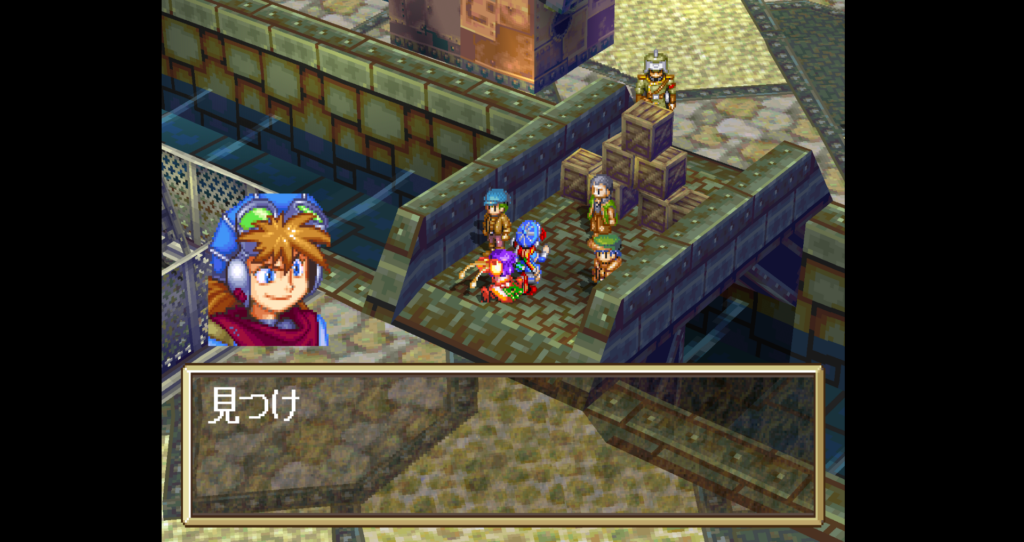
Our main character is Justin, a 15 year old who has a mom who was a former pirate but now runs a restaurant, and a deceased father who was an adventurer. His dad gave him a stone that he believed to be one of the seven Spirit Stones although most people now think that the spirit stones and Angelou are just legends. The beginning of the game involves Justin and his 8-year old friend Sue doing kid stuff with town bullies and such.

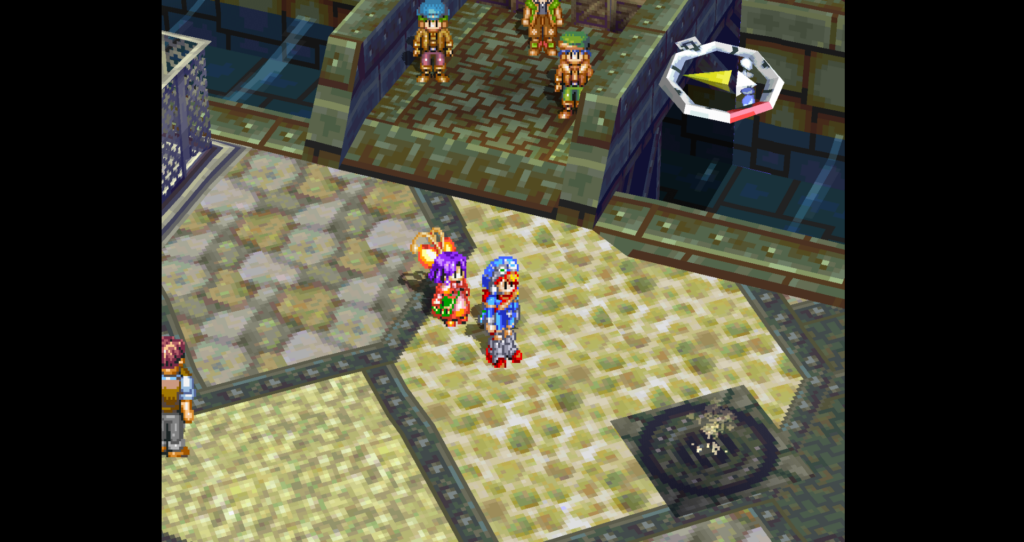
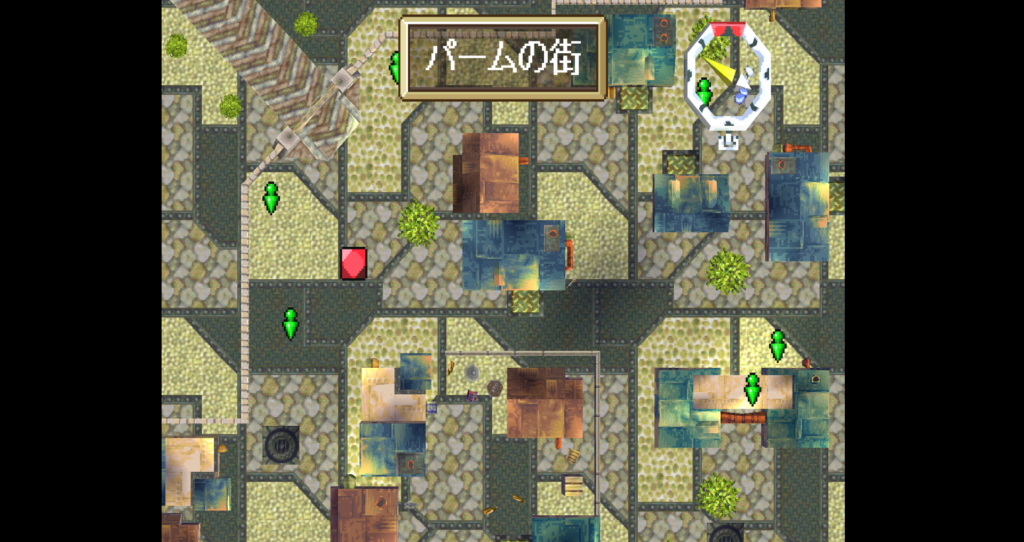
My biggest problem with this game by far is the 3D maps. I find them extremely difficult to navigate, and I am constantly getting lost, wandering in circles, and being unable to see where I can go. This game really needed an inset minimap — you can press select in town to zoom out like this:

But personally I do not find that sufficient to navigate the areas, and the dungeons don’t have that (they have designated spots where you can zoom the camera out). I’ve always had issues with 3D games; I was never able to get into Super Mario 64 or Ocarina of Time because I could not deal with the 3D environment.

Because of this it took me a long time just to clear this initial section where you are running around town trying to find things. In any case, once this is all done Justin wants to go to the nearby Sult Ruins to find out things about Angelou, and the museum curator gives him an intro letter to let him do so.

First we have to go through the Marna Road, and this introduces the battle system. Enemies are encountered on the map (symbol encounter) and you can get a surprise attack or be surprised. I believe that once you beat an enemy symbol it only reappears if you leave the map entirely, but I could be wrong about this.

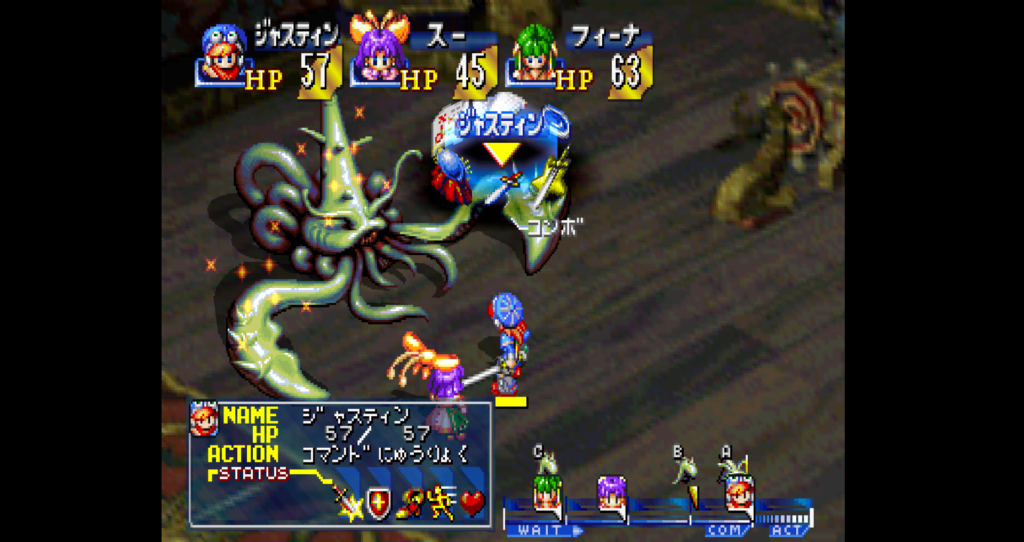
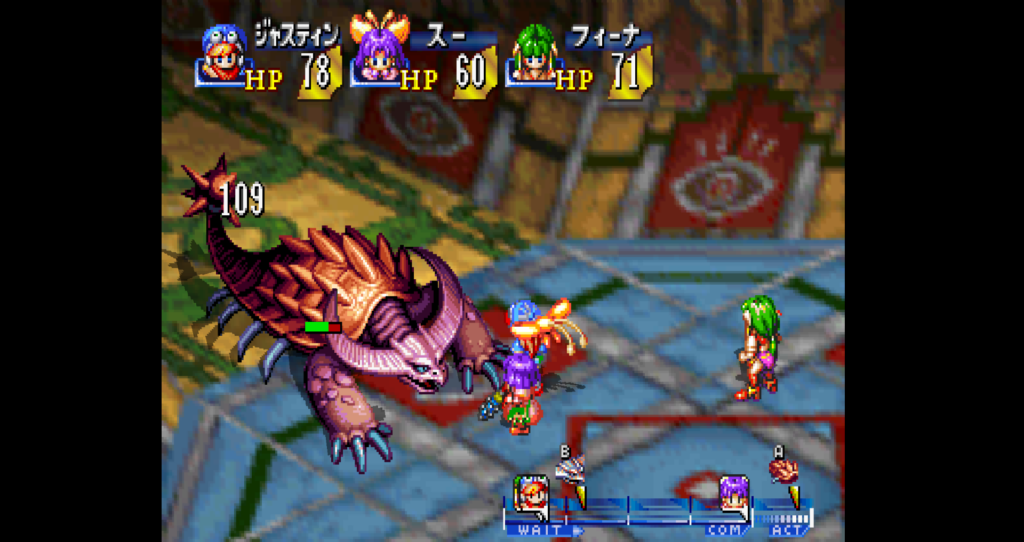
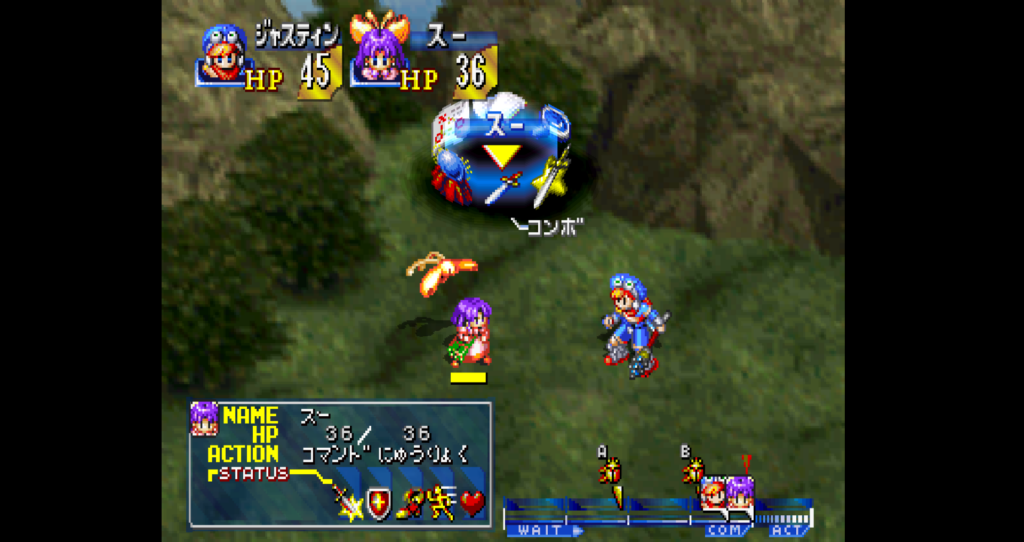
The battles themselves are done in a kind of combination real-time and turn-based system. The bar at the bottom right shows the enemies and your characters, and they move right on the bar at a speed determined by their Action stat. When they reach COM you can give them a command, and then once they reach the end of the bar they will take the action. Being attacked can stop your bar movement temporarily or even return you more to the left (known as IP Damage). You can run into problems of stunlocking and being stunlocked, but I have only had this happen a few times so far.

The speed of Command->Action depends on the move, and the more you use moves the faster they will go off. A character who gets attacked when they are between COM and ACT will have their action cancelled and they’ll suffer IP damage. If they get hit when they are at the right of the bar but haven’t done their action yet they will be Countered for additional damage, but they will still get to do their action.

The basic actions you can take are Combo (two attacks; if you kill an enemy you will do an attack on another one), Critical (slower attack but can cancel enemy moves), Magic/Skill, Run, Item, Defend (either defense+ or evade+), and Look (see enemy stats and what they are doing).

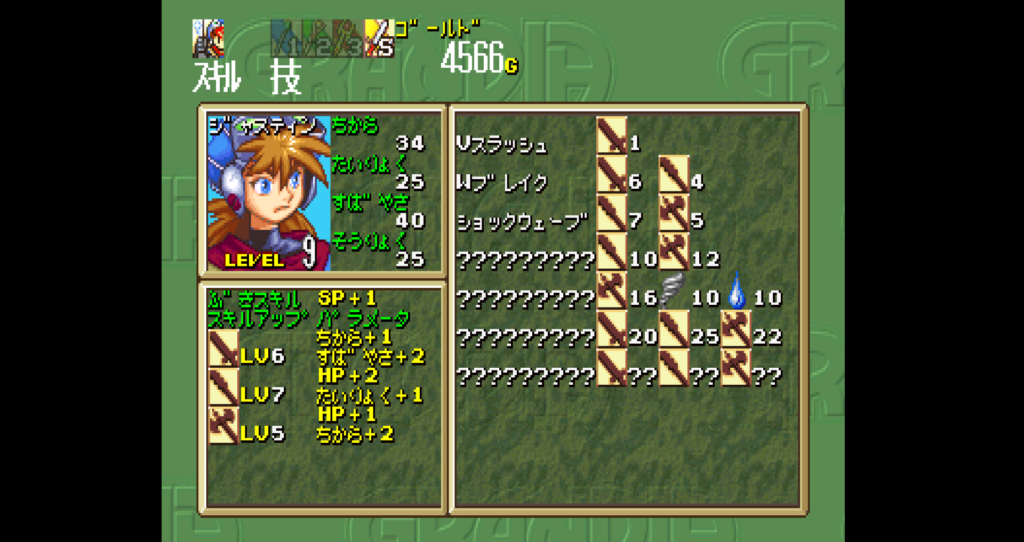
Each character has weapon levels, and they gain XP from the levels by doing attacks or moves in battle. Levelling up the weapon levels gives you stat bonuses (i.e. a sword level gives +1 str and +2 speed), and if you reach certain levels you will unlock new moves.

For magic, you have to find a Mana Egg which you then take to a shop and use to give one type of elemental magic to a character (Fire, Wind, Earth, Water). There are three levels of magic spells each with their own spell point pool, and there are combinations of elementals as well.

So there is a lot going on in the fights. Overall I think it works fairly well; it feels fast paced and gives you more to do than just mash one button.

This is from a later scene

In the ruins we are introduced to three army women adversaries (Mio, Nana, and Saki); they’re also at the ruins searching for something on the orders of Mullen. They are part of the Garlyle Army, and they’re searching for some final piece to advance their nefarious plans.

When we reach the bottom, Justin’s spirit stone activates — it turns out that his dad did indeed give him a real spirit stone, and a mysterious woman named Liete appears, telling Justin to find Alent which is on the New Continent. So after escaping from the Garlyle women and Mullen, Justin decides to go to the New Continent. There’s a fetch event here where we have to clear out a mine of monsters to get a passport from an old adventurer, and then Justin tries to leave in the morning on his own, without telling anyone. But his mom realized what he was going to do and left a letter, and Sue sneaks on to the ship.

Also on the ship is Feena, an adventurer who is considered the best adventurer in new Parm. When the ship they are on encounters a “ghost ship”, Feena allows Justin and Sue to tag along to solve the mystery of that, which turns out to be just a big kraken:

Feena’s fire spells are deadly against the monster, and it goes down pretty quickly despite the tentacles. Now Feena sees that Justin and Sue have some real adventurer qualities, and tells them to visit her at her house.

In New Parm, Justin tries to join the adventurer’s guild with an introduction letter from his mom, but it turns out the head of the guild is the son of the old leader, and this guy is a complete tool who refuses to pay any attention to Justin. They go visit Feena, but then the new leader guy kidnaps Feena and tries to marry her by force. Of course we go save her.

We manage to save Feena, although she’s pretty worried about pissing off the adventurer guild because you can’t do adventures without their permission. But Justin helps her see the silliness of that idea and she tells the leader to screw off. She joins up with Justin to search for more information about the Angelou and try to bypass the World’s End, even though she’s skeptical that any of this is real.

First goal is the Dom Ruins, where Justin hopes he can learn more about the Angelou the same way he did at Sult Ruins.

Dom Ruins is a big place where you have to keep going back and forth between sides of it…I still find the maps hard to navigate.

The ruins boss was another enemy I didn’t find too hard, powerful spells and moves took it down pretty quickly.

After this, we do indeed get more information from Liete — it seems that Arent is on the other side of the huge wall so Justin is going to have to try to get past there. On the way out we find a child who is hurt on the ground; we try to help but it, but it needs some special herb to heal so this is another side fetch-quest. Once the herb is recovered, the child recovers but can’t speak to us because we don’t understand the language. Just then, then the Garlyle military shows up again. Apparently they’re the ones who hurt the child; they are chasing the “demi-human”(? I guess? I don’t know how the english translation deals with 亜人) for some reason. We’re all captured and set to be executed.

However, Mullen’s underling Leen appears to free us, or at least set things up so we can escape. On the way out, we have to fight each of the three military women.

They are all really fast and can often act multiple times for each action of yours. Saki was the easiest, I think. Nana is a little harder because she uses these yoyo attacks that hit a large area and are able to do IP damage so that it’s hard to get turns, but even so I was able to beat her fine. I think Mio is the hardest because you can get stunlocked if she decides to keep spamming her balloon move (that puts people to sleep) and the stungun move. But if you can start cancelling her attacks and get a bit lucky it’s not so bad.

We escape on a train, and the child (Rem) gives us some tree nuts that let us communicate with him. Unfortunately, the military is on the move.

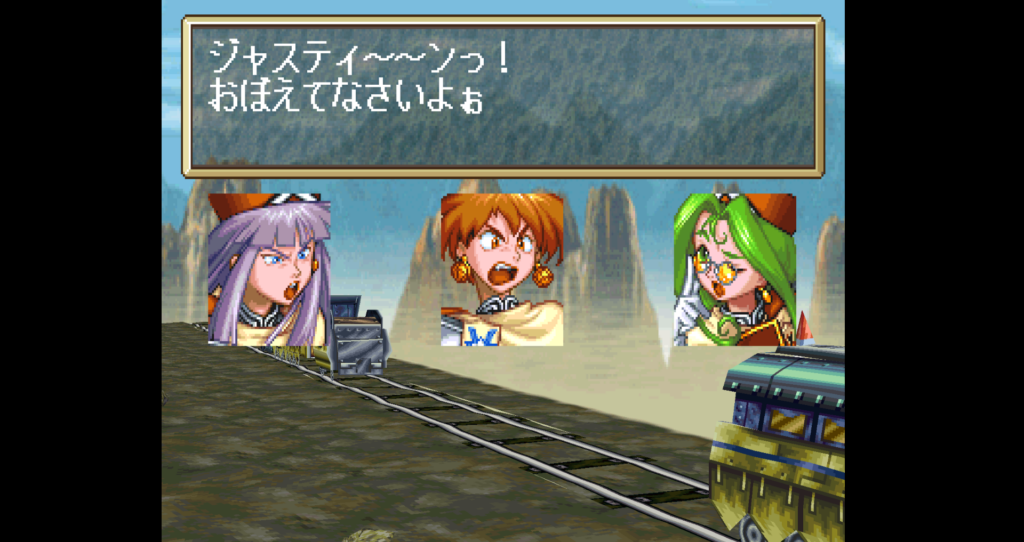
But Justin manages to uncouple the train and disable the brakes so that the military people are sent forward while they can escape. Justin and the rest head for Rem’s village, hoping for some information.

This is as far as I got; it seems like this is only about a quarter of the way into the game. I think overall it’s fun but the 3D maps are really annoying. I believe that I will play Shining Force III this coming week and then return to Grandia the week after that.

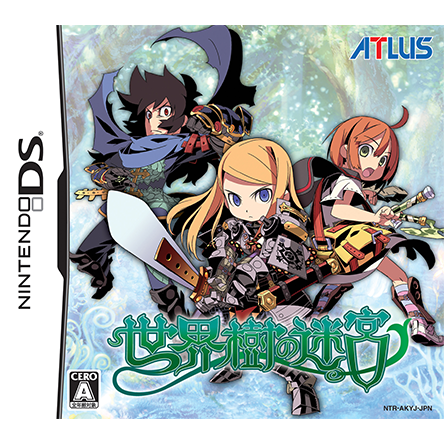
Sekaiju no Meikyuu / Etrian Odyssey (DS)

Sekaiju no Meikyuu (世界樹の迷宮), released 1/18/2007, developed by Atlus

My next randomly chosen game came up as Elminage, which is a first-person dungeon crawler. It seems to be a nearly exact copy of Wizardry, and since I had already played a Wizardry game recently I decided instead to play Sekaiju no Meikyuu. The title means “Labyrinth of the World Tree,” but it was localized as Etrian Odyssey. I had heard about this game for a long time but never played it before.

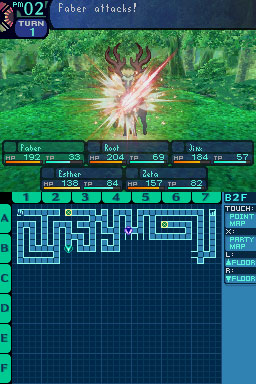
Since it uses the stylus, I pulled out my actual DS to play it — this is the first time I’ve played a game on the actual console in years. Of course this meant I could not take screenshots so all the pictures will be borrowed from Atlus’ official site, Wikipedia, and other review sites (I took them from IGN and Ars Technica).

According to the JP Wikipedia article, the designers were also heavily inspired by Wizardry, which is not surprising — they were trying to make a new kind of “hardcore” game that would be more appealing in 2007 while also capturing the nostalgia for old dungeon crawler games.

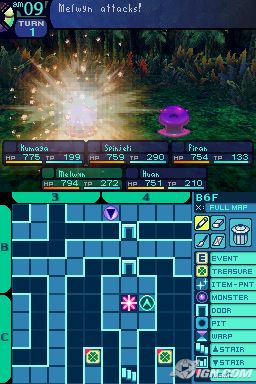
The most striking aspect of the system is that you have to make your own map, which surely was done to recapture the nostalgia of the graph paper pads in the 1980s. The map is always on the bottom screen of the DS, even when you are in town. You can set it to automatically mark the squares you have traveled over, but you have to use the stylus to draw the walls yourself. The screenshot above has the map zoomed out to show the whole floor, but if you zoom in you can then draw the walls and drag symbols to the map.

I found this pretty well implemented and entertaining; it did capture that mapping nostalgia without being too annoying or tedious.

You begin the game by creating characters. You assign a class and distribute skill points. I went with a Swordman (“Landsknecht” in the localization), Dark Hunter, Paladin (“Protector”), Medic, and Alchemist. I’m not sure why they changed the names of some of the classes. You also assign points to skills — you begin with 3 and get 1 more every time you level up. You can take a 10 level penalty to reassign your skill points, and it’s also possible to change class.

The skills work on a kind of tree system — for instance, if the Medic gets Healer level 1 skill, that unlocks Cure (the weakest heal spell). The skills all take MP, which are pretty limited in the game.

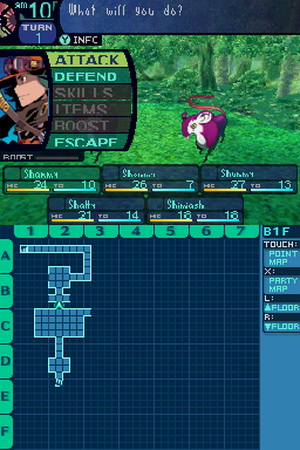
The battles are exactly what you would expect from a game trying to emulate Wizardry — you fight a group of monsters and have the usual choices. “Boost” is the only new thing, it’s basically an overlimit/super power mode that you can use when your boost gauge hits 100 (it increases when you get hit).

In town, you have the normal services you would expect. You can also take Missions from the guild (which are major quests), and Quests from the pub (which are more minor quests). The first thing you have to do is map a large portion of the first floor for your first Mission. This unlocks some of the basic town services and also lets you proceed to the next floors.

The 1st floor has relatively easy monsters and a few small events, treasures, and item farming points (where you can use skills like Mine and Gather to get items).

When you get items, you go back and sell them to the item store. This is the main way to get money, and also if you sell certain items or combination of items it will unlock new equipment and items in the shop.

After mapping that first part, there were no more missions available, so I went down to the second floor. There was a huge difficulty jump in the monsters and I found my characters getting killed from full HP in one hit by the elk enemies. There are also “F.O.E.” monsters that are much harder enemies that wander around on the map (you can see them).

I made several forays into the 2nd floor because it was going to take way too long to grind levels on the 1st floor without emulator speedup. But I kept getting killed and having to go back. Ultimately I hit a point where 3 of my 5 guys were dead and I had no more money left to revive them or use the inn, and this is where I quit playing.

The Japanese wikipedia article notes the high difficulty of the early game, and apparently this was intentional (again, to capture the classic Wizardry feel). The article also says the developers didn’t think the game would sell very well but they misjudged and it very quickly sold out.

But for me it’s too tedious, slow, and difficult to keep playing. However, I think the series has a lot of promise and I would like to try one of the later entries — I have a DS and 3DS (but not a switch). If you are familiar with the series, please tell me if there’s a later entry that is particularly good and I will try it.

Surging Aura

 For this week’s off-week post I’m looking at Surging Aura for the Mega Drive, which came out the same day as the next two SFC games on my list. I was already planning in my mind a post that would contrast the Mega CD with the Playstation that just came out as well as the PC Engine CD — but then I realized that Surging Aura is not a Mega CD game, it’s just a regular Mega Drive cartridge game. It looks like of the 4 Mega Drive RPGs that came out in 1995, only one of them was a CD game. This is in sharp contrast to the PC Engine, where the final non-CD RPG came out in 1992. The Mega Drive was a more technologically advanced system than the PCE, but it’s still surprising to see that many games released this late in the system.

As you can see from the title screen, the character designs are by Inomata Mutsumi. She is best known for her work on the Tales series over 20 years; this is an early video game she worked on (I believe she had done some anime work before this as well). This game has a feature I wish SFC RPGs had — inset graphics and face graphics.

Maybe there was a feeling that it’s better for all the action to take place in one style of view, but I like these graphical insets, especially for games when you can barely tell even what the characters look like without the instructions.

The story starts out pretty cliche — the main character, Muu, is waking up to go through a ceremony to confirm him as crown prince. But as the ceremony starts, monsters attack and seemingly kill everyone, including Muu himself. But a “time rabbit” comes out and restores Muu’s life, leaving him in an unknown place. But since he’s a silent protagonist we don’t know who he is or where.

Immediately in the town he wakes up in, bandits attack the magic shop and steal away a girl, and Muu finds himself assisting a local guardsman who is in love with her to free her.

The combat system is interesting; it’s a realtime system where you choose an action while a glass sphere fills up. When it fills, the action happens (but magic takes additional time beyond that). Then they will just keep doing that action until you change it. Muu starts off weak; he seems to be the only magic user (at least judging from the status screen, which has no space for any other characters to have MP).

The interface is rather frustrating to use, particularly the spellcasting. There are 6 types of spells you can get and there is some complexity in that, but to choose a spell in battle you have to use this confusing wheel and a number counter; I never found it convenient to use (I notice that richie, in his walkthrough, says that the system is bad — I’ve never seen him criticize a game in the ~40 or 50 walkthroughs of his I’ve looked at up to now).

So this is a pretty short post as these off-week ones usually are. This isn’t a terrible game and it seems generally competitive with the quality of games that were coming out for the SFC. I’m surprised that it wasn’t released on CD.