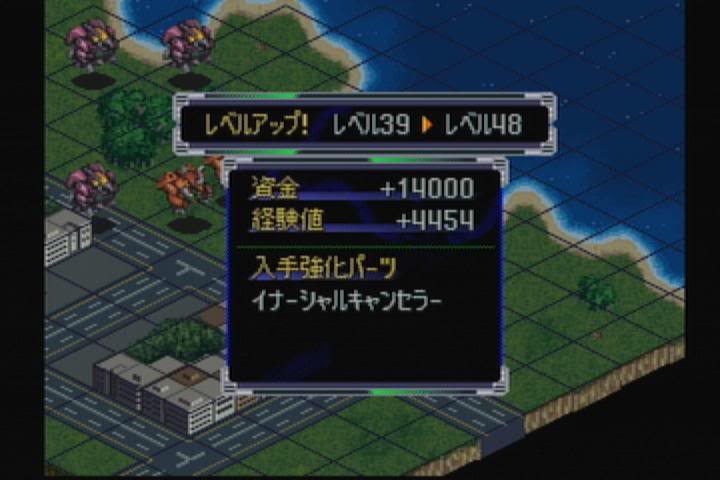
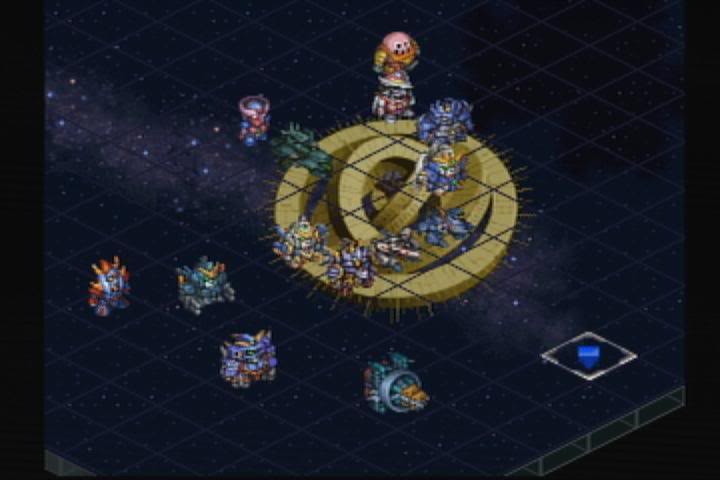
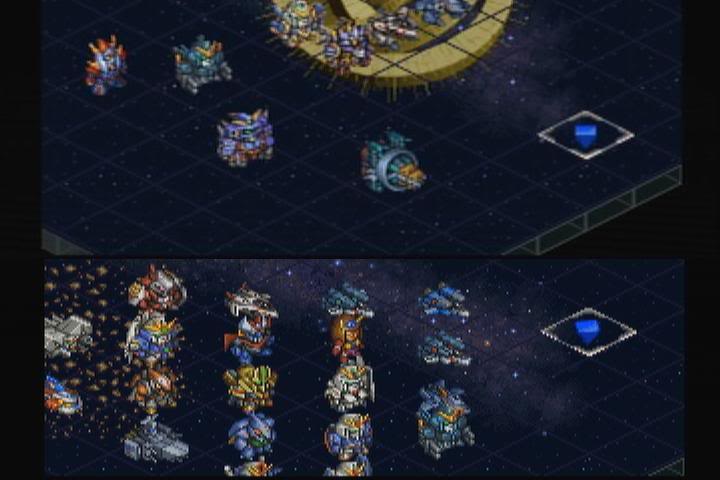
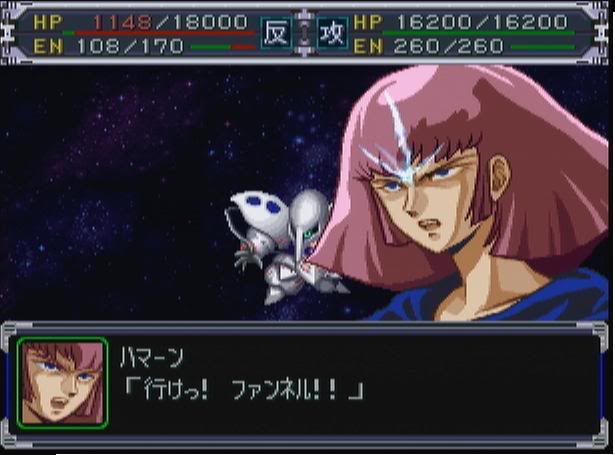
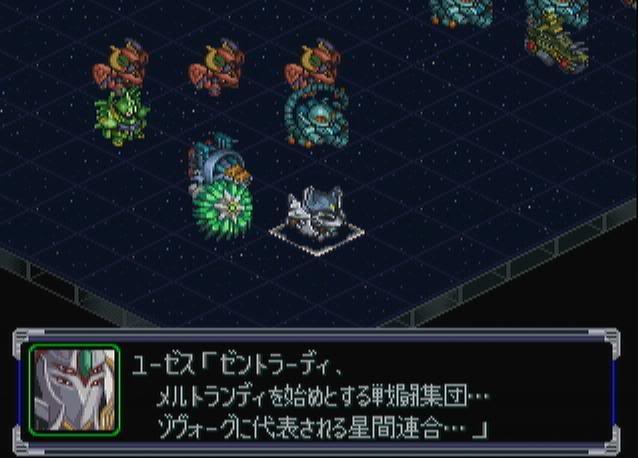
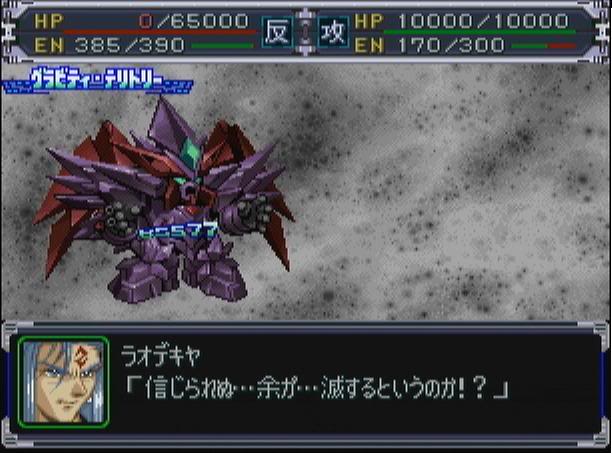
SDガンダム GGENERATION GATHER BEAT, released 7/13/2000, developed by Vanguard, released by Bandai
This is a game in the long-running “SD Gundam G Generation” series. The series started on the Super Famicom in 1996 with six short games that went from “SD Gundam A generation” to “F generation”. Each game focused on a different Gundam series (original, Z, ZZ, Char’s Counterattack/F91, V, and G), and a peripheral called the “Sufami Turbo” let you insert two games at once so that you could transfer mechs from one game to another. These games could be considered strategy RPGs if your definition is very broad, but they failed to meet my personal criteria.
Next, on the Playstation, they went to the next letter G but decided that this would be the franchise name from here on out and that it would combine all the series into one game. The 1998 game was 42 stages, and covered the story from Gundam 0079 to Char’s Counterattack, including several side stories (08th MS Team, 0080, 0083, and Blue Destiny). In addition, there were characters and mechs drawn from a bunch of other Gundam series (including even Wing and G, although I have a feeling these were just cameos or mechs you could build).
This was followed in 1999 by SDDG Zero, which added additional series and storylines and had 50 stages, although these were now separated by series rather than being played continuously. This was where the series had reached when Gather Beat came out, although a month later the flagship entry for the series (at least from this era) came out — SDDG F. This had 101 stages drawn from 38 series (including manga, novel, and video game series) from both Universal Century and the alternate timelines. There were over 1000 mechs in the series. I played this game a while back but I found it too slow moving to really get into.
Without getting into a full description of the SDDG series, here are some features of the franchise (not necessarily every game):
“Guest” units that are the characters from the shows (Amuro, etc) and then generic characters that pilot your mechs and ships (in some games you can get the Guest units on your team as well)
The ability to capture enemy mechs
Create new mechs by combining enemy mechs, or mechs with parts
“ACE” units by levelling them up, which can transform them into new units
Bonus money/xp/etc for activating events from the series (like attacking Char with Amuro in the first stage)
Later entries introduce other stuff like “heat”, additional move if you kill things, and other such elements.
SDGGG, Zero, and F are considered by some people to be strategy RPGs. To me they are borderline, and the main reason I didn’t play them is that they are very long games and there is a great deal of repetition between the three. In general I do not plan to play the SDDG games of this type (which includes games like Spirits, Wars, and Genesis).
However there were other games in the franchise that fall more under my definition of SRPGs; they have a Super Robot Wars style crossover storyline and give you named characters with identities that you can develop throughout the game. The first game of this type is Gather Beat for the Wonderswan. Although released in the SDDG name, it is more indebted to Emotional Jam, an earlier SD Gundam strategy game for Wonderswan.
The storyline is centered primarily around the One Year War, beginning with Amuro’s first battle in the Gundam and ending with A Baoa Qu. But there are characters and storyline elements drawn from a number of other Gundam series (including Z, ZZ, Char’s Counterattack, G, W, X, Blue Destiny, 08th MS Team, 0083, and 0080). The game is 20 stages plus 6 optional stages that can be activated by fulfilling certain conditions in the stage. The optional stages mostly involve the side stories, and get you additional characters like Judau (from ZZ) or the Blue Destiny events.
One feature that Gather Beat has is “ID” skills. They are sort of like Super Robot Wars seishin, but they are named after famous quotes the characters say in the series. This one increases Amuro’s hit rate.
There is no equipment or items in the game; you can give mechs weapons by using the mech combine (develop) feature but that’s permanent.
Before each stage you assign mechs to the battleships you have. This screen is very annoying because there is no way to view any information about the mechs on this screen. You just have to remember what the different mechs look like and who you assigned to the mechs. It is very frustrating when you want to send a new unit you just got into the ship because I often found myself guessing who to sub them in for because I couldn’t figure out who was who.
Once you are on the map, you send out your units from the ships. Thankfully this game did not carry over the Emotional Jam system where ships fight each other on separate maps, sending out units. They kept the “three person squad” system from EJ but somewhat differently. You can send out units together in a squad (up to 3 units), or you can make squads on the map by moving units on top of other units (if you do this, you have to immediately attack or the turn ends for all the units in the squad).
There are two kinds of attacks. You can do a direct attack where the squads fight each other. One interesting system element is that all the distance attack (beam/rifle/etc) happen first for both sides, then the melee attacks. I did see occasional exceptions to this but I was never quite sure how they operated. I think also if the squads are unbalanced (like a single unit attacking 3 people) there are some additional modifications to the attacks or defense but I am not sure about this and I never looked it up.
The other form of attack is an “indirect attack”. Battleships have these, but some units do as well. When this kind of attack is used against a squad, they have two options. The first is to maintain formation and just take the hit (I don’t know if defend is applied). The second is to break formation, which halves the attack chance of the attacker but it causes the squad to break up into separate units on the map. Using this against enemy formations, especially boss class units, makes the stages considerably easier to beat because the enemy nearly always uses the formation break in response and only sometimes tries to reform the squad. If you can use your ships to break up the formations and then pick off the enemies individually, they are a lot easier to deal with.
If one of your units is destroyed on the map, you permanently lose the mech, but the pilot survives. This applies even to unique mechs that cannot be recreated through the Develop feature (such as Shining Gundam). It also applies to cases where units are NPCs during the stage but join up after the stage is over. You can send your units back into ships to heal, though. If a battleship is destroyed it just retreats from the map, although whatever battleship Bright is commanding is usually a game over if it’s destroyed. (I assume any units on a battleship that retreats are unavailable until the next stage but this never happened so I’m not sure.)
One system that I do like is that you get a lump sum of XP at the end of a battle which is then (I think?) divided up against your surviving units. So you don’t have to make sure certain units get kills to avoid falling behind.
You get new mechs in a few ways. Characters will join with a mech, and a few story events give you new mechs. You can capture enemy grunt mechs by surrounding them and then using the “capture” command, but I never found this very useful. You can also buy mechs, or develop them by combining mechs with items that you get either by buying them, or by some story events. This is the main way to get new units. Unfortunately there is no database that tracks your completion of getting all available mechs (this is available at least in F, I don’t know about the previous ones).
Overall I enjoyed the story. It was a good decision given the short length of the game to focus on the OYW and include the other series as seasoning — in some cases I think they overdid it (like the brief appearance of the Turn A moonrace) but overall it was well done. We get some story elements that are rare in these games (like Char appearing as Casval and a younger pre-Zeta Haman). The story ends with an original mech.
The gameplay is OK. I mentioned the interface issue previously with the battleships, but there are other annoying elements of the interface as well — I’ve said this many times, but can be unfair to criticize these handheld games too much until you get to the point where they could do as well as the consoles (which is the PSP or maybe the Game Boy Advance).
I sometimes felt like the individual mechs were not distinguished very clearly. Some of this is the interface not allowing you to get as much information as you might want before dispatching the units, but that’s not all.
The stages are fine, they have some varying goals and events, and you can have some of your characters talk with the enemies or allies to activate events that give you additional XP. I didn’t think it was especially difficult either (if you use indirect attacks).
Gather Beat 2 is for the Wonderswan color, and Advance is basically a remake of this game. I believe that this is the last monochrome game I will play (SRW Compact 2 parts 2 and 3 are still ahead but I already played them). I won’t be sorry to see the end of monochrome games…
Super Black Onyx (スーパーブラックオニキス), released 7/14/1988, developed and published by BPS
The Black Onyx was one of the earliest RPGs developed in Japan (although it was actually made by a foreigner living there). CRPG Addict played it a while back. The Famicom version came out four years later, and I wouldn’t even call this a remake, it’s basically an entirely new game. It’s a “blobber” first-person maze exploration game with a strange battle system and other things that just feel off.
The first thing you do is make your main character (the entire game is in English despite this never getting a foreign release). In the original game there was only one class, but this version adds two spellcasting classes (mage and monk). The way spellcasting works is pretty interesting. There are a number of different items that the mage and monk can equip. Each has two effects: one in battle, one out of battle. The number of available items is pretty small but these kind of old computer RPGs are notorious for having a ton of spells, most of which are worthless, so a small set is not that important.
The other stats are pretty self-evident except for Karma, which is like Wizardry’s alignment. You need a high karma (and I think even a monk) to win the game and get some of the better items.
Once you enter the dungeon, you start having encounters with other adventurers. The goal here is to assemble your party by talking to them. Fighting them gives you no XP. I went with 3 heroes, a mage, and a monk…or at least that was my intention. Unfortunately once you have gotten a character you can’t get rid of them except by killing them off, so I ended up with two mages instead.
The interface is difficult to figure out. I could not figure out how to do combat after reading the Japanese rulebook. I read a GameFAQs walkthrough and I still couldn’t figure it out. Finally I watched a video and figured it out. When you attack, the thing they are holding in their hand (spell or weapon) goes flying towards the enemy. If you press A again before it comes back, you successfully attack. If you have a turbo controller you can just hold down the A button and it works. There is evidently some way to switch targets but it’s not easy. On the whole the interface is horrible. It operates entirely on icons and it can be quite confusing to figure out what you are doing. Sometimes A is confirm, sometimes B is confirm.
The maps are not very easy to map or navigate either. There are something like 64 floors but none of them follow any clear pattern (because they are actually coded as 8 maps with 8 floors squashed into each one, see this example map for what I mean.)
The town area has a bunch of shops with weapon and armor upgrades as well as hair color change and other stuff like that.
As is typical for first-person maze games of this era, the vast majority of the game is simply mapping everything and gaining enough levels, gold, and items to survive the fights. There’s very little you have to do to win, and no plot development during the game.
I will admit that I did not play the game very far; the interface was really annoying and it just didn’t seem like it would be a rewarding experience.
Ogre Battle: Prince of Zenobia (伝説のオウガバトル外伝 ゼノビアの皇子), released 6/22/2000, developed and published by SNK
After the release of Ogre Battle and Tactics Ogre, the main development team for the Ogre games left Quest and joined Square, where they developed Final Fantasy Tactics. OB64 was released in 1999 without their involvement, and (as of 2026) is the last mainline game in the series. After that, there were two “gaiden” (side story) games and then two remakes of Tactics Ogre that are different enough they are almost like new games around the same story.
This game, developed by SNK, was almost like a fan release — it was developed in house by SNK consisting of a team of people who liked Ogre Battle. They licensed the IP from Quest to develop it. What they came up with was a game that is very faithful to Ogre Battle’s system.
As usual you begin with the tarot card questions that determine your initial army makeup and MC stats. The game itself is structured as 13 total stages with 4 secret extra stages, although there are two paths and so you will only play 11 (3 of the 4 extra stages are also route specific) in any one playthrough. The storyline is set during the original OB game, with one of the side characters (Tristan), who tries to take his land back from the enemies.
The gameplay is more or less identical to the original Ogre Battle, although there are some additional unit types, items, and such. But you still liberate towns (based on the alignment of the troops), find hidden areas and items, and fight battles.
The enemies still have very simplistic AI where they just rush you (especially your home base). You do not have to worry as much about your towns being retaken, though, and apparently the drawbacks to sitting on a map for a while to earn money aren’t in this version.
The battles work just like they did in OB; each unit does a set number of attacks depending on their class type and position. After those happen, the battle is over and the “loser” (who took more damage) gets pushed back.
So this game will be appealing for people who liked the original Ogre Battle, and not so much otherwise. As I said in my posts on Ogre Battle (especially the second post), I was not a fan of the original game, and I’m not all that excited about this one either. To me it has all the flaws of the original game plus you have to play it with the more awkward Neo Geo Pocket controls. But, if you liked the original OB it’s worth a play, and there is an English patch.
There is one more original game in the franchise — the Tactics Ogre gaiden game released for the GBA in 2001. After that, it’s just the TO remakes.
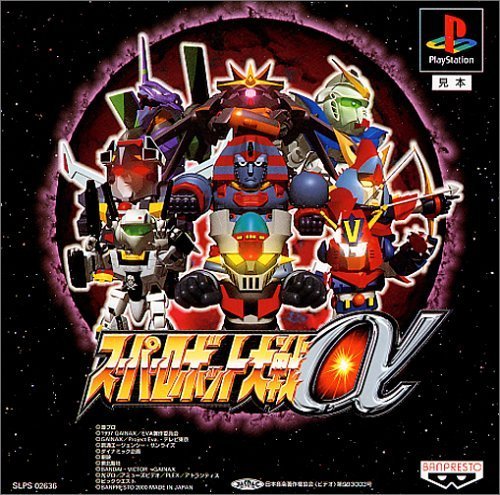
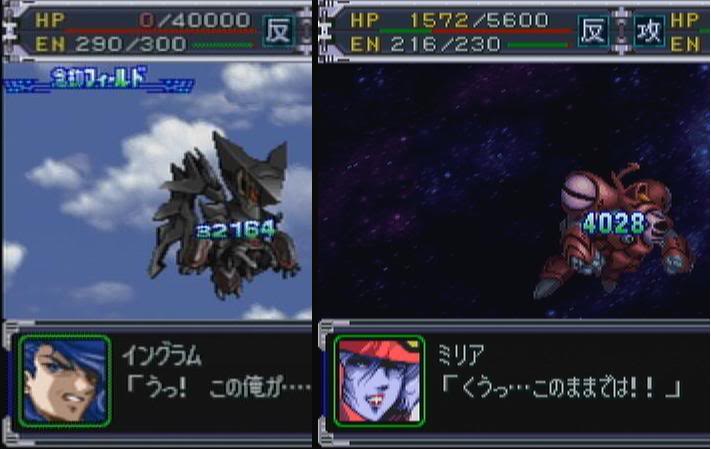
Super Robot Taisen Alpha (スーパーロボット大戦α), 5/25/2000, developed and published by Banpresto
[As usual, this is a compilation of message board posts I made years ago — this is much longer than usual]
Finally, we’ve reached the first “modern” SRW game. SRW Alpha represents a huge new development in the series that set the bar for future releases.
There are three huge, noticeable changes — the ability to skip attack animations, animated sprites in the attack sequences, and the use of full unit sprites on the map rather than heads. (The latter, along with the 3/4 view instead of top down, had already been used in Masou Kishin before this, but never in a main SRW game.)
Of course, by far the best change is that finally, 9 years after the series began, you can choose to skip attack animations. Unfortunately there are still 4 more games after this that do not allow you to do so (C2-2, C2-3, A, and C1 color). Also unfortunately, the speed increase is not completely realized because the game is kind of sluggish — the load times are long and the movement of the sprites on the screen is slow. Even so, it takes less time to play a stage than in any game perhaps since SRW 3.
The sprites during the attack sequences now have animation; i.e. the arms and legs and such actually move rather than the static sprite just sliding across the screen. It wasn’t really until Alpha Gaiden that the animated attacks were fully realized; in this game there are still a lot of attacks that are just sliding sprites (particularly beam saber attacks and the like), or non-moving sprites with bullets coming out.
Systemwise, the game does not really advance that much on the old games. Some of the recently introduced features like combination attack and support are absent, and in some aspects Alpha is still holding on to some old series features which will soon be discarded — the main ones being double move, the Limit stat, and individually upgrading weapons. Probably the most interesting addition is Skill Points. Alpha does skill points a little differently from the other games in that there isn’t necessarily one per level, and they often come from dialogue choices rather than challenges within the mission. One little tweak is that the further away you are from an enemy, the lower your hit rate is. Higher ground also increases your hit rate. I’m pretty sure future games use both of these as well. This game also has a one-off choice of “Defend Attack” as an option when you get attacked, which does a 50% damage counter and you take 75% damage from the enemy.
The series in Alpha are mostly old ones — the only new series are Macross, Macross Plus, and End of Evangelion. Other than that you get all of the usual UC Gundams plus Wing (with Victory making a repeat appearance), and Dunbine for the reals. The Super lineup is Mazinger, Great Mazinger, Getter, Dancougar, Raideen, Combattler V, Voltes V, Giant Robo, and Gunbuster. The Originals are sort of an OG-like mix; you get some Masou Kishin characters, the SRX characters from Shin, plus new ones.
In terms of storywriting, Alpha is head and shoulders above the previous games; 64 comes the closest but Alpha has even more dialogue and story interweaving than 64. The story setup at the start:
Zeon declares independence, One Year War starts
A mysterious large object falls to Earth, wiping out half of both fleets and stopping the war
EOTI is formed to investigate (headed by Bian Zoldark) and finds out it’s a big ship
Bian warns them that Earth is doomed, but the Federation doesn’t listen so Bian forms the Divine Crusaders to develop weapons to fight the coming aliens
The SDF is also formed to fight aliens
Because of the economic impact of that, the colonies get oppressed and spacenoids start revolting
The Zeon remnants form at Axis under the name Neo Zeon
The Titans and OZ are formed to deal with the Spacenoids and Neo Zeon
The Dinosaur and Demon Empires attack in the Far East areas, but thanks to the efforts of Mazinger Z, Getter Robo, and Raideen, they are defeated. However, Prince Sharkin and Dr. Hell are rebuilding their forces.
[This post is going to be very long because I played all the stages of every route; before that I will put my conclusion first because that might be of more interest]
So, what can I say about this game? It’s definitely one of the best, if not the best, SRW in the entire series. Especially playing these games in order you can see what a huge improvement it was on the series. The story is a masterpiece; the writers did a great job of combining all the series into one storyline and adding the originals into the mix in a way that made the originals seem like part of the story. I especially think they did a good job of answering basic questions like why this super powerful galactic empire would care about the Earth, and why they wouldn’t just immediately crush the Earth with their huge armies or mechs. Shuu played an important role, thus making the Masou Kishin originals worthwhile as well.
As far as the individual series, Giant Robo once again didn’t do much — the appearance was sort of like 64 in that they’re always in the background and supposedly have some plan but you never find out what it is. In this case, Giant Robo was apparently planned for future games but then dropped (supposedly due to licensing costs), so perhaps we would have found out later what was going on. The only other disappointing seres is Dunbine — in the end, it just gets quickly disposed of in a route split without a final battle or anything like that. Perhaps it, too, was intended to be used again?
The system is still a little primitive since it lacks a lot of the later features like support and skill building, and it still has limit, double move, etc. But overall it’s fun to play, and the lower difficulty allows you to do a little more with your army building than before. Some people might think there are too many characters, though, which is understandable.
I’m a little surprised I played the entire game, including all the route splits, in less than a month. But I guess that’s a testament to just how fun this game is.
And now to the stage by stage comments:
Stage 1 – The Steel Cockpit
I don’t think I can fully communicate the sense of relief at finally being able to skip animation sequences after playing 11 games in a row where you are unable to do so. As I said before, not all the attacks are animated — for instance, the Grungust Wing form’s Spiral Attack is just a sliding sprite with some aura around it.
I chose Leona with Super Robot, and the 11/11 B birthday so I have super seishin — it is a bit problematic though because you lack basic seishin and can only cast Miracle (once) at the beginning of the game.
This mission also features a seldom-seen robot — the Hover Pilder from Mazinger.
(I’ve played Alpha before, but it was only the second SRW game I played — I had a hard time following the story because I really didn’t know anything outside of Gundam. This time should be better, and I’m considering the insane idea of playing all the route splits to see the whole story, since the Alpha story is so good. We’ll see.)
Stage 2 – Mazinger Z’s Ultimate Danger
This has a little joke at the beginning — after Boss says “Jan ja jan!” he comments that he said that first once before (a reference to SRW F). Professor Yumi mentions “Professor Shirakawa” who of course is our old friend Shuu.
Stage 3 – Getter Team, Move Out!
You get the very rare (unique?) chance to use the separated Getter Robo mechs; they’re not that special and I doubt anyone would use them past the required point, but it’s interesting to see them. Getter Robo, as usual, starts after its plot has ended — the GR enemies are under the control of Dr. Hell this time; I think both @G and @2 have actual Getter Robo enemies. (Mazinger Z also has the ability to separate into the Pilder; once again not something you would normally do but it’s kind of interesting to have around.)
Stage 4 – Zeon’s Reappearance
The skill point here is to defeat one of the Zeon named enemies before they retreat; it’s not very hard (I killed all three tri-stars; taking down M’Quve would be a bigger challenge.) The Gundam faction in this game is massive, containing all the enemies from FG, Z, ZZ, CCA, F91, V, and W. It’s somewhat reminiscent of the older games like 2 and 3 where the vast majority of the enemies were from Gundam. Some people have wondered why they had to cram so much Gundam stuff into the first game — according to Terada, the original plan was that @1 and 2 would finish everything on Earth and that @3 would take place entirely in space. So if @2 was going to be Char’s Counterattack that means that everything before that has to happen in @1.
Stage 5 – Secret Numbers
SRX makes the first appearance in Alpha. They had very little presence or story in Shin but here Ingram is added and there’s something secret about them. Ingram emerges immediately as a suspicious character because he knows all about Leona and her Grungust skills.
In Shin, all the SRX characters had Time To Go as their BGM; here the characters are given their individual themes.
Stage 6 – The Order to Shoot Down Argama
A few Gundams join your party here. The Gundam units have lost their eyes in the models. Also, the beam rifles are now post-move attacks, which helps a lot.
Stage 7 – Let’s! Combine!
Combattler V starts here — you don’t actually have to use the uncombined forms for very long, though. V is always a great unit because of the 5 pilots contributing seishin.
Stage 8 – Move Out — It’s Name Is Giant Robo
Giant Robo, in only its second appearance in SRW, and possibly (judging from rumor) its last. I hope the story is a little better developed than in 64; the GR appearance in 64 was kind of pointless and never really went anywhere.
Stage 9 – The One Who Calls the Wind
Shuu makes his first appearance here; this time he starts as a friend, although he seems to have ulterior motives. Robert mentions Shott Weapon (from Dunbine) as one of the SRX developers, or at least someone working with them — kind of an interesting crossover.
Masaki also appears in Cybuster. There’s a lot to assimilate here if you’re not familiar with any of the games before this. As usual you can’t use Cyflash right away because the jump from La Gias messed things up. Finally, this stage has the first Aerogaters, but they’re just the little megilots so they’re not very hard.
Stage 10J – Amuro, Again
Basically this is from Zeta, although here Amuro is developing mobile suits instead of just living in a mansion.
For some reason, Christina doesn’t get the 0080 theme here — she’s back to the FG theme like in F and previous games.
Stage 11J – The White Mobile Suit
This is basically the first couple of Victory episodes; we find out that the Zanscare Empire is cooperating with Neo Zeon (of course).
Stage 12J – Who Are You Fighting For?
Second Victory stage; not much to say about this one.
Stage 13J – The Winged Gundam
I’m not going to bother with this stage since it’s pretty much the same as 13N.
Stage 10N – Awaken, Hero
RAIDEEN, FADE IN!
Stage 11N – The Gundam Theft
0083’s starting stage. Beat up Gato, then some other Gundam units as normal.
Stage 12N – The Ambitious Man
Shapiro leaves for the alien side as usual — so far in SRW he’s cooperated with Guest, Muge, and now the Aerogaters. Who does he join in GC, I wonder?
The skill point in this map is kind of hard so I couldn’t only send out low level people; I took down Gato with a Miracled Maxi Blaster and some other shots. (I would have let it go if it were just a skill point but it’s also a necessary thing to get Gato and the Gundam)
They mention in this mission that the Campbellians are part of the Balmar Empire.
Stage 13N – The Shooting Star She Saw
This is the required “first episode of Gundam Wing” stage. As I said before, Alpha 1 has a very heavy leaning towards Gundam shows — not as much as the early games (i.e. SRW 2 and 3) but it seems like in general they’ve gradually reduced the Gundam emphasis the further along the series has gotten.
Stage 14 – I Promised My Father
Giant Robo officially joins the team here along with the Ginrin robot. Shougeki no Albert is here also; as far as I know, there are only three people in SRW history who appear as normal humans on the map and in battle scenes — Albert, Domon, and Master Asia.
Stage 15 – Angel Attack
Here comes Evangelion. This stage is unusual because you can control Shougeki no Albert at the beginning; you can’t do anything because of the Angel’s AT Field, but it’s kind of fun. I had to ignore my “low level characters” attempt here because the Rick Dias and such wouldn’t be able to actually pierce the AT Field of the Angel. Next, Shinji comes out!
Stage 16 – Howl, EVA 01
This is almost just a plot mission — you can’t really do anything except let EVA 01 go berserk. The way they’re dealing with the EVA plot so far is sort of like F; the Evas will (later) be going with Londo Bell to lure the Angels away from NERV. Although for some reason Gendo wants the Evas and the STMC to fight, although the conversations are too elliptical to know why.
Stage 17 – GR vs. GR2
BF-dan is after the Granzon, but Shuu refuses to leave and lets everyone else fight for him. There’s some internal intrigue with the BF-dan but IIRC this never gets really resolved in this game since GR was originally planned to appear again in Alpha.
Stage 18 – The Red Lighting, Mazinger Flying in the Sky
I don’t understand why Dr. Hell is so obsessed with Mazinger; there are so many other powerful super robots out there to kick his butt too. Anyway, this is a big Mazinger stage with the usual upgrades.
Stage 19 – Getter Robo vs. Getter Robo G
Oh no, Musashi’s dead! …well, not really. Just like in the last mission — Boss died!! …well, not really. Anyway, Getter Robo G appears, along with Texas Mack. Ryuusei joins the team for real, and you get the first look at the Ryukooh when Brocken tries to send them at you — silly Brocken.
Boss is at level 21 and still he hasn’t gained a single seishin. Apparently his last seishin is Miracle but I assume he gets that at some ridiculous level like 95 or 99 so I’ll probably never see it.
Stage 20 – Deciding Battle, New Tokyo City
This same basic stage is in F and is taken from episodes 5 and 6 of Evangelion. Here, though, rather than using a positronic rifle, Shinji uses a Tronium Engine Cannon supplied by Ingram, and various defense mechanisms from the Super Robot labs. You have to beat Sharkin’s forces but it’s not very hard. This stage has an enormous amount of story dialogue in it; the whole stage took me over an hour even though the fighting part is very short.
Route split time!
Stage 21A – Holy Warriors
Enter Dunbine — well, the Argama gets pulled into Byston Well at any rate. I think this game contains the fullest “version” of the Dunbine story in any SRW; Dunbine has been absent from recent games (after this, the only ones it shows up in are Impact and C3, neither of which have stories as expansive and detailed as Alpha). Ingram meets up with Shott Weapon; as I said earlier it seems that Shott was on the SRX team until he was pulled into Byston Well. Aura Power and Nendoryoku seem to have a similarity.
Stage 22A – Elle’s Spiritual Power
More Byston Well; this isn’t a very hard map since all you have to do is move everyone forward to the other side of the screen.
Stage 23A – The Queen of Na Country
Another easy stage; Shott and Musy appear in their mechs and Shou gets the Bilvine.
Stage 24A – Aura Road
Another easy stage — the Gran Gulan was able to shoot down almost everything that attacked it. Everyone is whisked back up to the surface for the usual “surfacing in Tokyo” scene with Galaria and Shou. Do Galaria and Shou meet in Tokyo in the anime? I couldn’t find it in summaries but it appears so often in SRW that it seems like they must have gotten it from somewhere.
Stage 25A – Flying Above Tokyo
Mio appears in this stage but just as a little cameo; she makes some comments to Ryuusei like the ones she makes in EX to Masaki and then leaves. Of course now that people are rejoining you get a long tedious explanation of what happened on the other route which I can skip since I’m about to play it. Looks like a lot of stuff happnes on that other route split.
Stage 21B – Surpassing Beast and Man, Come Forth, Warrior of God
Shapiro’s betrayal is revealed! Dancougar successfully forms! Shock!
YATTE YARU ZE
As usual, Dancougar is awesome in this game — I think 4 is the only game where they failed to make Dancougar one of the most powerful and useful units.
Stage 22B – To the Sea of Battle
BE TOGETHER! LET’S VOLT IN!
I don’t really see the point of having both Combattler V and Voltes V in the same game; they’re almost the same thing. Voltes was in Shin but I didn’t play the Earth route so I don’t know what they did there. Here, the Boazans are part of the Balmar Empire. The Campbellians and Boazans always seem to be part of some bigger empire or group in SRW (i.e. Muge, Vega, Balmar). The problem with that is that it creates sort of an odd situation — at least the Boazans have a reason to be connected to Voltes, but there’s no reason the Campbellians should go after Combattler any more than any other heroes.
I assume Hyoma getting his arm hurt is from the anime; in F they regenerated it with Guest cloning technology, here they’re going to use some sort of SRX related tech to fix it.
At the end the Great General of Darkness appears, so it’s time for more Mazinger stuff.
Stage 23B – Mazinger vs. Great General of Darkness
This is one of the most detailed Mazinger stages yet. Great Mazinger appears, but only for a short time. The Mikene Empire is revealed and you even fight the Great General of Darkness, although he’s not too hard (as usual). Unfortunately Great doesn’t stick around; I assume he joins later but I don’t remember clearly.
Gorgon had a unique death line with Great Mazinger but GGD didn’t seem to have any unique speaking lines which is too bad.
Stage 24B – The Revival of Voltes
Of course, this is a Voltes stage — the requisite “Voltes can’t combine”. However, you can lose some Voltes machines and not lose the stage so even when I defeated the enemy, Voltes still couldn’t combine. 🙂
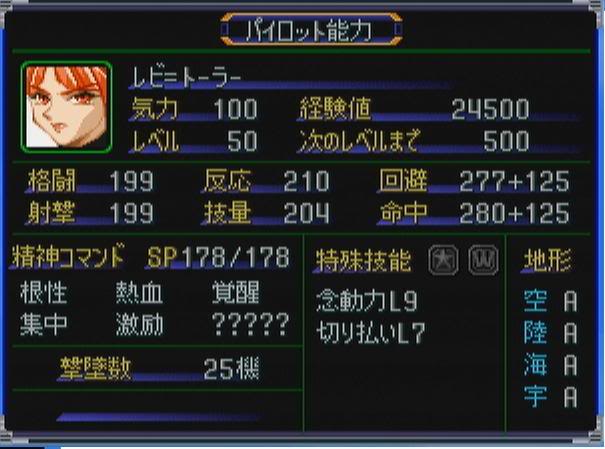
After the mission, Rebi Torah makes her first appearance telling Hainel to return to the Helmoze, and “Ze Balmary” is mentioned as the name of the Empire for the first time. It seems that Hainel is being forced to cooperate with the Empire because they have the King of Boazan as a hostage.
Stage 25B – Fight Against the Demon Sharkin
Continuing the theme, here’s the end of Sharkin, although there’s not too much development in the overall Raideen plot — Sarumoji hopes to access the memory of Raideen to find out more about the Angels.
Stage 26AB – The Scarlet Evangelion
This stage looks similar enough to 26 on the Gundam route that I don’t think I’m going to bother.
Stage 21C – Hong Kong City
This is pretty much a straight Z Gundam stage, although the Shrike Team appears as well. I guess if I’m going to try to keep everyone at even levels I’m going to have to use them for the whole game — at least a few of them have Great Effort. Kou also does — I think he’s gained about 15 levels from 2 or 3 kills.
You can convince Four twice with Kamille in this stage but my resources are inconsistent about whether this is necessary or not to recruit her later. You do get some DVEs by doing it, though. (Alpha has a lot of DVEs — I missed them in OGs and I hear that Z doesn’t have many either; it’s too bad, that’s one of my favorite parts of the series.)
Stage 22C – Gundams, to the Sea of Stars
There’s a skill point here to defeat Cima, who runs at 50%, but since she only has 3300 HP it’s not that hard. The rest of the Shrike Team joins up, and Dellas gives the Gihren Zabi speech. Roux appears as well, so it looks like it’s time for the ZZ crew to join up soon.
One other recruitable character question — my resources are also inconsistent on whether the choice between routes coming up (between “stop with EVA” or “shoot it down”) matters. One site says you have to pick a certain one to get Rebi later.
Stage 23C – Double Zeta Moves
This stage shows one of the other unusual parts to Alpha’s skill points — you can’t gain any in this stage, but you lose 3 if you don’t get Judau to the Lienhorse Jr. by turn 3.
One thing I forgot to mention is that this is the first instance of the pilot cut-ins that was used in almost every game afterwards. Inset graphics were used since 3, and faces appeared in Shin, but this is the first time that the pilots upper body appears from the side of the screen when an attack occurs. In this game, it’s mostly the Gundam units that have them, though.
The development of the mobile suits is really fast in this timeline — Kamille just joined AEUG at the beginning of Alpha, and already the Double Zeta and Victory have both been built following Kamille’s plan for the Zeta.
Now unfortunately I somehow forgot to save after this map and I got myself into a situation where I can’t beat Gato in the next one, so I’m probably going to have to replay this. At least I don’t have to read the story again.
Stage 24C – The Nightmare of Solomon
This is, of course, the 0083 stage with Gato blowing away some fleets with the nuclear bazooka. The skill point is fairly hard to get, and it’s also a requirement for getting Gato later. You basically have 2 turns to kill Gato using only Kou in the GP-01, and possibly one attack from your main character. The only help the rest of your force provides is if they can use Encourage on Kou. Luckily my Kou was levelled enough to have Hot Blood, but even then it took two Hot Blood attacks from an upgraded beam weapon, plus a hot blood attack from the Grungust.
Stage 25C – Crossbone Vanguard
F91 enters the series, with Seabook jumping into the F91 to protect Cecily. The skill point is very easy; all you have to do is just attack Dorel when you get your first chance. Seabook is good enough to dodge almost everything. Zechs and Noin strangely show up as NPCs; it’s not clear from the dialogue why they’re attacking the Crossbone Vanguard, who (of course) is working with Neo Zeon, but when the Neo Zeon forces show up they leave.
Now it’s back to Earth for more Eva stuff.
Stage 26C – Visitor From the Sea
Asuka joins in the Eva 2 here; the skill point is pretty easy since the Angel doesn’t have many HP and you have 3 turns to defeat it. After that the rest of the stage is just some Gundam enemies that aren’t very difficult to defeat.
I was happy to see that when Boss rejoined he had Hot Blood. Finally a third seishin. 🙂
Now we’re back off the route splits until stage 42.
Stage 27 – Developing Machines
This stage has one of the hardest skill points in the game — defeating the Gear Garing, that runs at 50% HP (21600 HP). To make matters worse, if you choose “Go to South Atalia” (to get another skill point), you don’t get to choose your members. My main options for success were the main character using Sutemi and a fully upgraded Spiral Attack, or Shou with a fully upgraded Hyper Aura Giri. I went with Shou, and my first attempt produced a result that I’m sure is painfully familiar to most SRW players:
Thankfully, Shou was only at 142 Will and I still had Haro’s Encourage, so raising Shou to 150 Will did the trick:
So much for the Gear Garing.
After the stage there’s more plot development; finally we’re coming to EOT Island which has been mentioned portentiously since the beginning of the game. I like that Drake’s army attacks the Titans; I always like to see the enemy factions fighting each other since I think it makes the game’s story more realistic.
Stage 28 – EOT Island
Another Angel fight, against the splitting Angel. This stage has kind of a fun skill point; you get +1 for beating the Angel with Asuka, but +2 for beating it with Bright. The key to getting the skill point is to realize that AT Fields do not work if the unit has less than 100 morale, so you have to Exhaust the Angel with Rei and then shoot it down with Bright. Everyone is very impressed when Bright does it.
Of course the Angel comes back so it’s time to come up with a plan. Meanwhile, the Macross franchise is finally brought into the game — the rumored ASS-1 (heh) is actually going to be used as a ship, Bian Zoldark came up with the plan to take a vestige of humanity away from the Earth to settle somewhere else.
One thing I forgot to mention earlier is that each Eva in this game gets its own BGM, unlike F where they all had Shinji’s.
Does anyone have any comment on the upcoming route choices? I’m not going to do both of them since they’re pretty much the same thing, so if anyone has preference for one or the other, speak up now.
Stage 29 – The Unseen Blade of the Heart
This stage has the start of the “rival points”, which allow you to get Irm on your team — it’s kind of demanding because you need 6 (or more than 6?) to get him and there are only 8 points in the game, one of them being on a route split. You have to make a choice in this stage between a love point and a rival point, but since the rival points are so scarce, the best way to do things is to have the main character attack Irm, then attack your partner, then attack Irm again (do not Persuade your partner). This gets you 1 love point, and possibly 2 rival points (I’m not entirely clear on the conditions), but even if you just get 1 rival point it’s enough for now.
Irm is a character from 4/F, adding to the Original Generations-like mix of originals in this game.
Stage 30 – Combine Your Spirits Immediately
I chose to have the two Evas work together (since that’s like the show); this is basically Episode 9 of Evangelion, although the Evas don’t dance because there’s no combo attacks in this game. If you want the 2 skill points for killing both Angels on turn 1, you have to upgrade the Evas’ weapons about halfway, I think.
Stage 31 – The Value of a Miracle
The Macross plot starts here; it seems that the Macross was built by Aerogaters rather than the Protodeviln but we’ll see if that actually holds true. I chose to have the EVAs try to stop the Mass Driver launch with their AT Fields.
Stage 32 – Space Fold
This is roughly episodes 2-3 of Macross. It’s a big “protect the ship” mission where you have waves upon waves of reinforcements, plus a skill point for killing the mothership; this isn’t too hard if you just take a couple of super robots out there and hit it with some hot blooded finishers. There are so many enemies in the stage they’ll probably get close to 130 morale even if they don’t do anything.
Once again I want to point out that one great thing about Alpha is the relatively high amount of DVEs (i.e. where they voice key lines in the story sections).
Stage 33 – Armed Attack
This is more or less episode 5 of Macross. It’s another “protect the ship” mission but it’s hard to imagine losing this one. The Macross now has the Pinpoint Barrier that activates at 120 morale and only uses 5 en, which means it can be used 50 times before the Macross runs out of energy. It’s conceivable you could beat this mission just by ending your turn over and over again.
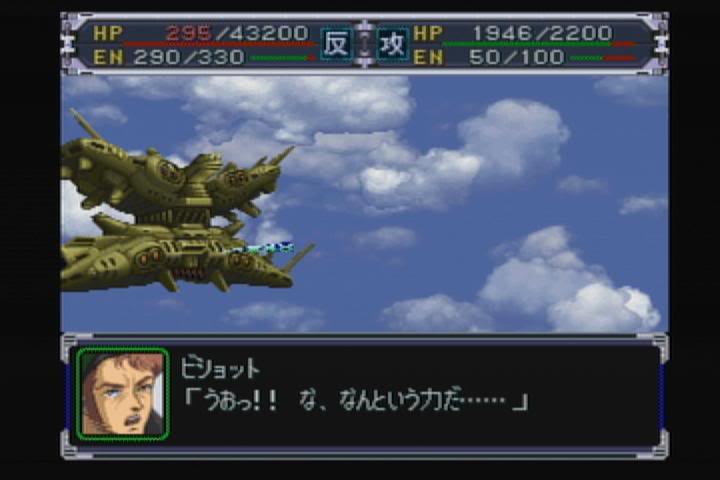
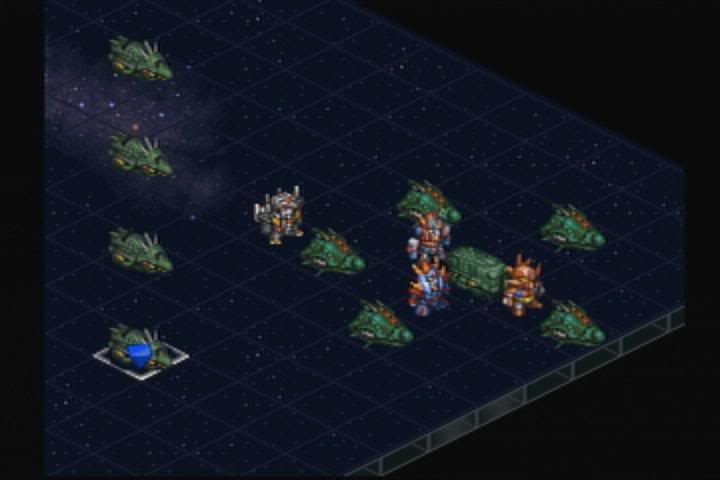
The real challenge is to get 3 skill points from defeating the Britai, the flagship that’s in the far right of the screen surrounded by other ships:
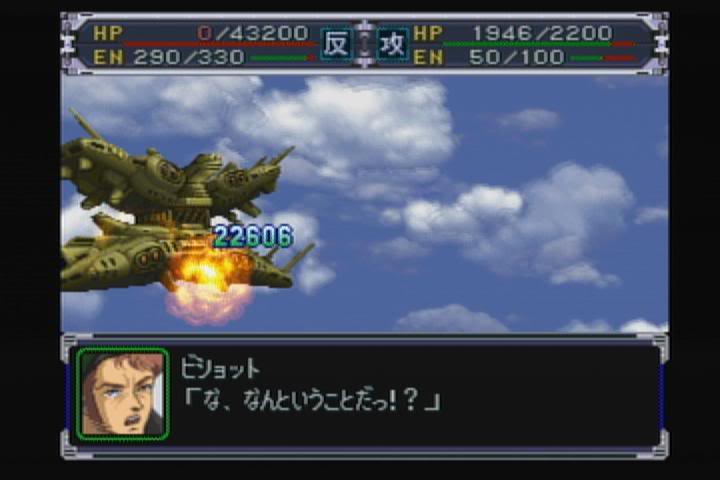
The Britai has 50,000 HP and uses full HP restore when it drops below 25,000. I think really your only choice for beating it is to take a number of super robots down there and just do the best you can; use a lot of Iron Wall and upgrade your finishing weapons if you need to. Most likely you’ll lose a few Super Robots but it’s worth it. I beat the Britai with a Dancougar Dankuuhou Formation:
Now we’re going to see what happened to the Excelion, which hasn’t been seen since the intro to the game.
Stage 34 – Encounter With a Natural Predator
Gunbuster was previously in F but it was just a random super robot; here they bring in the Space Monsters, who turn out to be a pretty major aspect of both this game and Alpha 3. Raideen has a connection to them; I’m not sure if this “Raideen predicting the coming of a great enemy” is in the anime, but here it seems to refer to the Space Monsters.
Isam also shows up (from Macross Plus).
Stage 35 – Ingram’s Malice
In Shin SRW, neither the SRX nor Balmar had any particular purpose or deep meaning. SRX was just another combining Super Robot (developed by Voltes’ Hamaguchi!) and the Balmar was just another Guest-like alien race that wanted to take over Earth; there was no connection between SRX and Balmar, nor was there any particular reason why Balmar was targeting Earth. In Alpha they expanded a lot on this and created the war between the Balmar and the Zentradi, a nice fusion of original and licensed series. It does seem now like the Aerogaters are standing in for the Protodeviln from the standpoint of Macross, but I don’t remember how they introduce the Protodeviln in Alpha 3.
After this stage there’s more original development as Yuuzes and Laodecia appear; it seems that the Aerogaters have two purposes for targetting Earth. One is to use the Earth weapons (and possibly Earthlings) in their fight against the Zentradi, the other is to get Tronium, which they need. I especially think the former motivation is a good idea because it explains why the vastly superior Aerogaters don’t just crush the Earth immediately.
Levi’s Judecca is also in this stage; last time I played this game I did not complete all the conditions to recruit Mai later, so maybe I can this time (I may not have taken the correct route later).
Somehow I don’t recall the OG explanation for Ingram and the Aerogater’s actions being as good, but maybe I’m just not remembering correctly.
Stage 36 – Miss Macross
I don’t understand the intent of the designers in some of the skill points where you choose a dialogue option. There’s usually no way to predict which one will get you the skill point; in this stage, the skill point option gives you a stage with only 5 enemies, whereas the non-skill point option has you facing 30. I suppose that the 5 enemies is just Quatre, Duo, and Hikaru as allies, but they’re more than enough to defeat the 5 Zentradi.
The first Endless Waltz suits show up here; this game doesn’t really seem to use the Gundam Wing plot all that much. In general, despite the relatively high number of appearances of Wing in the SRW series, the original Wing plot doesn’t seem to be developed all that much. Often it’s just Endless Waltz in the game.
Stage 37 – The Refugee From Jupiter
Ryuune Zoldark joins with her Valsione R. Since Bian isn’t dead, her backstory is a little different — she and Bian were going out to Pluto to establish an early warning radar network, but Bian got captured by the Jupitorians, leaving Ryuune to escape. Of course she immediately falls for Masaki.
I think the easiest way to do this stage is to choose “leave the area”, which gets you a skill point, and then have Ryuusei attack Levi twice, which gets you another skill point. But, if you want to try to kill all the enemies and get more money you should pick to protect Ryuune. You just have to make sure Ryuusei is in the general area where Levi will appear so that he can attack her twice before the stage ends. Guts is a broken ability; once Ryuusei got down to 500 HP or so everyone had 0% to hit him and he slaughtered the majority of the enemy force.
Stage 38 – The Ones Who Will Lead Humanity
More development on the V Gundam front; the Angel Halo in the Alphaverse was planned or built by Bian Zoldark although it’s not clear what purpose he intended it for. The V Gundam enemies (they haven’t used the name “Zanscare” yet so I don’t know if that exists) are trying for their ESP people but they’re going to have to borrow from Balmar because they apparently can’t get enough from Earth.
Kind of a hairy stage since you have to prevent any enemy from reaching the top of the map, but it’s not too bad.
I had my biggest level gain here as Voltes gained 11 levels with one kill — my highest levelled guys right now are Christina Mackenzie and the Voltes crew (it’s not a coincidence that Christina has Great Effort).
Stage 39 – First Contact
This is named after Episode 11 of Macross, although they’re not really slavishly following the plot. The concept of the race that fights between men and women and doesn’t understand culture is a little silly at first; I don’t remember if the ultimate explanation is satisfying. Misato wonders whether the Zentradi were created to fight the Space Monsters.
The stage itself is really simple; all you have to do is kill the main boss and everyone retreats and the stage ends (and you get a skill point)
Stage 40 – Big Escape
This is named after Episode 12 of Macross; it’s an easy stage. Milia makes her first appearance so you can shoot her down with Max for later. Almost back at Earth and then the Macross-heavy stuff will come to an end for a while.
Stage 41 – Bye-bye Mars
This is named after Episode 9 of Macross
Stage 42A – Jupiter Ghost
They seemed to have renamed the Zanscare Empire to the “Jupitorians”. Valsione R has gotten a lot more attention in its animations than many of the other units. It’s a fairly good unit. Cybuster, unfortunately, has been severely nerfed. 120 morale to use Cyflash is harsh.
Stage 43A – The Flower That Blooms in Space
More F91 stuff — Cecily joins here, and the silly Lafresia appears. Wufei also appears briefly; he has the Taunt seishin. This is the final apperance of Taunt in the SRW series and Wufei is the only character in the game to have it. It’s useful in the later stages once he joins for real.
Stage 44A – The Gundam Called Zero
Of course this is the Gundam Wing time for Quatre to go berserk in Zero. Heero also gets Epyon.
Stage 45A – Attack, Limit Point
This is the 0083 conclusion except it plays out a bit more quickly; Cima shows up on the third turn to blast away Delaz. She apparently wants to drop the colony on a Jupitorian base on Earth; she’s afraid of the Angel Halo that’s coming towards Earth. Afterwards, Shuu uses a black hole from the Granzon to make the colony vanish so it doesn’t hit the Earth. Of course Masaki takes off towards Beijing, where Shuu is.
Stage 42B – Father, Earth is Close
Now switching to the Earth group; it seems that the Titans and Aura Battlers have been fighting it out on Earth, but first there’s a Voltes stage. It’s not very long, although Ken’ichi’s father appears. Usually the heroes’ fathers are dead so it’s interesting to see someone who is actually alive.
Stage 43B – In the Still Darkness
This is Episode 11 of Eva, except that of course you don’t need the Evas to defeat the Angel since a couple of finishing attacks from Super Robots will take it out before they even appear. They’re not strictly following Eva’s story, though, because Kaji shows Adam to Misato in this stage; I think that doesn’t happen until later in the anime, if it happens at all. Stage 45 is going to jump ahead to episode 17 or 18, also.
Stage 44B – The Red-Haired Woman
Ah, good old Hyper Jerill. There are a lot of DVEs in this stage — you get one for attacking Allen with Shou, and for killing Allen with Shou. Wakamoto Norio should get as many DVEs as possible.
Stage 45B – Angel, or Devil…
Basically Episode 18 of EVA, except that Shin Getter Robo appears to save Touji rather than Shinji defeating the Angel.
Now it’s back to my real route path.
Stage 42C – The Messenger from Axis
Now we’re back to Zeta Gundam stuff, with Londo Bell and Scirocco trying to ally with Neo Zeon. However, Scirocco tells Haman to surrender or they’ll all be killed by the Jupitorians’ “Earth clean” plan.
The skill point in this stage is one of the hardest in the game; you have to defeat the Jupitoris, with over 50,000 HP, by the 4th enemy phase. I believe that I might have been able to do it if I spent all my money upgrading the Grungust and the Zeta Gundam, but even then it might not be enough. Most units aren’t even going to be able to make it within attacking distance by the 4th EP.
Stage 43C – Puru and Axis
Quattro and the others are stuck in Axis, so it’s time to save them. You can win by moving some people to Axis, but killing all the enemies isn’t very hard and you get a skill point. It looks like Haman is planning on betraying the Zabi family, but Gremy is planning on betraying Haman. Silly evil organizations.
Stage 44C – Lina’s Blood
I don’t remember how Lina “dies” in ZZ, but here Puru accidentally “kills” her by blowing up Iria’s mech. You have to escape in 16 turns for 2 skill points but that’s easy; it’s more than enough time to persuade Haman with Quattro and get everyone out. Christina also gets to persuade Bernie, but I don’t understand why the developers decided to make Bernie not only join at stage 60, but in a route split. Who wants Bernie at that point?
Stage 45C – The Coming of the Black Angel
Haman Karn mentions her father “Maharajah Karn” in this episode; I don’t remember that being mentioned in Z or ZZ so I guess that’s from an outside source. Ingram shows up in the Astranagun and starts slaughtering Gremy’s forces. Fun.
Now it seems that the Aerogaters want Neo Zeon’s Enhanced Human technology, so Haman teams up with the Aerogaters.
Stage 46 – Dragon and Tiger
Time for the main character mech upgrade; of course it’s ridiculously powerful, even not upgraded. There’s also more Giant Robo stuff in this stage but not a whole lot of development — the BF-dan wanted the Ryuukooh to awaken, supposedly so they can use it to protect the Earth. Really?
Also, Cybuster really blows in this game. It’s kind of sad.
Stage 47 – A Man’s Fight
This is essentially a plot mission, covering episodes 19-20 of Eva. Although in this game rather than wait 30 days for Shinji to emerge from the LCL, the Psycho Drivers use their T-LINK system to get him back earlier, and he sees people like Kouji and Elle rather than just the Eva characters.
Like in F, you can choose whether or not to have Shinji absorbed by the Angel. It costs 40,000 to repair plus you get 50,000 if you defeat the Angel, so you’re losing 90,000 for the S2 Engine — I went for it anyway since it follows the original storyline, but it’s probably not too important.
Banjou has a connection to the Evangelion storyline which is kind of neat, I guess because his father developed the Meganoids which they seem to consider to be along the same lines as the Human Instrumentality Project (or at least for the same purpose).
Stage 48 – For Whom the Bell Tolls
This is a fun stage; you get to use all the little plane-like mechs; the macross units, the uncombined Super Robots, the Pilders, etc. You don’t get much opportunity to use them so it’s nice to watch them kick some butt for a change.
The SRX finally forms here; this time you’re limited to 10 formations and only one formation every other stage — but as far as I can see that means you can’t actually get to 10 times?
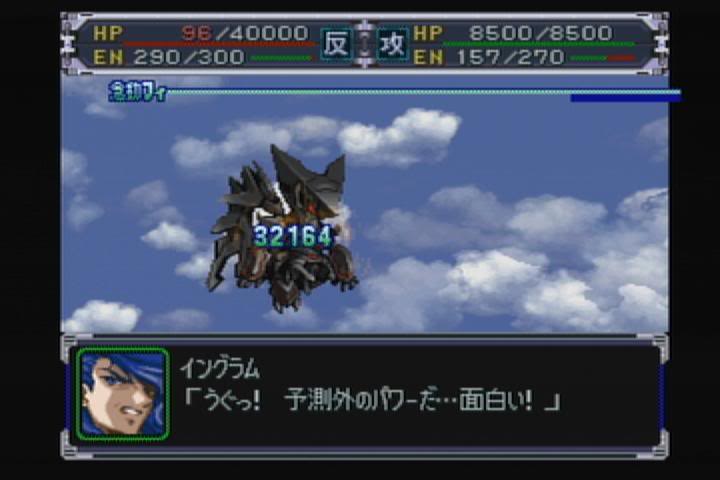
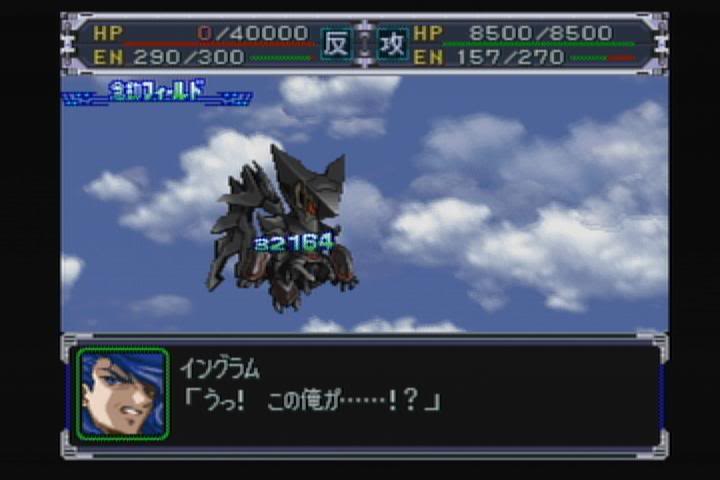
Anyway, the main aspect of this stage is the skill point. You get 3 for Astranagan and 1 for Will Wipps. The Astranagan has 40000 HP and flees at 70%, so you need to be able to do 28000 HP of damage in one hit — I used a 150 Will Shin Getter’s strongest attack fully upgraded. Of course the first try never goes well:
But I did have enough damage so all I had to do was do a little more to Ingram before I used the Stoner Sunshine; a bit of tweaking and it worked out:
The result was well worth it for the Getter Team:
Unfortunately I didn’t have enough power left to defeat the Will Wipps, but that’s OK. Now it’s another three-way route split to deal with some more problems on Earth. The Space Monsters have now been introduced as a major adversary, maybe even one that would be superior to the Zentradi and Aerogaters.
Stage 51A – The Glass Kingdom
Back to Gundam Wing, and we’re protecting the Cinq Kingdom yet again. Of course the inevitable will happen; here Treize kidnaps Relena and Heero appears in the Epyon, but he’ll soon switch to the Wing Zero. The Titans make an appearance as enemies after a long absence; they’re not in this game all that much, it seems.
Stage 52A – The Kingdom Destroyed
Of course the Cinq Kingdom is easily destroyed, this time by beams from orbit. This mission seems hard at first — you have to get the Gran Gulan down to the bottom of the map, and you have crappy units and really strong enemies. Actually it’s not that bad; many of the enemies attack with beam weapons and the GG can easily deal with those via Aura Barrier. You just have to kill a couple of enemies to forge a path for the GG and it should go OK. Although if you were trying for the skill points you have to do it in 4 turns, which is a little tough.
Stage 53A – Cross Fight
Cross Fight, Cross Fight…CROSS FIGHT! Here comes Danga…er no, Cross Fight is the name of a Dunbine episode, apparently.
This is just a fight vs. Bishott, and the Wing boys get their Endless Waltz suits. Now it’s time for the final showdown with Drake.
Stage 54A – The Departure of the Otherworlders
Although this is the final Dunbine stage, it’s kind of an odd one. You don’t actually fight anybody — Shuu just shows up in the Granzon, notifies you that the Angel Halo is coming so it’s time to send the Aura Battlers away. Then he activates a gate and they all disappear. (I guess if you pick not to listen to Drake you can fight them for a bit, but the end result is the same).
I wonder if they originally planned to use Dunbine in @2 but dropped the idea later. I guess they covered a lot of the usual stuff that happens in Dunbine’s SRW appearances, but all of the enemies are still alive and (apparently) back in Byston Well.
Stage 55A – Queen Relena
Into space to rendevous at Solomon. This stage is actually kind of rough; you have to fight a lot of guys with a small force and protect the Excellion. Luckily the Excellion is really good and can survive for a long time until someone gets there.
Masaki gets Ranbu no Tachi on this route; in SRW 3 this wasn’t a special move, he just said “Ranbu no Tachi!!” sometimes when doing Dis Cutter. They made it a special final attack in Masou Kishin, and it’s a route-specific attack here, but I think he automatically gets it in Gaiden. What about OG?
Now onto the Mazinger/Voltes-heavy route.
Stage 51B – The Death of Baron Ashura
As the name indicates, this is Ashura’s last fight. You get to fight the Dragonasaurus and Pikdrone, enemies that are used a lot in the original SRW games but less and less as time goes on (I think?) The Gilgilgan is also coming soon, apparently. Asuka also has her mental problems like in Episodes 22 and 23 of EVA, but she doesn’t go catatonic (yet?)
Stage 52B – Demon Emperor
Here comes Majinkaiser, and the mass produced GMs.
Stage 53B – Betting the Earth on One Strike
Hainel vs. Ken’ichi one on one, and you have to move everyone around to combine them. The V machines get particularly confusing. Garuda also appears here — I’m surprised he’s survived so long. Usually poor Garuda gets swept away pretty early in the game; Alpha doesn’t have a “Garuda’s tragedy” stage so I don’t know what ultimately happens to him.
Stage 54B – Memories, To the Future
This is a little Gunbuster past history stage, plus the return (and maybe final appearance in SRW?) of the Gilgilgan and Mecha Gilgilgan. The Mecha one isn’t very hard because Leona uses her Psycho Driver power to give everyone 150 morale and full HP/EN.
Stage 55B – Cry in Your Father’s Breast!
This has a funny scene at the beginning where Ryouma teaches Noriko to use the Buster Tomahawk, and then Benkei talks about teaching her to use Buster Home Run. Noriko practices yelling her lines.
Then there’s a lot of Voltes stuff; here’s where you find out that Hainel and Ken’ichi are brothers and such. If you take this route for real you can get Hainel as a special character in the Scirocco battle, but I’m going the other route to get Haman and Gato (and Mai).
Stage 51C – The Day of Dakar
Zeta Gundam stuff, of course. A good opportunity to level up some lower people since (without explanation) all your guys get 150 morale at turn 4. Now the Titans have been messed up — the Titans are much less a threat in this game than they were in F.
Stage 52C – Vibration
Fight vs. a lot of Neo Zeon guys — this was another good chance to level up; as usual the Great Effort people gained over 10 levels per boss kill. My top 5 levelled guys are Kou, Christina, Robert, Aya, and Emma (Robert is there because he was in the Super Gundam with Kou and thus got the benefit of the Great Effort). Kayla just got Raid, which surprised me.
Stage 53C – The Attack on Solomon
This is a First Gundam stage. First you get to defeat 12 Rick Doms to make Conscon do his famous speech. You have 12 turns to move the Macross to Solomon, or kill all enemies — I killed all enemies, even the Big Zam and the Alpha Aziels, although only on the last turn.
This also has the Sleggar/Big Zam event except this time Sleggar survives.
Afterwards we see that Leena has been saved by Haman, and Haman seems just as disturbed by the appearance of the Angel Halo as the heroes are.
Stage 54C – The Women’s Battlefield
All the insane Gundam girls attack you here — Lupe, Katejina, Cima, Farah, Sara, and Reccoa, plus Rebi for fun. Brohho is the lone male, but I bet he’s not too happy with that crowd. He may find himself without some important parts of his anatomy if he hangs around them for too long. (Incidentally, after watching Victory Gundam my reaction was that it proves that you can’t defeat the forces of good if your evil organization is composed entirely of insane people. Chronicle was about the only halfway normal one in the whole Zanscare Empire.)
Anyway, the skill point is to defeat Rebi — a Miracled finisher from Ryuukooh does over 45,000 so that’s not too hard.
My first characters are starting to get double move now; only Max and Fokker so far. Considering I use the lesser guys so often, I doubt many people will be getting double move by the end.
Stage 55C – The Running Storm
This is the “stop the solar ray” mission, although I was able to kill all the units as usual. There’s a reused element from F, where Gato and Kerry get used as pawns by Gihren and left to die. Does this resemble something in 0083? I don’t remember it from G Generation, but I’ve never seen 0083 itself.
Now everyone is rejoined so it’s time to level up some of the people who are behind; by this stage even my lowest level people were above the levels of the enemies. I’m not playing strict “must dispatch low levels” characters so I’ll probably avoid some of the harder people to level like the Bluegars. I am running out of stages, though.
Stage 56 – Idol of Zeon
At the beginning of this stage, Ken’ichi’s dad does the big reveal about the Balmar Empire, that it’s a huge space empire that’s been at war with the Zentradi for 1000 years and that it seeks to take over Earth to use its fighting power. The Angel Halo is being used because Earth isn’t controlled by a king like Boazan or some of the other planets the Balmar Empire has incorporated. They also need Tronium, and the Psychodrivers, for whatever reason.
In any case, this is the final stage for the Zabi-led Zeons; Kycilia kills Gihren and then you get 5 skill points(!) for accepting her cease fire. Does Kycilia ever show up in the Alpha series again? I don’t remember her being in any other games. This is also the final stage in Alpha for Dr. Hell; he’ll be back in Alpha 2, but Brocken seems to survive too and I’m not sure if he appears again.
Using the Angel Halo as a plot of the Balmar was a good idea; it makes more sense than the original Victory plot.
Stage 57 – Above the Angel’s Ring
These stages are getting pretty challenging; this time my team included Texas Mack, Boss, Noin, and Keen (from Dunbine) — fortunately there were a bunch of required strong characters (Shuu, main character, Raideen, Heero, Usso) so it wasn’t so bad. Boss actually helped quite a bit because all the warships kept targetting the Goraon; they couldn’t hurt the ship because of the Aura Barrier but it needed an energy recharge every couple of turns to keep that going. Boss also has Exhaust now.
Anyway, this is the final stage for many of the V Gundam enemies — the goal is just to get someone to the Angel Halo’s center but that’s no fun; you get a lot of money and stuff if you kill all the enemies so I went ahead and did that. Scirocco was left alone at the end:
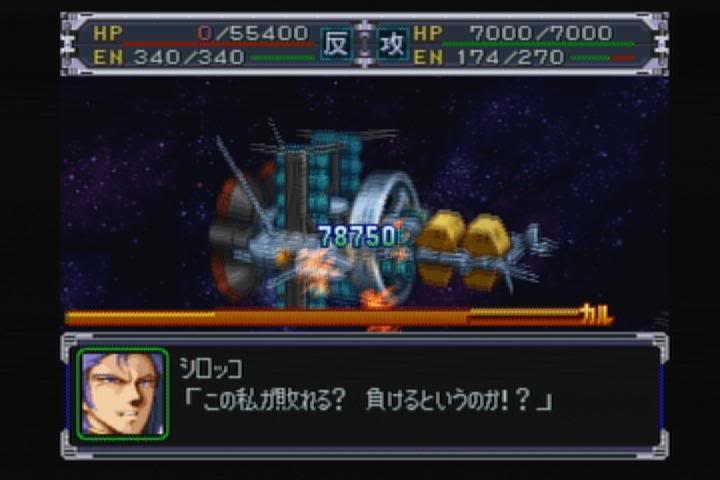
You get a skill point for beating him, but he runs at 90% and has 55400 HP. What am I to do? No problem; I exhausted his Will down to 100 and then used Sutemi (x3 damage) on the main character, then pulled out the big guns:
Was it enough, though?
EAT SHIT SCIROCCO. That may be the most damage I’ve ever done in SRW with one hit. If Rei hadn’t died earlier I could have exhausted him down even more and the damage would have been increased.
Now it’s on to the last route split.
Stage 58A – Blessing for the Defeated and the Victorious
This is the final stand of the Jupitorians and OZ; Chronicle, Treize, and Dorothy all die. (Katejina lives to Alpha Gaiden and Zechs, of course, is there until the end of the Alpha series).
Stage 59A – Humanlike, at least
This stage incorporates parts of Eva episodes 22 and 23, although Yuuzes’ Antenora stands in for the Angel (and the Lance of Longinus isn’t used at all). The title is episode 22 of Evangelion, although Usso also says it in reference to the fact that the Aerogaters populated the Angel Halo with just brains instead of people.
Stage 60A – The Last Angel
This is mostly episode 24 of Eva, which pretty much ends the Eva stuff in Alpha 1. The Human Instrumentality Project stuff is left for Alpha 3, when (AFAIremember) the End of Evangelion plot is covered. In this game they mention a few times that Balmar has thier own Human Instrumentality Plan but I don’t remember this ever coming up in Alpha 3 — maybe I just didn’t pay enough attention, though. Now for the other route — Rebi and Haman await (and Bernie…I can’t believe he’s route specific)
Stage 58B – Lured to the Kingdom of God
Shapiro captures a few dudes here. There are four skill points in the stage — you get one each for attacking Viletta with Masaki, Ryuusei, and the main character, and one for attacking Shapiro with Shinobu. The problematic one is the Shinobu point — he has no defensive seishin and he’s in the uncombined mech. I didn’t try to do it, but probably you would have to either load his mech up with mobility items and hope to dodge Shapiro’s hit, or load him up with defensive items and hope to survive the hit. I didn’t bother since I already have 69 skill points which is enough to get every skill point-required thing in the game.
Stage 59B – Cross Target
More Aerogaters stuff; they deal with Shuu and the Black Box in this stage. In the original continuity, Guest used the Black Box to draw trouble to the Earth to accelerate the weapons production of the Earthlings. Here, it’s sort of the same thing except that it was Balmar rather than Guest/Inspector that did it. Shuu figured out what was going on but let the thing blow up anyway because if he fixed it, he knew that Balmar would realize Earth’s technology level was higher than they thought and would immediately come and attack instead of sending scouts.
You can finally save Rebi here; I didn’t do this last time I played the game so it will be interesting to see what happens (she’s not awake yet; I know that she’s Mai Kobayashi from the other Alpha games, of course). The skill point is defeating Yuuzes, who runs at 70% — not too bad; a fully upgraded Sun Attack was just barely enough to beat him, probably a fully upgraded Gunbuster hit would have done better.
Stage 60B – Warriors, Again
The title, of course, is the title of the final episode of ZZ; this is the last fight against Neo Zeon. If you’ve followed all the Haman recruiting stuff up to here you can do the last stuff to get her — convince her with Quattro, fight her with Judau and Kamille, then destroy her with Judau. This results in a lot of spoken lines and unique battle dialogue and I was going to record the whole thing, but it proved too difficult to get everything to work out reliably. Haman is too hard to hit (I had to reset on several <35% chances), the Mercy seishin apparently doesn’t work on her, and she has Potential which makes her hard to damage at lower HP. I would highly recommend upgrading the ZZ Gundam’s double beam rifle and mobility, and giving Judau as many mobility increasing items as you can — it will make your life a lot easier.
That’s it for the route splits; now on to the last 7 stages to deal with the Zentradi, the Space Monsters, the Aerogaters, and Scirocco.
Stage 61 – The Arrow of Destiny
You vs. many Meltrandi ships. I was able to use this opportunity to move up a whole bunch of levels and I still beat it in 9 turns for the skill points. Most of my guys are now in the 50’s, with the exception of one of the Bluegar pilots and a few stragglers in the upper 40’s.
Afterwards, you find out that the Protoculture from Macross also is connected to the Aerogaters. Also, the music to Minmei’s song comes from the plate Kaoru gave to Shinji — apparently the Central Dogma area below NERV is a Protoculture deposit of some sort.
I got an S-Video cable for my gamebridge so now things look sharper, if a bit pixelly. Some comparisons:
Also, I did succeed in getting Rebi. Aya suspects she’s Mai but they haven’t confirmed it yet. She lost all her memories of being with the Aerogaters although Minmei’s song brought her out of her coma. She wants to pilot the R-GUN Powered to make up for all the times she fought the heroes.
Stage 62 – Do You Remember Love?
This is the conclusion to the Macross story.
This is a two-part stage. The first part is somewhat difficult; you have to prevent any unit from reaching the far side of the map. You basically have to move your people forward otherwise you don’t have enough time to destroy all the units. You also need some powerful attacks to take out some of the ships (I don’t think you have to take out any of the large ships, only the small ones). But I was able to do it even using all my lower levelled non-ace pilots, so it’s not so bad.
The second part is fun because all the enemies have 50 morale (except the main boss); they’re all annoying high-HP ships but it’s not too bad.
Because I sent Londo Bell out in episode 61, I got Macronized Max instead of Micronized Milia here — this is the continuity of Do You Remember Love rather than the TV series (and Macross 7).
Stage 63 – The Beginning of the End
This is a rare instance of a stage with only dialogue; as far as I know, only EX and Alpha have these. So only 4 stages left — Titan remnants + MP Evas, Voltes enemies, Scirocco and his group, and STMC/Aerogaters/Campbellians.
I don’t understand why this stage has no battle — it seems like they could have combined the story parts with the next stage.
Stage 64 – Air
The title is taken from the first “episode” of End of Evangelion and it follows a lot of the events of that pretty closely except that nobody dies, and the Titans are substituted for the JSDF in the first part. In the end Instrumentality Project is stopped although it’s not entirely clear how that happened — maybe there will be some further dialogue later to explain it. The last we saw of Gendo was him confronting Rei in Central Dogma; but the stuff from the second part of End of Evangelion doesn’t happen until Alpha 3 so I’m not sure exactly what Gendo is doing or where he went. Incidentally, Shuu says that 500,000 years ago, the Protoculture used Instrumentality to create humanity.
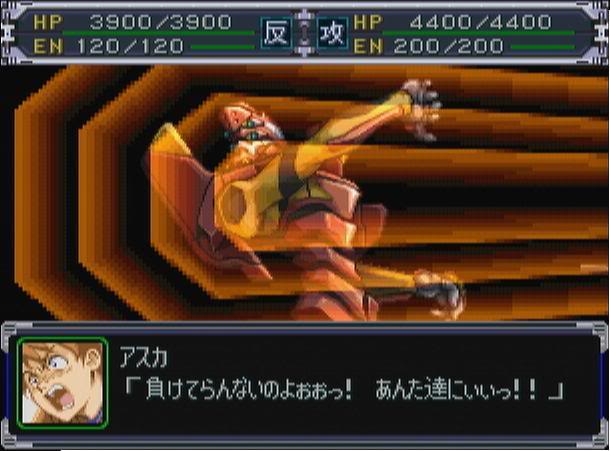
Asuka gets her super-powerful AT Field attack:
Stage 65 – Gear of Destiny
This is (more or less) it for Combattler and Voltes, at least for Alpha. I hadn’t taken the Hainel path so Hainel seemingly dies — he’s still in the other games so I don’t know if this isn’t canon or whether the game shows him surviving later. This is the “tragedy of General Garuda” episode; he’s done for good (although some MP Garudas show up in the final stage).
Lowest level character is now 53; I have two ships at 53 so that’s going to be hard to deal with before the end of the game. Only two more stages.
Stage 66 – The Banquet of Hopelessness Begins Now
This is vs. Scirocco. Scirocco is used a lot as an antagonist in the early SRW games but he seems to drop out after that — after Alpha, which games is he in other than Z? Is he in GC/XO? Here’s a video of the Scirocco/Kamille event:
You also get Haman, Gato, or Hainel as allies depending on if you did all their recruitment conditions, but just for this battle.
This is also the stage where Yuuzes mentions the Zovorg:
This is the only time Zovorg is mentioned in the entire Alpha series, so it’s not clear what the intent was here — it seems that after Alpha Gaiden they decided to stop mixing original continuities outside OG, so it’s possible they might have planned to use the Inspectors/Guest later and dropped it, or this could have been intended as just a throwaway random reference from the beginning (I would tend to suspect the latter).
I was pretty successful at levelling my characters evenly; my highest levelled guys were the Dancougar team at 69, and the lowest level was Burning at 53. The top 10 levelled units are Dancougar, Ino, Jung, the main characters, Daisaku (Giant Robo), Monshia, Seabook, Cecily, Trowa, and the Voltes team.
Next up, final stage!
Stage 67 – For the Future of This Planet
Final stage! It’s in three parts, but none of them are very hard if you play cheap. The first two parts just require you to move the Excelion to certain places on the map — you can easily do this by using Wufei’s Taunt to lure the blocking ships away and then use Move Again as many times as you need to in order to get the Excelion there.
The third map has you first fighting the Helmoze. You can taunt the Helmoze over to your guys, kill it with a few Soul’ed funnels, then the Zfield comes out. I killed the Zfield in one hit with a soul’ed final attack from the SRX (Just barely — it’s hard to see the damage on that shot but it’s just a little over 65,000).
Then Yuuzes comes out with 4 more Zfields and the Astranagan. Once again I used Taunt to get Yuuzes and the Zfield over to me. Folka asked for a video of Final Hell Judecca, here it is:
Now, I have not one but two one-hit kill videos of the final boss, the first one using the Ryuukooh and the second one using SRX.
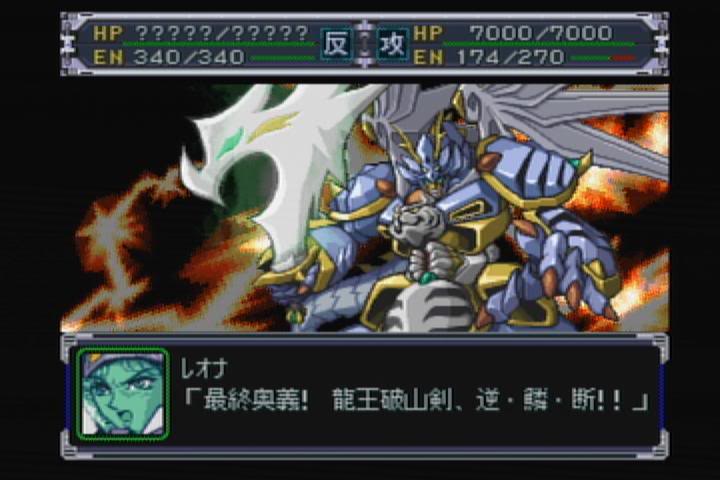
Leona wins, 90031 to 77499.
I wonder about this plan they used to kill the STMC — this shock wave that’s going to do so much damage to the Earth, what about all the other planets it contacts on its way to Earth, and in the other directions? I guess they’re left to protect themselves.
Sanada Juuyuushi (真田十勇士), released 6/27/1998, developed and published by Kotobuki System
This is a somewhat odd game — it appears as a top-down RPG but in a way it’s more like an adventure game. The title translates to “The Ten Sanada Braves,” a reference to a group of fictional ninja that served the (historical) warlord Sanada Yukimura in the sengoku period. They have appeared in a lot of fictional media since the late Edo period; the best known of them is probably Sarutobi Sasuke.
The story is relatively basic; Yukimura’s father Masayuki tells him to gather the 10 braves and defeat Tokugawa. That’s the entire game; the final boss is Tokugawa.
Getting the ten braves requires talking to specific people, finding items, and sometimes defeating enemies. Often you need to recruit one Brave to open the path to the next area as well. For instance, the first Brave you recruit is Sasuke; you just have to talk to him, then go back to the first town to get a letter from his master, and deliver it to him. He then joins you to get revenge on Tokugawa.
When you get people on your team, you need to supply them with soldiers, who are basically the HP of the game. You get these soldiers by recruiting them from the random battles on the world map — you offer them Rations, and then you should add them to the appropriate person (for instance, recruited Ninja should go to Sasuke and recruited Samurai should go to Yukimura, otherwise you will have to also pay them in “weapons”).
You also have to pay attention to the loyalty stats of each Brave, which goes down based on various things. You especially need to bother with this if you are assigning the “wrong” soldiers to a warlord. You can increase the loyalty by giving Rations to the unit. If the loyalty ever hits 0 you have to fight a battle against the revolting soldiers, and the Brave then has 0 soldiers (same as if they were defeated in battle).
There is no equipment; the entire battle system is based on a compatibility chart between the attacker and defender, and of course the number of soldiers each side has.
If you choose not to try to recruit the enemies, all you can do is attack, and the effectiveness of the attack is entirely dependent (I think) on the compatibility. For instance, Samurai are very effective against Ninja. So in the beginning area Yukimura can cut through all the enemies. All you get from victory is money, there is no XP in the game.
It’s kind of an interesting system I suppose, but it doesn’t feel much like an RPG because there is little feeling of character development. Battles are more like a puzzle than normal RPG battles and most of the rest of the game is just figuring out how to recruit each Brave. So it might be interesting if you are looking for an early NES game with unusual gameplay but it scores very low on the “RPG qualities” meter.