Monthly Archives: September 2025

Two Famicom games

I played two FC games this week that didn’t seem to merit their own posts, so I will combine them here.

Minelvaton Saga: The Revival of Ragon (ミネルバトンサーガ ラゴンの復活), released 10/23/1987, developed by Random House and published by Taito

This is the first game in the series that includes Silva Saga and Silva Saga II; I played the last one. This is another game that CRPGAddict randomly decided to play, and you should read his account for more detail. The game is yet another one that mixes the Dragon Quest style of overworld exploration, with battle systems that are action “run into the enemy” style.

The basic story is that the main character is the last surviving prince of a destroyed kingdom that was thought to be dead but has actually been hiding in a town. When his father dies he goes out to defeat Ragon who destroyed his kingdom. It seems like the story is in two basic parts — destroying Ragon to recover your kingdom, and then going after “the gods” (according to CRPG Addict. I didn’t get this far).

One weird thing is that any conversation with an NPC in a town goes to a separate screen like this — I’m not sure what the point of that is. The initial town has weapons and armor that are a bit expensive, and also medicine, which you need a lot of.

The battles are random on the map, and always seem to be against 3 monsters. Their HP are on the right. You run around the map and charge into the enemies to hurt them. Unlike Ys and other similar games, there seems to be no particular place you want to hit the enemy — the only thing you need to be sure of is that you aren’t in a place where more than one enemy can hit you. As long as that’s the case you just move into them and use medicine if your HP get too low.

The first quest is to go to a nearby castle and get a crown that for some reason proves you are actually the prince (couldn’t anyone get that?) This takes some amount of levelling to get the money you need to buy enough medicine. Levelling is generally pretty quick although the gains are incremental (apparently you hit 120-130 by the end of the game). I went into the castle a few times to pull out all the treasure before I beat the boss and got the crown. Unfortunately a game over sends you back to your previous save so you can’t be as daring as you might like.

At this point you get a companion Wizard who can’t be controlled but appears in the battles and helps you. I don’t think they level up.

That’s as far as I played; you can read CRPGAddict for more. I suppose it’s an OK game for the time but the combat quickly gets old.

Momotaro Densetsu (桃太郎伝説), released 10/26/1987, developed and published by Hudson

This is the first game in the Momotaro Densetsu series. I played the Super Famicom version, Shin Momotaro Densetsu, which is apparently the third game in the series. I think this is the first game that is really a Dragon Quest-style game. We did have Glory of Heracles before this that was a turn-based RPG, but it had a number of unusual features that made it not quite a DQ copy. This game, though, fits into what will become the basic RPG standard game for quite a few years.

The story follows the legend; Momotaro is born from a peach to two old people, and he decides to go out and defeat monsters. Like Dragon Quest 1, you only have Momotaro alone for the whole game. One of the famous parts of the Momotaro legend is that he gathers companions as he goes — in Shin Momotaro the traditional companions (bird, monkey, dog) were not actual party members but could do random attacks and other such things. It’s the same here.

The battle system is as you would expect — attack, defend, magic, item.

I believe that it’s always a 1 v 1 fight.

The game has a lot of atmosphere and they clearly were not lazy on developing the theme, even if the story itself is not particularly good. Your goal at first is to visit various wizards to learn spells. But in the end, the game is mostly grinding levels and money, and the 1 vs 1 battle system doesn’t offer many strategic possibilities. In 1987 this would have been a welcome game for people who wanted more Dragon Quest, and it’s better than some of the other games of the time (the next one I’m covering is Hoshi wo Miru Hito…) But I don’t think it’s worth playing now. There was a remake for the PC Engine that seems to be more playable.
SRPG 116 – Front Mission 3 (PSX) Finished

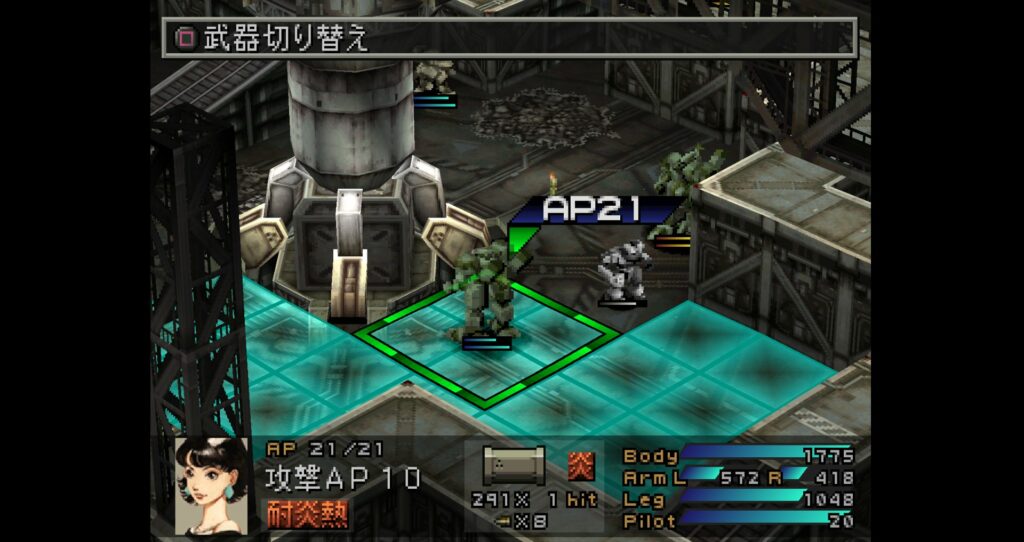
I finished FM3. The setup I mentioned in the first post worked well for the whole game — try to get everyone a missile weapon, and then I usually had one machine gun, two shotguns, and one melee. Two machine guns would have worked fine too. Whether you want to use machine or shotgun depends largely on the defense compatibility of the enemies.

If you want to get a “platinum” ranking on every stage (which is mostly useful just for personal accomplishment), you need to vary the types of weapons you use, but for the most efficient combat it’s better to have people specialize in one type of weapon and only use that.

My views on the luck element did not change. I still think that the FM system has too many things that can happen that can wildly swing the battle, that are based largely on luck. A great example of this was in the final stage.

One thing that can happen as the result of an attack is that the pilot can be ejected from the Wanzer. This can be devastating if it happens to you — at best you have to waste one turn to get back into the mech. But at worst, the enemies can attack your character and kill them. Given that you can only send out 4 people per map, this is a huge swing. But if you do this to the enemy, you can move next to their mech and have your pilot board the enemy mech. The enemy AI has a flaw where they will only try to get back in their own mech, they will never board your mech that you just exited. So the ejected pilot will just run around shooting people with their handgun, which is quite ineffective.

So on the last stage, I was able to (by luck) eject one of the enemy pilots from his mech when the mech was still at near full HP. I moved Lin into that mech and the final boss just kept attacking her. His attack uses so much of his AP that he is unable to defend or counter any of your attacks, so I could just lay waste to him on the enemy turns, and then he would waste another attack against Lin on his turn. Once that enemy mech had been nearly destroyed, I just had Lin get back into her own mech. By that time, the final boss was either defeated or nearly so. If I had not been able to use this technique the final boss would have been significantly harder.

Similar luck swings can happen due to status effects (particularly the one that paralyzes the enemy), or the ones I mentioned last time where you can eliminate their attacking capability.

On the whole the game was quite easy. I never did any simulator battles to grind, and I didn’t pay a whole lot of attention to my mech builds. Despite that, I never got a game over. I always found it hard to compare parts since you are always comparing an upgraded part of yours with a completely un-upgraded new part you’ve encountered. My desire to have a missile weapon on everyone also was a huge constraint on what Body parts I could use since you need a Body part with a high Power to be able to equip a shield, missile, and main weapon.

I never really understood the skill learning. My main character never learned very many skills, whereas Shogo learned a ton. This is just yet another luck-based element in the game that can have a huge effect on how the game progresses.

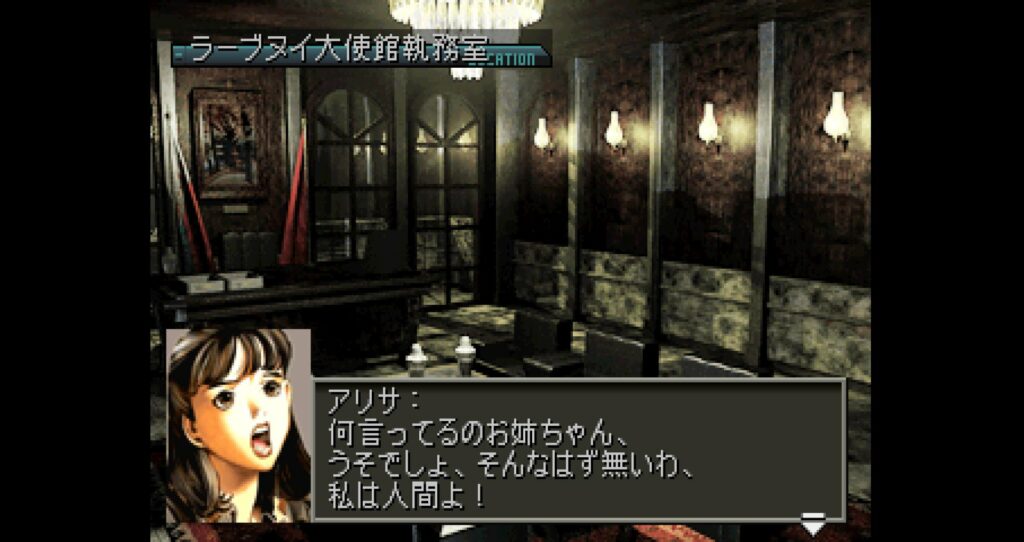
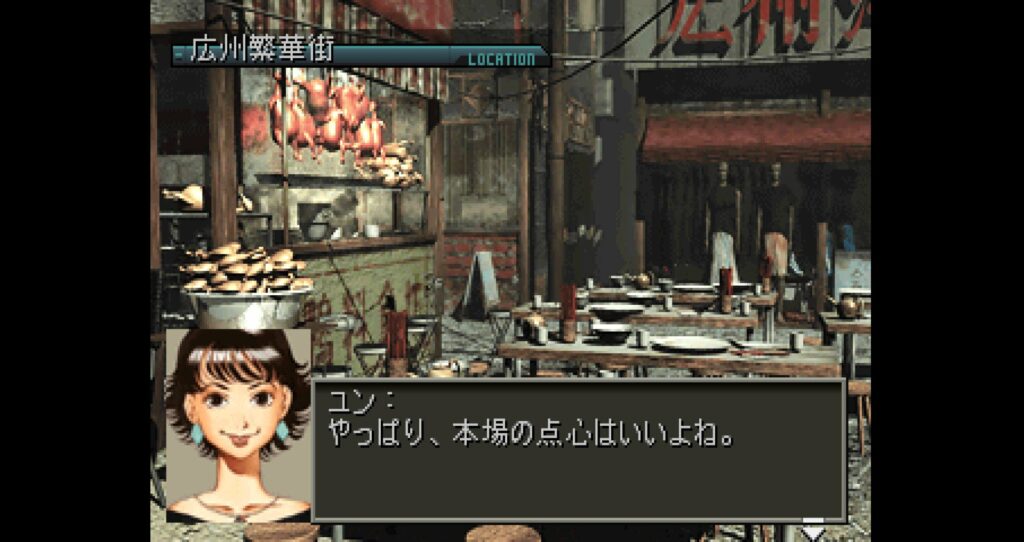
Since the game is available in English I don’t necessarily want to cover the entire storyline — it was decent enough, and the fact that there is an entire second storyline gives the game a lot of depth and replayability. Perhaps my main criticism would be that some of the secondary characters (particularly Linny) don’t have much role in the story and seem to be largely put in there to fill out your party so that you can have 8 units for the multiple places in the game where you have to split into two teams.

But on the whole, I’m still not really sold on Front Mission. I would say this is the best of the three FM games that I’ve played, but the series just doesn’t appeal to me.

SRPG 116 – Front Mission 3 (PSX) Part 1

Front Mission 3 (フロントミッション サード), released 9/2/1999, developed and published by Square

This is the third SRPG entry in the Front Mission series, and the first one to be released in English. I haven’t been a huge fan of this series so far — I finished 1 but found it pretty mediocre, and 2 was just too slow moving for me to put up with the difficulty. I think FM3 is better than either of the first two, although some of the same issues that made me dislike the first two are still here.

The story takes place in the same world and timeline as the first two FMs although it doesn’t seem like they share many characters or direct plot elements. It’s 10 years after FM2, and involves a cold war between the OCU and the Chinese DHZ groups. The OCU is continuing to experience separatist violence with countries wanting to go their own way. There are two separate storylines you can play in the game (after the first tutorial mission). I don’t know different they actually are in story or gameplay. I went with the Emma route.

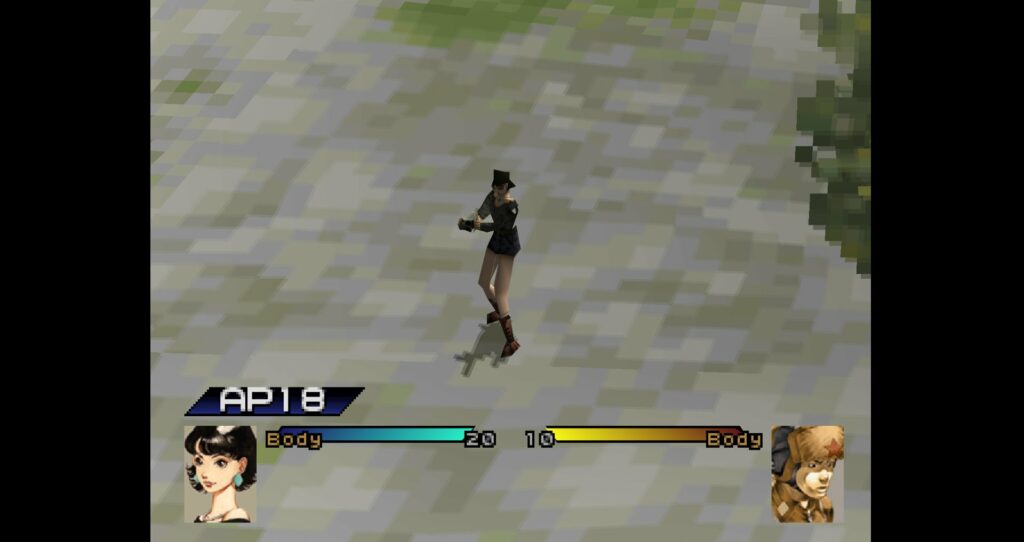
The gameplay is fundamentally the same as the first two games. You still build Wanzers from parts (body, right arm, left arm, leg) and equip them with a variety of weapons, shields, missiles, etc. The game uses the AP system from the second game, albeit in a simplified form. You still use AP to move and attack, and remaining AP can be used for counterattacking (or shield defense) on the enemy turn. They got rid of the “team” system where you recover AP based on how many of your own units (or enemy units) are around you.

One welcome feature (at least for me) is that you can always upgrade your wanzers and train in a simulator between missions, even when it makes no logical sense in the story. This of course makes the game considerably easier than FM2, but I am not a fan of games where you can get softlocked if you don’t build your team in the correct way — especially since there’s often no way to tell whether the game wants you to focus the XP on a core team, or spread the XP around to your whole team.

I still don’t like the random skill learning, which doesn’t seem to have been improved much from previous games.

The levelling system this time works by giving you XP for each type of attack (shotgun, machine gun, missile, etc) and using a letter-based grade system. You also gain a different type of XP from destroying parts or complete mechs, and these levels increase your available AP. In addition to using the AP for moves in battle, you can assign AP before a battle to improve evade, hit rate, and other things. These lower your maximum available AP for each turn.

Another new system is the “surrender” system. If you do enough damage to a unit, they might stop attacking and consider surrender. If you make another attack without killing them, they will surrender and leave their mech (but not the weapons) behind. You can then put your own units in the mech, or sell it. Certain attacks will also force the pilots out of their mechs, and if you kill the pilot it will be the equivalent of a surrender.

The best way to ensure a surrender attempt doesn’t kill the mech is to have one of your own guys exit their mech and shoot at it with a handgun. Although in some cases this isn’t necessary if you are pretty sure that your attack will not kill the Body of the mech.

One thing I haven’t been doing much with is the “forum” system, which is rather complicated at least in appearance. You mostly just get additional lore from this (and maybe some maps for training). You can also send and receive e-mail, which also seems to be mostly backstory and lore.

The Emma route has 70 stages, which means the game has a fair amount of content. I’m about halfway through the game now. After some experimenting, I think my preferred setup is to ensure each person can have a missile launcher, a shield, and then either a gun or a melee weapon. In some ways I feel like the guns are better overall — the melee weapons do a lot more damage but it’s completely random where the damage will go. So you might just be taking off half the Leg HP which is not necessarily very helpful.

I think this is why I’m still not completely sold on the Front Mission gameplay. FM1 was way too easy because the ability to target parts meant that you could just target Body and often kill enemies in one or two hits. But when the part targetting is random, it means that there’s a huge amount of luck involved. If you fire three missiles and get lucky you may eliminate a strong opponent on the first turn, or all the shots might go to 3 different parts which is significantly less useful.

I will say more about the story next week. It starts off with Kazuki and Shogo, test Wanzer pilots for OCU. Kazuki’s sister is a scientist, and when he hears there was an explosion at the base she’s working at, he’s determined to find out if she’s OK. With the help of the mysterious Emma, they make their way into the base and see the aftereffect of a powerful weapon called MIDAS. Because they’ve seen this military secret they are pursued by the military, and the three of them escape Japan to try to locate both MIDAS and Kazuki’s sister. (The other route is the Alicia route, who is Kazuki’s sister, but I think the story still involves MIDAS.)

SFC Game 131 – Card Master Seal of Rimsalia (Arcana)

Card Master: Seal of Rimsalia (カードマスター リムサリアの封印), released 3/27/1992, developed and published by HAL

This is an early Super Famicom RPG that I skipped initially because it was released in English (as “Arcana”). I played this game as a kid; I assume that I rented it from a video store but I know I never finished it. It’s a first person “blobber” dungeon crawler game.

The main feature of this game that sets it apart from others is Rooks’ card and summoning. At the beginning of the game you only have Sylph (air spirit) but as you go on you will get the other three. These elemental spirits are virtually ineffective at attacking but they gain a number of spells as Rooks levels up. They recover 1 HP and MP every step in the dungeon, and once you get more than one, you can freely switch between them (in battle you can do this on Rooks turn as a free action). In the first dungeon, Sylph is not very useful, but once you get a second spirit and start learning more effective attack spells, they become much more important. The spirits recover their HP and MP even if they are not currently summoned, meaning you can switch between them effectively and use their spells even in regular random battles.

A big problem with a lot of these early games is that spellcasters have very limited MP and there is no way (or no cost-effective way) to restore their MP, meaning that the spellcasters are basically just dead weight healing potions, or can only really be used in boss battles. So it’s nice to see games break out of this pattern.

Aside from Rooks and the spirit, you get a number of other allies. But they join and leave as the story progresses, so you never quite know who you are going to have. You also get a game over if any of the human characters reach 0 hp. Defeated spirits can be restored in towns, or later Rooks will get a spell to bring them back.

The battle system is typical AMID, with some element of battle placing — I think the enemies or allies who are in the back row are harder to hit. In addition to the sprites and basic attacks, you can buy “cards” in the town that Rooks can use to do things like flee from battle or use elemental attacks. I never really used these much although I think some of the encounters would have gone more smoothly if I had.

There is fortunately an automap, although it is limited — it can only show you a certain area around your current location, and it does not mark anything except for stairs/exits.

The dungeons themselves are relatively featureless. Basically the only things to find in them are treasure chests and an occasional boss or story sequence.

The game takes place over 5 chapters. Each one has a town you start in, and then a dungeon or series of dungeons. Once you move on to the next chapter you can’t go back (not that there is any reason you would want to). One thing that I never was able to figure out: the Gamefaqs maps seem to imply that in the English version, when you return to town you do not always have to start from the beginning of the chapter’s dungeon. In the Japanese version you do, but I don’t know whether I am misinterpreting the walkthroughs or whether this was an actual change in the English version.

Overall I thought the game was relatively easy. There are some encounters in the later chapters that some with a lot of strong magicians using area attacks, but even there I never got a game over.

The story is serviceable but nothing too out of the ordinary. The goal is to stop an evil demon from being revived by a magician. There are some surprise betrayals and such, but you can pretty much expect a 1992-level story from the game.

So overall this game is decent; it’s a lot more playable than some other SFC games but it’s nothing special. There is a patch someone made (https://www.romhacking.net/hacks/4505/) that apparently improves the game, although I wasn’t able to find a full description of what the changes are.