Monthly Archives: February 2025

Random selections (Medarot)

I am going to continue doing different kinds of games between SRPGs. First up was a random selection from my complete list of games.

The first game that came up was a PSP game called Jikandia, developed by Idea Factory. I was not able to find the Japanese version so I did the English instead.

This is a rather strange game that in the end seems more like a platform action game than an RPG, so I went to the next game.

Next up was Slayers Royal 2. I had initially put these games on my SRPG list but I covered the first game in a short previous post — this lacks the character development that I want from an RPG and is more like a story-based game with some simulation battles. At least in SR2 they got rid of the AI-based gameplay of the first one and just made it a straight command battle system.

I think this is still primarily a game for Slayers fans rather than SRPG fans.

Finally I rolled Medarot 3, so I decided to play the first Medarot game in its Wonderswan remake. This is a long-running series that has been described as “robot pokemon”; some of the games and anime in the franchise were released in the US under the name Medabots, but not the first game.

The similarities to Pokemon are hard to miss. It came out about a year after Pokemon for the Game Boy, in two different versions (Kabuto and Kuwagata, two types of stag beetle). Your main character is a young boy who brings robots out of his phone to fight other people who have their own robots. There is a “collect them all” aspect to the game. Despite the similarities I think it was able to forge its own path; there were 9 main Medarot games (up to 2015), associated media, and the most recent (non-RPG?) game came out just a few weeks ago.

The main character isn’t in to Medarot fighting at the beginning but his dad is. But his dog accidentally steals a medal from the enemy “boroboro group,” and he gets his first Medarot called “Metabee.” The Medals are the core of the medarots; they’re what level up and they also determine the overall strength.

Beyond that you can equip four different parts. They can have various stats; some give you attacks, some are more defensive oriented. You gain the parts in various ways — defeated enemies will give you parts, you can buy them, find them in dungeons, and such.

The save screen shows how many parts (out of 240) you have found so far. I would assume as with Pokemon you have to do link battles with someone that has the other version to get all 240.

The battles are kind of long. You have at most a 3 vs 3 fight, although all you have to do is defeat the leader for the battle to end. You choose an attack and then it happens — each part has its own HP bar and when you destroy a part, the attack associated with that part can no longer be used.

The length of the battles is kind of an issue and it’s the biggest problem I see people talk about with the game.

At first the main character is simply learning how to use his new Medarot. He goes down to a seaside cave where first he has to fight a “shark” (who is actually one of the enemy Boroboro Group bots), and then in the cave you can find a new Medal so that you can create a second Medarot.

This is as far as I played. From what I can tell looking around at reviews, it seems like people think the first game was OK but that the series doesn’t really hit its stride until the second game. I never really was able to get into Pokemon (I didn’t play it when it first came out, and somehow by the time I did play it in my 20s it just felt too simplistic), so I don’t know if would like any game in this series better.

SRPG 108 – Ecsaform (PS1)

Ecsaform (エクサフォーム), released 1/28/1999, developed by Bandai Visual

Ecsaform is our first game up for 1999, and it recently got a fan translation so you can try it yourself. It’s a pretty underwhelming game, though: an interesting world and setting, and a potentially good system. However, a lot of it is undeveloped and it bears the hallmarks of a game that ran out of development time. One aspect that most reviews comment on is the second disc, which is entirely devoted to a huge database of characters, terms, plot elements, etc along with concept art and sketches. While this may seem like a neat addition, the fact that the main game can be completed in 15 hours makes it seem odd that they spent so much time on that accessory disc. Although I have no proof of this, it seems possible to me that the accessory disc resulted from the designers realizing that they were not going to have enough development time to put all the detail they wanted to in the game.

The graphics are only slightly better than Super Famicom level and there is no voicing. There are a few FMVs, which is really the only place that the game really uses the PS1’s power.

The game consists of 53 battles, with no alternate routes or free battles. Between the battles, you often can walk around the areas, but this really serves no purpose. All the dungeons are just one-path routes with nothing to find aside from the next combat and an occasional “lost” merchant who will sell you stuff. You can explore the towns and talk to some people, but they are needlessly large given that there is basically nothing to do other than shop or talk to a small number of people who don’t add much to the game.

The basic stats are typical for RPGs. There are three equip slots. The first is a weapon. You equip the weapon and then (press down on the control pad) assign the “ridou” (spells). Not everyone can use spells, and the number each character can equip varies. The TP are used both for the spells and for weapon skill moves.

The armor allows you to equip items that boost your base stats (from +1 to +5, there are also ones that raise multiple stats). Finally, you can equip 4-5 consumable items for each character.

Character’s turns are determined by “wait points”. On your turn, you can use your AP to do actions. You can use as much of your AP as you want, but excess AP at the end of the turn are coverted to EP (5 AP = full EP, 4 AP = 80% EP, etc). EP act as a kind of shield; with the exception of a few magical attacks, attacks will first deplete a character’s EP and then their HP. Overall I think this was a pretty good system; it was never as simple as “always leave at least 5 AP so you can have full EP”. Often you do have to calculate whether it’s worth doing an extra attack or move at the cost of not having as much of an EP shield for the next round.

One mystery to me is the “wait” command. If you “end turn”, your remaining AP are converted to EP as above. But if you choose “wait”, you don’t get any EP. There must be some purpose to the “wait” command but without the instruction manual I wasn’t able to tell what that might be. Possibly your turn comes sooner?

Susely is the main magic user; I generally had her use the damage dealing spells and give the stat up spells to other people. All spells work on both enemies and allies, so you often have to carefully target them to make sure you’re not damaging your own guys. At some point you get a spell that stops the enemy’s movement and actions — not only that, but it lowers their EP to 0. This is by far the best spell in the game and it even works on all the bosses (including the final boss). In the last third or so of the game this is basically all I had Susely use.

The characters are mostly distinguished by their type of attack, and the number of AP they have. One character uses ranged weapons, another is a big dude with a bigger range attack, and another can control insects (more on that when we get to the plot).

The map design is not especially good. Way too many of the battles are just “here’s another set of grunts to beat”, which is unacceptable in a game that’s already as short as it is. It makes it seem like they realized they were not going to be able to fit as much overall content in the game as they wanted to, and so they just added 2-4 grunt fight battles to each sequence to add some length.

There is height but no facing. One thing you can see from the image above is that there’s a one-square halo around each character that you can’t stop on, and one movement point is 1/2 the size of a character.

The extra disc divides the story in to four “acts” although Act 1-4 doesn’t actually appear in the game itself.

Act 1 begins with Susely, who is the product of some sort of experimentation to make someone who can handle Ridou (the magic) better; she’s survived to 14 years old which makes her exceptional, but the scientist(?) Due no longer has a use for her and she’s set to be disposed of. Meanwhile, Due is trying to activate a “Harm Constructed Being” for the completion of some kind of plan.

With the help of some sort of spy-like figure named Haburo, Susely and the Harm Being (who Susely names Beed) escape the lab and make it to a city called Vorel.

Act 2 finds them in Vorel, where they join a mercenary group along with Palam (the person in the screenshot above). The next portion of the game involves doing various jobs for the local guild — none of them seem to be advancing any kind of overall story, but a number of them have to do with “Insect Masters” who are able to command “insects”, beings who are left over from a previous age and come out of ruins.

Eventually we learn that these Insect Masters actually have an insect as a kind of parasite inside them, which is why they can control the insects — but removing it results in their death. It seems that Insect Masters are being captured for some purpose we don’t know.

Acts 3 and 4 involve the party leaving Vorel and investigating the ruins, where eventually the insect master storyline is connected to Due’s experimentation and his plans, along with the past civilization that caused a great cataclysm. I usually don’t reveal the entire plot when there’s a translated version of the game you can play. Ultimately the story is OK, as I said before, it really seems like they didn’t have the time to flesh out the story in the way they wanted to — it’s not a bad story, but it could have been a lot better.

“It could have been a lot better” I think is probably a good tagline for the game as a whole.

I’m going to try doing a numerical score of the game in a subsequent post later this week.

1998 Wrap-up, other housekeeping stuff

First off, as of Feb 3 it’s been 8 years since I started superfamicomrpgs on blogspot, which is hard to believe. Anyway:

1998 had a lot of games; 1999 has more but from what I can see, the number of SRPGs (especially the ones I will actually be playing) starts to decline. As I said in my 1999 preview post, every game I played for 1998 was either Playstation or Saturn (with the exception of the remake of Black Matrix for the Dreamcast, but that wasn’t actually a 1998 game).

1998 saw the effective end of four SRPG series: Langrisser, Shining Force, Eiketsuden (the Koei series), and Farland (Eiketsuden and Farland both have additional entries on computers that weren’t ported to console).

Choosing a game of the year is difficult. I only gave an A rating to five games (more on the rating system in the next part): Tokyo Majin Gakuen, Epica Stella, Wachenroder, Houshin Engi, and Guardian Recall. I know a lot of people would probably want to see Shining Force III as GotY but I just didn’t enjoy it as much as a lot of other people seemed to.

Usually I try to make my GotY a mix of personal enjoyment, significance/reception, etc, but that’s hard to do here. Looking at those five my immediate reaction is that it should be Tokyo Majin Gakuen or Houshin Engi.

So based on that reaction I went back and read the posts I wrote for both games, and I think I am going to pick Houshin Engi. I liked the ability/skill system and the feature of calling in reinforcements if your initial characters die. There aren’t really any interface issues to speak of and the story is functional. So here’s my GotY list:

  • 1990: Fire Emblem
  • 1991: Langrisser
  • 1992: Just Breed
  • 1993: Super Robot Taisen 3 
  • 1994: Langrisser II
  • 1995: Riglord Saga
  • 1996: Energy Breaker
  • 1997: Final Fantasy Tactics
  • 1998: Houshin Engi

Rating system

When I started the SRPG plays, I didn’t want to try to do a rating system that depended on objectively rating the games. Instead, I just did a simple A-B-C system that was purely based on my feeling after finishing the game. The ratings I have assigned to each game do accurately reflect that feeling*, but I’ve come to think that they don’t really do much to qualify which games are good and which are bad, even by my own opinions.

(*the exception is my decision to automatically give a C rating to a game that I give up playing because I get stuck. I’m not sure this was fair to a few games, especially Langrisser IV.)

A big issue with the rating system has really come to the forefront in the 1997-1998 games. Saturn games have a much harder time getting a B or A than Playstation games because the emulator speedup works much better on Duckstation than it does on Mednafen, meaning that the Saturn games are much more likely to try my patience with slow/sluggish play. The ratings can also be influenced by factors that have nothing to do with the game itself, like illness or anticipation of the next game on the list.

So I think I’m going to give numeric ratings a try, while still doing the letter ratings alongside them. I haven’t fully decided on the rating yet, but I do know that I am only going to factor into the rating things that have a significant impact on my enjoyment of the game (so excluding things like graphics and music). We’ll see how it works.

Games to play

I’m going to go back to switching between SRPGs and other games; I had started to do this but I really wanted to get past 1998 so I really focused heavily on the SRPGs while just doing an occasional quick play of an old Famicom RPG if I needed a break.

SRPG 107 – Brave Saga Finished (PS1)

I did manage to finish the game this week. I’ll write a bit about the game and then do the introductions of the other series.

I decided at some point to stop trying to catch up the low level characters for two reasons — first off, it was making the stages take too long because even the grunt enemies had to be whittled down. Second, you reach the point where you have such a huge set of characters that you have no hope of actually getting all of them to a decent level without doing a bunch of training outside of the stages.

So I started using primarily the main robots of each series and putting most of my money into them. This turned out to work well, for the most part. The game will often require you to use some of the characters you haven’t levelled, but in almost every case they allow you to choose enough of your own preferences that you don’t have to rely on the bad units to succeed.

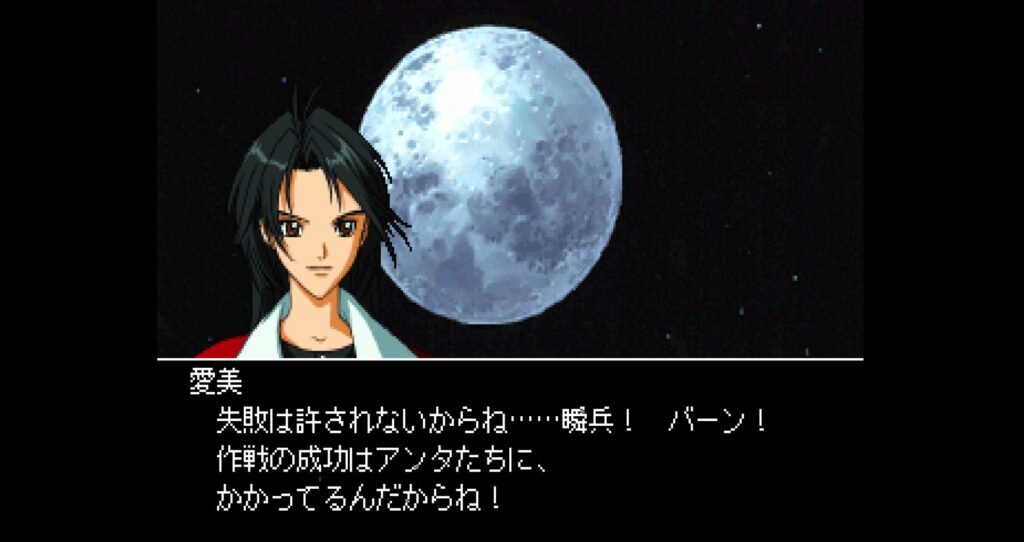
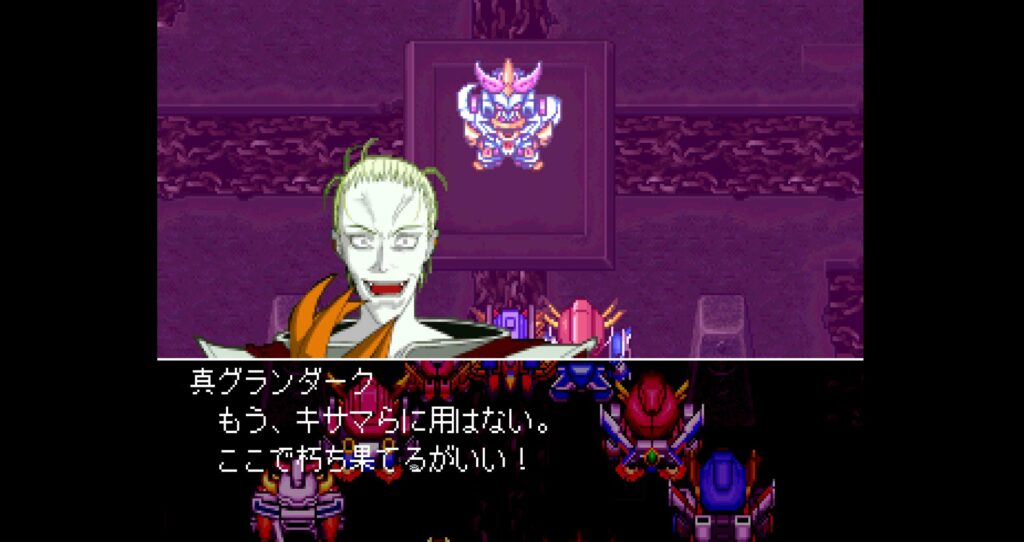
The exception to this is the last two stages, where you go to the moon to confront Granddark. First off, they throw a dirty trick at you in not letting you save between the last two stages. One issue with this game that I didn’t mention before is that you can only save between stages, which means you sometimes have to do fairly long sequences of story and multiple battles without being able to stop playing. This is a problem that most reviews I’ve seen mention, although if you are playing on emulator it’s not so bad.

But after stage 47 you do not get to spend any money; I had some money saved up that I was going to spend on upgrades and items before the last battle but I was unable to use it unless I wanted to do stage 47 again. But this means that you have to fight eight battles over two chapters without any chance to save your game, which to me is an unforgivable error in game design.

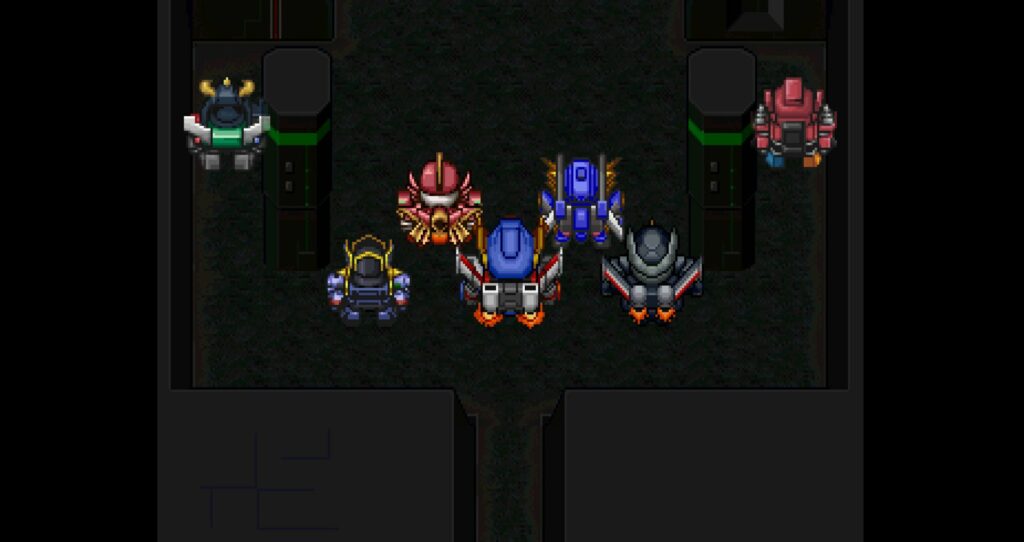
As it turns out the final boss is not that hard so I could have used a lot more of my items earlier in the process (the second to last boss is far more difficult than the actual final boss). In chapter 47 you have to split your team into 4 or 5 different groups to take on different units — this is the only time in the game when it really is helpful to have some of your backburner units levelled. I still managed to win the stages, but in a few of them I had to load states in order to do it.

Ultimately this game isn’t all that good, especially if you are not already a fan of the Brave series anime. The plots are thin and not well developed in the game (a lot of them get ignored in favor of the Baan Gaan storyline, which itself is pretty simplistic). The battles are pretty repetitive and rarely involve anything more than a very basic strategy (nor does the game itself give you the potential to use more than very basic strategy).

There is a Brave Saga 2 that came out in May of 2000 so we’ll see this game again; hopefully they’ve addressed some of the issue in this game (but given the short time between games I somehow doubt it).

The Brave Express Might Gaine

One of those is might gaine

The main character here is a teenage billionaire who fights crime syndicates; a bit different from the other series. I guess because it takes place in a fictional version of Tokyo, this game has Might Gaine be a fictional series within the game. Everyone knows about it from movies and such, but then by some hand-waving stuff they allow Might Gaine to get sucked into the “real” world. This series has shown up in Super Robot Wars as well.

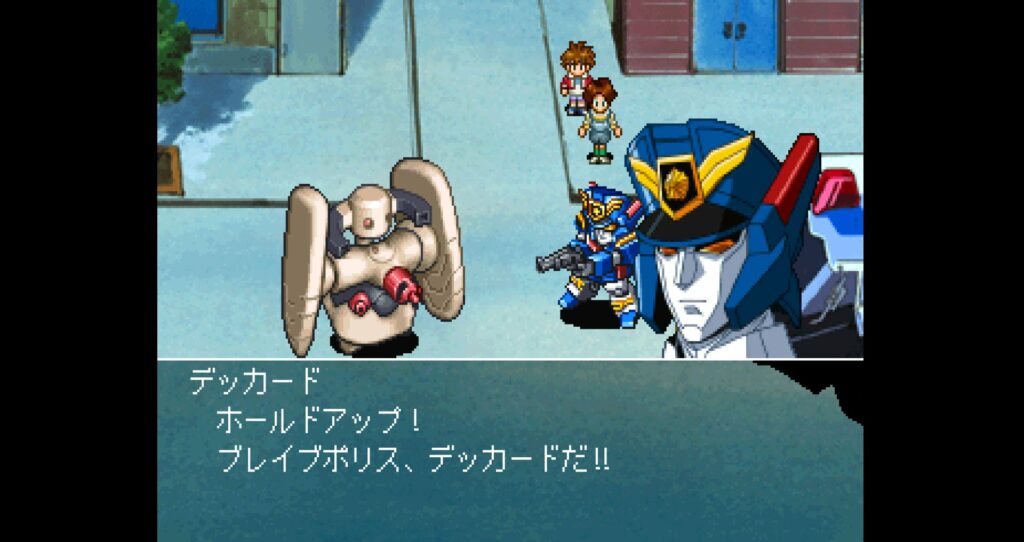
Brave Police J-Decker

This returns to the more kid-friendly ideas of the earlier series, and as the title suggests, is police themed. It has a similar “robot/human friendship” idea that the original series had.

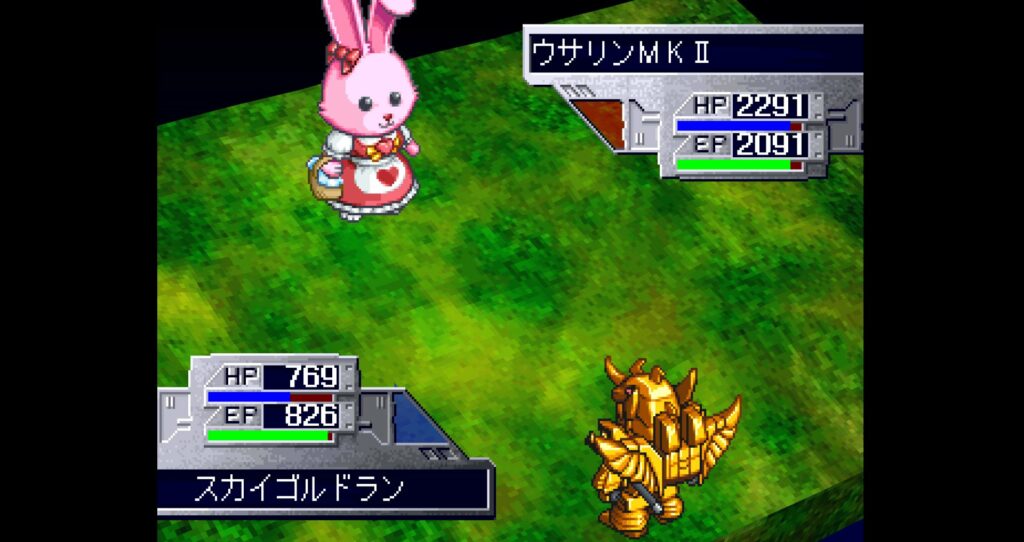
The Brave of Gold Goldran

Apparently this series is a bit sillier than the others. It is similar to Da-garn in that it has 8 power stones that the heroes have to track down.

Brave Command Dagwon

This series pits teenage students against aliens who have escaped from a space prison. According to Wikipedia, the main characters were of the “bishounen” archetype and this series was more popular among girls.