Monthly Archives: January 2025

SRPG 107 – Brave Saga Part 2 (PS1)

This is a pretty long game, and I’m not even sure I will finish it by the next post. It’s 48 stages plus 29 subscenarios. A good number of the main stages have multiple battles per stage. My time counter is at 21 hours and I’m not even quite at the halfway point yet.

I don’t have a whole lot to say about the story. The stages up to now have mostly been geared towards introducing the various series, and the stages themselves are often just little episodes that don’t advance an overall plot. Grandark is still recovering his power so he hasn’t been doing much.
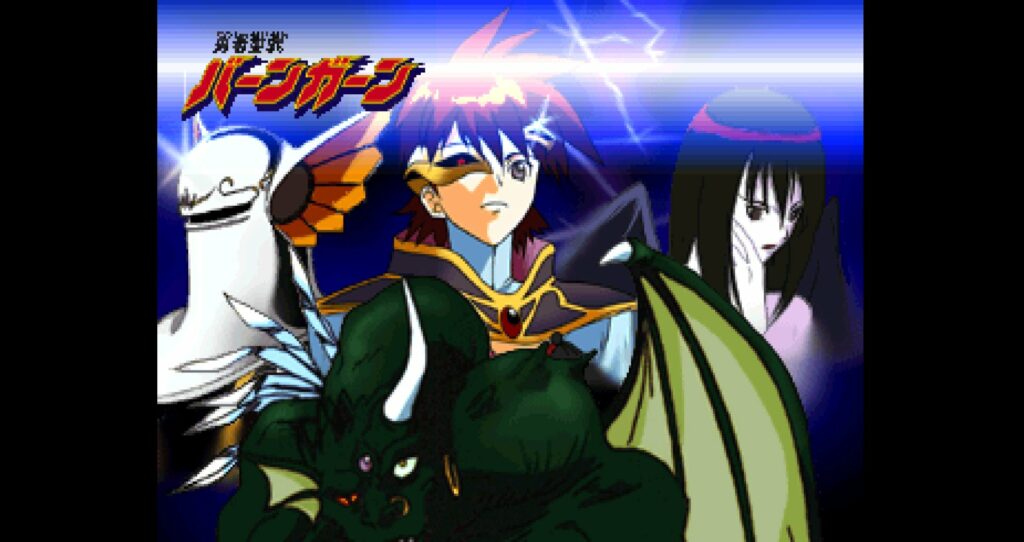
The main plot element that has emerged in the Baan Gaan storyline is about Shunpei’s friend Hiro. In the first stage Shunpei and Hiro were facing off in the finals of the VARS tournament, and when the building collapsed, Shunpei thought Hiro had died. But actually he has reappeared as “Guilty”, an enemy who follows (or is controlled by) Grandark. He’s helping raise the bad emotions of humans to help Grandark recover.

On the gameplay side, I’ve generally been using my lowest level units in each stage because you never know what units they are going to force you to use. One annoyance that many reviews of the game point out is that if one of the mechs has multiple forms, or if they combine into a better mech, the levels do not carry over. Ideally you would then just be able to use the combined forms or the upgraded forms, but some maps force you to use the original mechs instead. I don’t know if this happens often enough that you really need to make sure the weaker mechs are keeping up in levels, but I’ve been doing it anyway.

One thing that does help is that once the weapon upgrade place is accessible, you can fairly cheaply upgrade the weapons of the weaker units and it will often unlock newer weapons they can use.
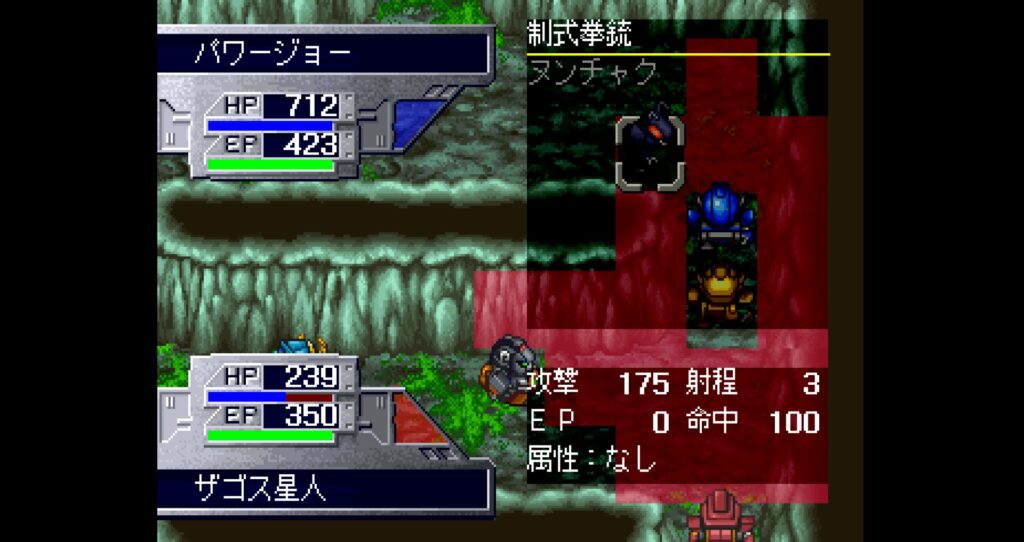
Before I unlocked the weapon upgrades I just spent all my money on items to unlock all the items. After that, I focused on the heal items, particularly the full party heal items. I usually buy a few of those and then spend money on upgrading the weapons of the lower level units I will have to use. I’ve also upgraded Baan Gaan’s weapons since he is present in (almost) every stage.

The battles themselves are pretty much the same thing; each map does not present a unique challenge in the style of Fire Emblem or the like.

I think what I will do with the rest of this post, and next week’s post, is introduce the Brave Series components (partly just so I can learn about them). Apparently the initial idea was that the series would be simpler and more suited for young children than a lot of the mech anime at the time which often had more complex themes and violent content. However, this was not always adhered to, and many of the series had fans beyond the 3-5 year old children that the initial audience was supposed to be. But this explains why the story isn’t really moving overall; the original anime were basically just single episode storylines with not much of an overarching plot arc.

Brave Exkaiser

The story behind this series is that space pirates have come to the Earth seeking treasure, and the Space Police Kaisers put their spirits into inanimate objects to help catch them. The leader, Exkaiser, inhabits the car of an elementary school student’s family (Hoshikawa Kouta) and Kouta becomes friends with the robot as they seek the lost treasures that the space pirates steal. Unless I overlooked something there’s no clear reason why Kouta’s presence is important to Exkaiser, but it may be that the writers didn’t really see a need to explain that given the target audience.

The space pirates are goofy characters that show up a lot in the subscenarios; they often misunderstand the “treasure” they are going after — for instance, they hear that mothers are a treasure and so they start kidnapping moms.

The Brave of Sun Fighbird
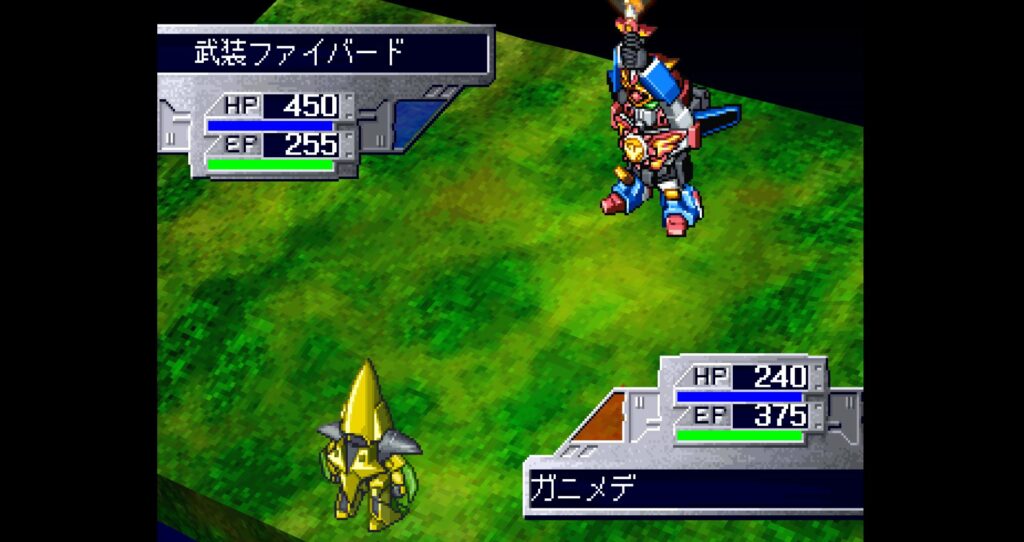
The setup for this series is essentially the same as the previous one, except that this time the invaders ally with a mad scientist and the hero protagonists put their spirits into robots being built by a Japanese scientist to serve as rescue vehicles. There’s the same deal where the grandson of the scientist makes friends with Fighbird (who also has the name Yutaro Katori).

The Brave Fighter of Legend Da-garn
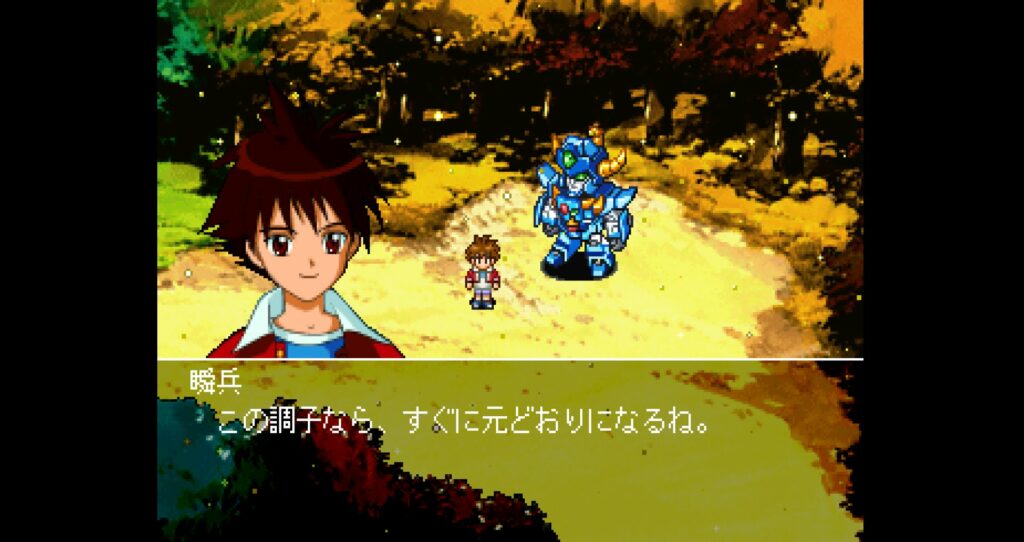
This series was intended to have an ecological theme, which is where the “enemy sapping the energy of the trees” episode from the first post came from. In this series the main character obtains a jewel called Aurin which is the soul of the Earth, and he has to track down the 8 brave robots which are sleeping as 8 Brave Stones. As with the previous series, the adversary is an invader from outer space who is trying to steal the planet’s energy.

In addition to the main Brave series there are three cameo series which are non-Brave mech anime — Votoms, Dagram, and Galion. It seems like the way they are using these is that Shunpei briefly gets put in an alternate world for him to learn something about himself or the reason why he is fighting. So the characters from those series only show up for a couple of stages and don’t join the main cast or have anything to do with the overall plot.

Next week I’ll cover the other Brave series…maybe I’ll actually be done with the game by then?

SRPG 107 – Brave Saga (PSX)

Brave Saga (新世代ロボット戦記ブレイブサーガ), released 12/17/98, developed and released by Takara

This game is basically Super Robot Wars, but with Takara’s “Brave [yuusha] series”. I’m not all that familiar with this series except for GaoGaiGear (which was in a number of Super Robot Taisen games). It’s basically a series of super robot anime that are aimed at kids. This game was made after the first seven series and so involves all of those, plus appearances by a few non-Brave series (including Votoms), and a new series called “The Saint of Braves Baan Gaan. This is basically like the original characters in SRW games, although Takara apparently considers it the eighth Brave series despite never having an actual anime to go with it.

I can’t tell exactly how the series are being treated since I don’t know the backgrounds of any of them. I’m not sure if the series ever had any crossover elements in the anime themselves. They definitely are not starting at the beginning of every anime because most of the non-Baan Gaan robots are already active, but it’s not after those animes conclude either. Unless a commenter can help out I don’t think I’m going to try to figure out much about this.

The game starts with Grandark, who seems to be the Baan Gaan adversaries. These spheres are “Astar”, but they are unable to seal away Grandark by themselves. So they go to Earth to find people with courageous hearts to help.

Each stage has an anime-like “eyecatch”.

The main character is Shunpei, who does some kind of toy robot fighting with these robots called VARS. But when the Grandark minions attack the dome where his tournament is, one of the Astar detects Shunpei’s heroic heart and the VARS turns into a giant robot (Baan) when Shunpei yells “Brave Change!” I don’t think any of the kids actually pilot the mechs, they just watch them from the side?

The battle system isn’t really that much like SRW despite the comparisons. It’s on a speed-turn system rather than player/enemy, and there is facing.

The five options there are:

  • Move (self explanatory)
  • Attack — you have a few different options, with various ranges and whether they cost EP or not. You can restore your EP with items or by using the wait command.
  • Choose counterattack — you can choose defend, dodge, or pick one of your attacks.
  • Wait
  • Item

Unfortunately you can’t skip animations.

Joining Baan are Exkaiser and Fighbird, which are the first two Brave Series anime.

The second stage introduces J-Decker, the police mech.

After the third stage, you get access to the VARS base. Here you can do a number of things.

First, you can talk to people, which can just be random conversations but you might also access subscenarios – right off the bat you can get two of them here. You can create items with CP that you earn in the battles (it seems like creating items will unlock additional more powerful items). You can use points that you get from levelling up to boost Baan’s stats — the game seems to indicate that other people will have this ability as well but so far it’s just Baan. Finally, you can load/save, and go to the next stage.

In Stage 4 the enemies use some weird plant to wither a park, but we defeat them.

That’s all I did this week. The game isn’t particularly hard, and the story is appropriately child-anime like. The graphics and presentation are better than SRW but I feel that it is not as strategically robust, particularly without the “seishin” commands.

Back next week

Just a quick update — I’ve been gone a lot in the past month, I’ve been playing Xenoblade Chronicles on the Switch. I’m maybe 2/3 of the way through but I will start playing Brave Saga tomorrow. I will probably make slow progress on it until I finish XBC but I’ll post progress in the meantime.

XBC is a decent game; I don’t like the level penalties when fighting guys above your level, but the areas look really good and the system is fun. It is also nice to see Tetsuya Takahashi finally make a game that doesn’t seem to have been plagued with development issues.

Digital Devil Story: Megami Tensei (FC)

Digital Devil Story: Megami Tensei (デジタル・デビル物語 女神転生), released 9/11/1987, developed by Atlus, published by Namco

This is of course the first game in the long-running Megami Tensei franchise that still lives on today (primarily through Persona, although they seem to release a new SMT game about every 10 years.) I played this game quite a while ago in the SNES remake (Kyuuyaku Megami Tensei), although when I played it then I used online maps to make things easier. This time I wanted to try making my own maps to see more what the game would have been like if you played it “as intended.”

When this game came out, there weren’t a whole lot of blobber first person exploration RPGs. For consoles there was only Deep Dungeon and DD2, very primitive games that just have one character and a fairly small dungeon. On computers there were the first 4 Wizardry games, Might and Magic 1, Bard’s Tale 1 and 2, and the first 4 Ultima games (which all had some first-person dungeons in them). All of these games share the general design where there isn’t actually that much you have to do to win the game, and there isn’t a great deal to find in the dungeons. The majority of the game is finding your way through the mazes (and making maps since I don’t believe any of those games have an automap), and building the levels of your characters to the necessary point to win the game.

Megami Tensei is also basically like this, but it also has the demon recruiting and fusing game system. MT does pale in comparison to modern games and even to many of the later blobber games that were coming in the late 80s and early 90s. However, I feel that it compares quite well to what was available at the time. By the time you reach the Shin Megami Tensei games I think the series is falling behind games like the Gold Box D&D games, the later Might and Magics, and the DW Bradley Wizardry games, with far too little development from the first game. But here everything feels fresh, and even the interface is not that bad.

As you might expect, the weakest part is the storyline. I don’t know if it was intended to fit in with the novels, but the instruction booklet gives the back story — Nakajima (a reincarnation of Izanagi) made a computer program to summon demons but that caused a bunch of demons to come into the world. With the help of a transfer student Yumiko (Izanami), they defeat Loki and Set, but later Lucifer comes back and creates a huge labyrinth. Nakajima and Yumiko have to go in there and defeat Lucifer.

This is basically the whole story — there’s a bit of plot development during the game but not much. However, for 1987 that’s not unexpected.

As usual you begin by assigning stats. One oddity in this game is that Yumiko’s spell learning is based on Nakajima’s intelligence and level + Yumiko’s intelligence and level. So this makes it even more worthwhile to boost nakajima’s intelligence (which I think helps him recruit monsters). I put most of my points into Strength, Speed, and Intelligence.

One of the themes I’ve been looking at in these early game posts is how “friendly” the beginning of the game is. Here you begin on a floor with no enemies, and you can get introduced to the interface as well as find the shop, healing area, and some hints. The enemies on the first few floors are not very difficult, and if you die you go back to the town with half your gold but everything else kept. I think this ranks on the “friendly” side of 1987 RPGs.

After buying some equipment for the duo, I headed down to the other floors of the Daedalus tower. There are 8 floors — 8F is the town, 7F-2F are 8×8 floors, and the bottom 1F floor is triple size. I made maps as I went, aided by the “mapler” spell.

It was quite nostalgic to be making the maps myself. I had fun doing it, although I don’t know if I could have kept up that interest for the whole game — there are about 30 different floors, many of which are much larger than 8×8.

However, as you can see there’s not much to find on each floor — the first two floors have one treasure chests and some hints.

One thing I did not write down is that some rooms have guaranteed encounters with one recruitable monster. You can use this to get Dryads and other useful allies that you can combine at the Jakyo place in town. This is quite an innovative game element and I think the game deserves a lot of credit for implementing this system in 1987, at a time when most RPGs were not trying to do much beyond the basics.

The recruitment system is basically the same as the next few games — the main difference here is that you can only recruit a demon if there is only a single demon there. In this game you only ever fight one type at a time, but there might be 5 enemies and in that case you will have to kill 4 of them before you try to recruit.

The dialogues here are familiar from Shin Megami Tensei — the monster will often want you to put down your weapons, or will be scared. They may run away, attack, or end up asking for Magnetite or money. Eventually they may join or may not. I’ve never seen any behind-the-scenes information on what actually determines whether this succeeds or not. I imagine it’s a combination of your choices and luck, and I wouldn’t be surprised if at least in the original game there’s no way to know what you should be doing (based on the enemy type, or whatever).

Anyway, I mapped my way through 7F-2F. Along the way I picked up a Cerberus which was a very helpful ally. I was also able to combine two other monsters into a Baku, which can cast a full heal spell that is quite helpful as well. By the time I reached 1F, Nakajima and Yumiko were level 9, and I had all the best buyable equipment from the shop.

There were two chests with money, and a number of people who gave hints. From those, I learned that the elevator would activate when I got a Shizutama (gem), and that there was a Minotaur boss on 1F. Other hints were about gameplay (that you can only recruit certain types of monsters, that there has to be only 1 monster, and that monsters are stronger in certain moon phases).

1F is three times the size of the rest of the dungeon. Here you find the Minotaur, the first boss.

He has 700 hp which is quite high, and I didn’t even come close to beating him. You do need to beat the Minotaur eventually to win the game, but you don’t need to do it right away. You can instead move on to the Valhalla Corridor.

There are stronger monsters to recruit and a shop here with stronger equipment, so it’s possible to do some more training here before you take on the Minotaur for real.

This is where I stopped playing. I said earlier that this is quite an impressive game for the time it came out — I wonder what I would have thought of it, if I had played it as a kid. I started getting into these kind of maze exploration games in the early 90s (I was playing older ones since we had bad computers that couldn’t run newer games). I believe that if I had played this game back then, I would have liked it. In comparison to Deep Dungeon, there is just more of everything, including the whole recruitment and fusion system.

I should be back with a new post this coming weekend although it’s possible I won’t have one until the 18th.