Monthly Archives: March 2026

JRPG 43 – Phantasy Star (SMS)

Phantasy Star (ファンタシースター), released 12/20/1987, developed and published by Sega
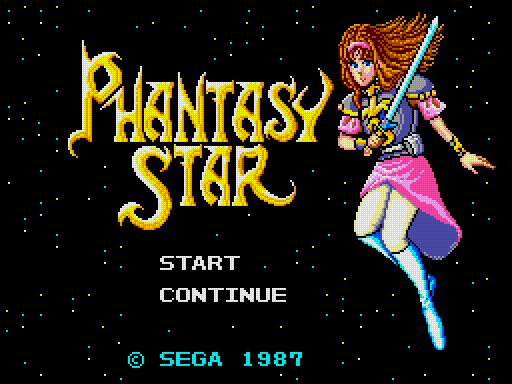
This is the only exclusive Sega Master System RPG. I never played it since I was always a Nintendo rather than Sega person, but I had friends who liked the later games in the series. The game was apparently made to compete with the Famicom’s lineup of RPGs, especially Dragon Quest. The English wikipedia article says there were a number of women on the design team, which might account for the woman protagonist.

CRPGAddict played this, surprisingly, as did Zenic Reverie.
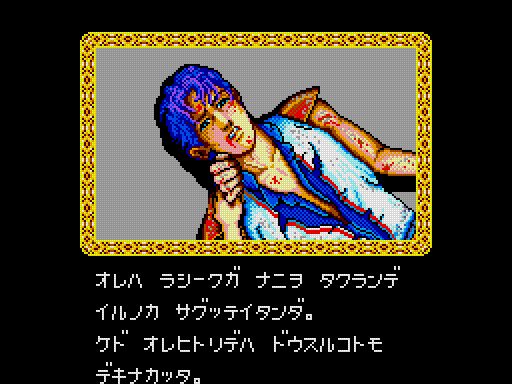
The text is all in katakana, which is rather difficult to read. I stopped talking to the town NPCs because of this. On the whole, the graphics seem to be better than those of the Famicom. The game was advertised as having a 4 megabit cart, fairly large for the time, and it also had music that was enhanced by an expansion chip to the Japanese system (which wasn’t available in the US). The English wikipedia article indicates that a lot of work was put into every part of the game, although ultimately the result was quite expensive. It looks like it was well reviewed both here and in Japan. In the US it came out before Dragon Warrior and Final Fantasy.

(It does seem a bit weird that they put so much effort into the graphics and music but they couldn’t get hiragana in the game’s text)
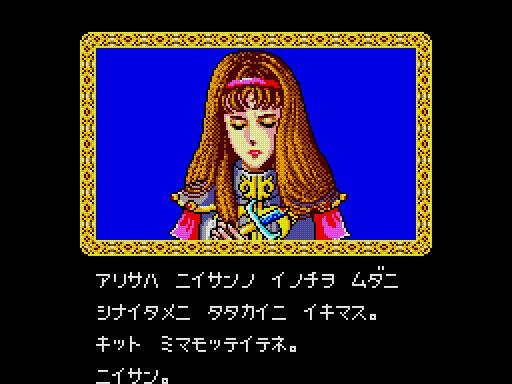
The story involves 15 year old Alisa, who sees her brother Nero killed by the forces of the evil King Lassic. She takes his sword and vows to get revenge. The setting is a mix of fantasy and sci-fi; a fairly early example of this kind of thing. It’s interesting that the game feels no need to justify characters fighting with swords, but also having spaceships. This is a standard “just accept this” feature of almost all these sci-fi/fantasy mix games, but I wonder where it started. The examples I know of from SF literature have a justification for why the mix exists, but games usually don’t bother.

As is expected from a game of this age, there are few plot developments in the game. Several more characters join, but their backstories and characterization is pretty thin. I’m not faulting the game for this since I don’t expect a huge amount of story out of a 1987 game; I’m just taking note.
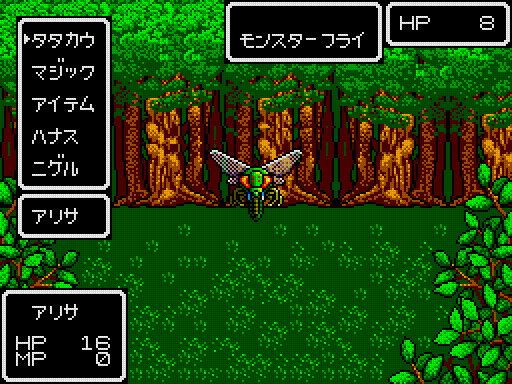
The battle system is your normal basic early RPG system. There is a “talk” command that you can use, although I never actually did this much because it didn’t seem to work often enough to bother. I think the only effect it can have is make the enemies leave you alone.
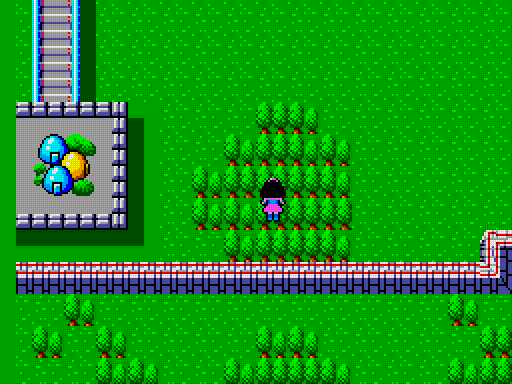
The game starts off pretty difficult. You just have Alisa by herself, and most encounters will result in a game over. You can save anywhere, but if you get a party wipe you have to reload your save. Basically the beginning of the game is dying a lot (if you can’t run from the harder fights) and using the free heal near the beginning until you’ve built a few levels and can buy some better equipment, then you can start venturing out further afield.
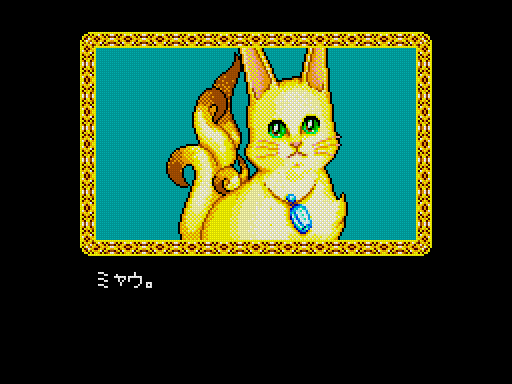
One issue that CRPGAddict ran into is that you sometimes have to talk to people multiple times to get them to do what you want. He didn’t like that, and I don’t much like it either. To progress early in the game you have to try to buy a “secret” item; the first two times the shopkeeper will yell at you that you can’t buy it, but then the third time he lets you buy it. There are several other instances of this in the game, but it’s annoying without some kind of clue. Once you get the passport you can go to another planet and get the cute little cat character Myau, your second unit. We also start learning some spells.
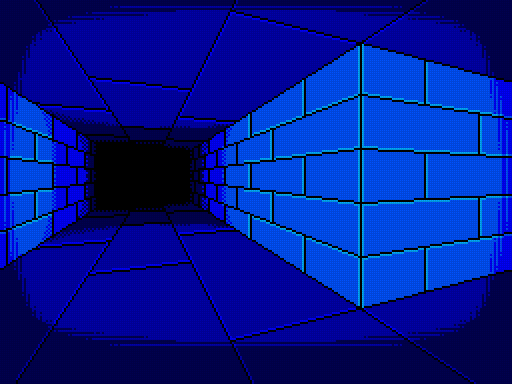
The caves and dungeons are all first person. There is no map and sometimes the way the screen moves is a bit confusing. Most of the chests in the dungeon are also a waste of time — the designer later said he didn’t know how to make an RPG, and you do wonder about some of these early RPGs when a dungeon has 10 chests, 8 of which are basically useless.
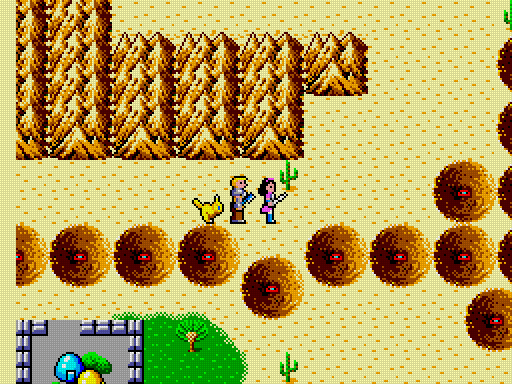
There are three total planets, a desert one, a winter one, and the one you start on.
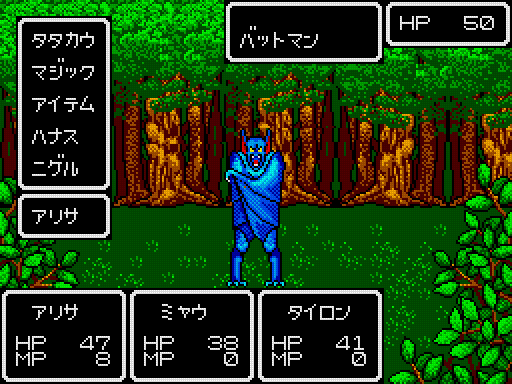
I think I played about half of the game. Compared to the other 1987 RPGs of this type, I think it holds its own. The graphics and music are better, the first-person dungeons are a nice touch, and I don’t think it noticeably more grindy than Final Fantasy or the Dragon Quests. The English wikipedia article has a lot of detail on the background of the game, which is worth reading.

I don’t recall ever seeing or playing this game as a kid. I vaguely remember one friend had a Sega Master System but we didn’t play it much. The later games on the Genesis I do remember; I never had a Genesis so I didn’t play them, but I was aware of the series.

SRPG 125 – Kukuroseatoro – Eternal Eyes (PS)

Kukuroseatoro – Eternal Eyes (ククロセアトロ 〜悠久の瞳〜), released 12/2/1999, Developed by Tamtam, published by Sunsoft

Here is one of the few 1999 SRPGs released in English. The English released dropped the main title (which I think is from ancient Greek) and just called it “Eternal Eyes” (the subtitle). It was not reviewed very well among either Japanese or American players, which isn’t a big surprise — it’s a mid-tier SRPG that is short, easy, and not very well developed in any area of the game. It’s perfectly playable but not really worth it unless you are really committed to playing all the games released in English.

The graphics are OK. The text is readable, they have some nice pictures for some of the story sequences, and they didn’t try the crappy polygon or 3D graphics.

The music and sound weren’t all that memorable. No voicing of the dialogue.

The story involves some kids who are descended from the “kukuroseatoro”, a kind of puppet master who can animate puppets into various kinds of beings and then use them to attack. The story is mostly a string of cliches that we’re all used to now that includes killing all of humanity to save it from endless war and stuff like that. There are some OK moments but on the whole the story develops slowly and you fight a lot of battles between story sequences.

The system is basically two aspects — the puppet system and the battles. For the puppet system, you gain various elemental stones in battles which you can use to create new puppet monsters, or to teach the monsters new spells or upgrade them (4 upgrade ranks total). The upgrade system is quite complex, with a total of over 100 possible monsters. The first upgrade just takes one stone (and a certain level), then the second upgrade takes two more stones of specific types, then three, then four. The problem is that what types you need are dependent on the upgrade path you are following, and there’s no way to tell what the correct stone options are. So you would just have to keep trying a bunch of combinations until you finally come across the right one, and for the fourth level upgrade that means you need to find the exact right combo from 6 stones times 4 choices, which is a lot.

So the opacity of the system is an issue, but also the large number of potential monsters are not that useful because you can only take 2 units into battle and any new puppet starts at level 1. So there is very little motivation to try all the various combinations to find new monsters, especially given how easy the game is. You can break the game wide open by looking at a walkthrough to get the level 4 monsters, which renders the entire game a cakewalk (especially if you aim for the strongest level 4 monsters).

But even if you didn’t do that, a pair of rank 2-3 monsters is enough. You level very quickly, and you can do grinding if you need to. You’ll be in the 90s by the end of the game regardless.

Aside from the monsters you have the main character, who just attacks. Everyone’s equipment can also be upgraded, and items can be bought as well. The MC can use bows and spears too, but I just stuck with the more powerful swords.

The map design is generic; mostly just small repetitive maps dotted with enemies. Each “chapter” is organized around a single dungeon with a bunch of floors; there might be a boss at the end but otherwise it’s just a bunch of generic enemies.

The balance, as I said before, is not great. The game is way too easy. The individual puppets aren’t really that distinct from each other — they use different spells but a lot of them are similar and there’s no real reason to use more than a few of them.

The interface is OK. For the extras, you do have a book that collects all the different puppets you can create. But filling this up would be quite a slog, I think. Even if you used a walkthrough to know what all the combinations are, you would have to do a lot of grinding to get all these level 1 puppets up to the point where you can upgrade them, and then also get the correct stones you need to do it. The whole game took me 8 hours to beat. I have a feeling that filling up the puppet book could take 3-4x that much, or maybe even more.

This game doesn’t deserve the 1/10 ratings it has on GameFAQs but it’s not very good or memorable.

JRPG 42 – Final Fantasy (FC)

Final Fantasy (ファイナルファンタジー), released 12/18/1987, developed and published by Square/

This is a biggie; the first in a long running series that continues to this day. In the Super Famicom era, FF was always head and shoulders above other contemporary RPGs — is this true in the Famicom era as well? I would say so. At this point there were only four of these classic top-down command-based RPGs: Dragon Quest 1 and 2, Glory of Heracles, and Momotaro Densetsu. Final Fantasy does advance on them in several ways, I think.

First off, the name: for a long time, I had always heard that this was called “Final” Fantasy because it was Square’s last attempt at a game before they went bankrupt. However, Sakaguchi Hironobu, the developer, has said in interviews that they wanted something that would shorten to “FF” in order to be memorable, and that “Final” was a word that was familiar to Japanese people. The Japanese wikipedia article doesn’t even mention the bankruptcy story, so that might just be apocrypha that started outside of Japan.

As soon as you start you choose your 4 Light Warrior classes. This is the first JRPG-style game that lets you do this — the designers would have been familiar with it from Wizardry and Ultima, though. The selection forms a big part of FF1’s replayability and ensured a long running popularity. People tried out unusual parties and also proved that the game can be cleared with a single Light Warrior of any class (even un-upgraded).

The visuals are similar to Dragon Quest on the overworld although they found a way to code faster movement for the airship. The battles are different, though:

Unlike the Dragon Quest style where you can only see the enemies, here you can see the players as well and they have little animations for their attacks. The results are still communicated via text boxes, but it’s a bit more visually striking than DQ. The battle system is pretty basic at this stage; unfortunately you have the “ineffective” message if you target someone who gets killed that turn. Magic is done via Wizardry-like spell levels, and all the spells are bought in stores.

The game came out in 1990 in the US (after Dragon Quest III). I have fond memories of the game — I subscribed to Nintendo power so I got this hint guide issue. I’m not sure why I thought I would like the game; I believe that I had played a bit of Dragon Warrior and Ultima: Exodus but for some reason I was obsessed with the game even before I got it. I read the strategy guide over and over again.

The game didn’t disappoint me. I played it through several times although I didn’t always know what I was doing despite the guide. I remember never using Cabins or Tents, and I didn’t understand how useful the heal items (helmet/staff) were. I played through the entire game without realizing you could equip more than one piece of armor. I remember that I had made it to the sea palace before my save game got deleted and so I had to start over. But I did finish the game.

I think this game is clearly ahead of the other top-down command RPGs of the time, but it still shows its age in a lot of ways. The interface has a number of issues: any status effect puts the character at the end of the marching order. There is no way to buy more than 1 item at a time. There are pretty severe equipment inventory restrictions, particularly in a game where you might want to keep multiple weapons around because of their effects.

There are also a surprising number of bugs, including some pretty serious one. Intelligence has no effect. The monk armor ability is glitched, as is the chance to run from battles. Some spells have no effect (or the opposite effect). There is a patch that fixes all or most of these bugs and adds some QoL improvements, which is probably the best way to play this game if you don’t want to play one of the remakes (which bring much more drastic changes to the gameplay).

On the whole if you had to choose an RPG from 1987 to play, Final Fantasy would be a great choice despite all the issues. Here’s Zenic’s playthrough of the whole thing.

SRPG 124 – Vermilion Desert (DC)

Vermilion Desert (バーミリオン・デザート), released 12/2/1999, developed by Riverhill Soft

This is a real-time strategy game with some RPG elements. I didn’t play it very far because it’s one of those games where you mostly just watch the action occur without really participating much. It’s also for me a textbook example of how not to introduce a game system to the player.

The story basically involves a world in a large war, and the main characters are part of an elite mercenary band called Silver Fox. The characters within the organization seem to have their own backgrounds and goals — there’s one woman who is apparently hiding her aristocratic (or elite) past, and the main character (of sorts) has lost his memory but is recognized as the “grim reaper” who survived a number of annihilation of his squads. The youngest character is 24 which is unusual. I didn’t get far enough to see how the story develops, but I saw reviews praising it.

The story is fully voiced and well presented, and from what I’ve read it’s apparently a strong point of the game.

In the first mission, you can’t control anything — you just watch your three squads progress to their predetermined locations. If they encounter enemies they will fight them, but all you can do is use “support” items like healing and some bombs (which are helpful against tanks).

The inset map shows you the whole area. You can switch easily between your three squads, with their information on the right. That arrow will change depending on whether they are fighting, disarming a trap, waiting, etc. The blue bars are the current HP of the members. This part of the interface is fine and makes it relatively easy to see what’s going on and to switch between your squads.

So after you’ve just watched a mission without really interacting, the game now throws the entire system at you at once. Because of the relative lack of control during the missions, the main thing you do in the game is set up your squads before the mission and set their movement.

You can set your characters into as many as five squads. Each character has several pieces of equipment, and they can take on one of six jobs that weight their performance towards a certain aspect (like disarming traps, or shooting, or melee fighting). You can also do training, where you pay some money and choose one of your characters as the instructor, and then a type of training, and this raises your stats (in a way that is not particularly clear to me).

The problem with this is that it’s way too much — maybe it’s just my personal preference for this kind of game, but I don’t like going from a tutorial(?) mission where you can’t control anything, to suddenly having to put 10 characters in squads and manage all their equipment and training. It doesn’t help that the interface is confusing; it’s amazing that as late as 1999 a game has a shop interface where you can’t see how the stats of the equipment compares to what your characters have equipped, and with 10 characters to outfit it’s especially annoying.

The instruction manual doesn’t provide much help, especially with the opaque training. One site I saw said that it makes it much easier if you do training “until you are sick of it” (it takes an annoying amount of time to watch useless animations to do the training). But neither the game nor the manual give very much information about how you should choose your trainer, or what the various training options do.

As I said this may just be my own preferences, but faced with this situation I just don’t want to play the game. But I did decide to do some random training, assign more or less random jobs to people, and then try the second mission to see how it went. The main thing I did was buy 99 healing items and give max healing items to each person.

Before the mission, you set your squads up and then decide how they will move (by selecting those points). For each point-to-point movement, you can decide whether they will go full speed, scout (for enemies), ready an attack, or search (for items). You can hit Y to bring up information about where the traps and enemies supposedly are on the map, although there cane be unforeseen complications.

You can change the orders during the mission, so you’re not set in what you do.

After that you just watch them move and fight. Once again you can change the orders or use “support” items but that’s it.

This is also a huge mission; there’s a large overworld area and then a 4 floor building. The tanks are especially annoying but I guess you should probably use support bombs to deal with them.

I quit during this second mission. I can’t tell whether this is a bad game or just a game in a genre/style I don’t like. But I really had no desire to play through the whole game when most of the game is just watching your guys move and fight without any input from you.

I was a little surprised to see most of the reviews I found on the game positive (although maybe for a game as obscure(?) as this those are the only people motivated to write the reviews). I thought more people might complain about the fact that you mostly just watch things happen, but maybe people thought the limited orders and setup you can do is enough to be fun.