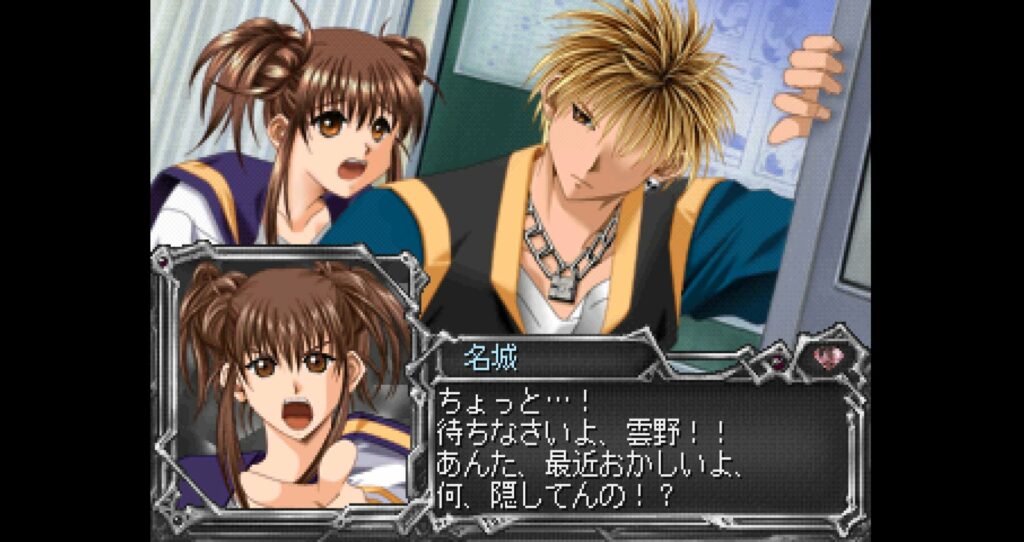
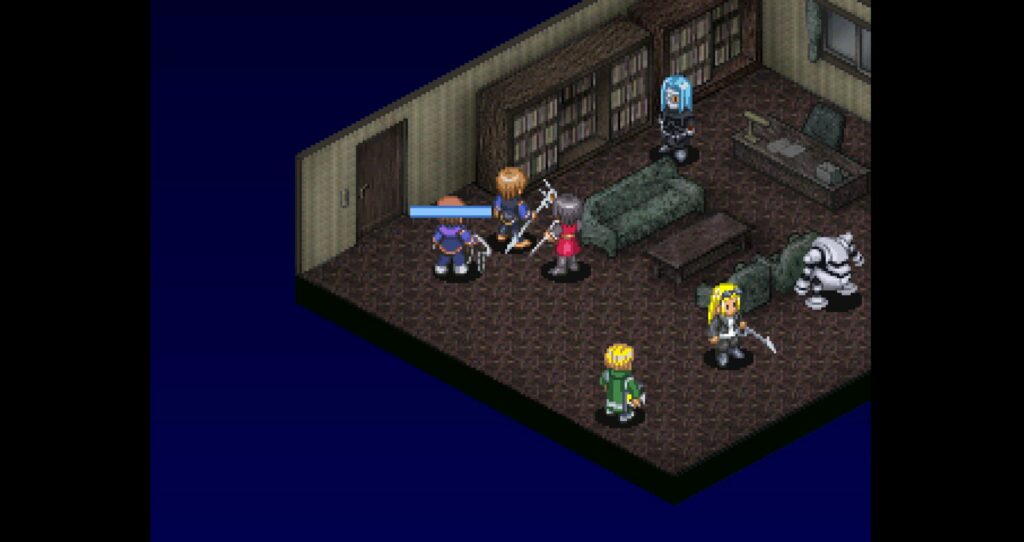
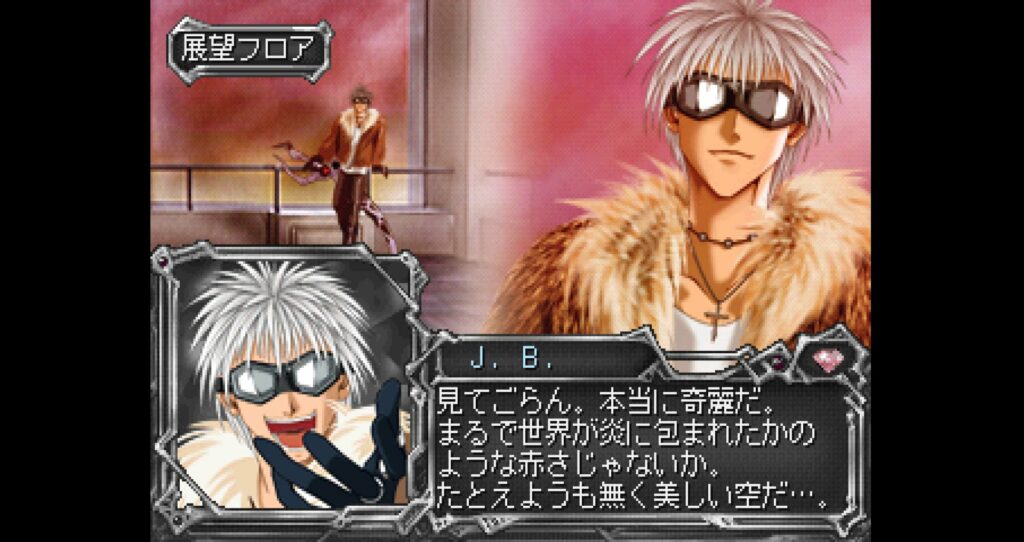
This is a game I added to my SRPG list because I thought it might be the same kind of “Simulation”RPG style game as the Atelier series. While the game is clearly following off the success of Atelier Marie, it’s much more of a regular RPG in an unusual style, rather than a simulation with RPG elements. Ultimately the game is pretty smooth and easy, but also has a lot of wasted potential — there was a sequel for WS or GBC planned but it was cancelled.
The game begins with a story opening — Noir and her friend Destin live in the rural village of Shamul. They are exploring one day when they accidentally unseal the Dark Lord, who turns Destin to stone but for some reason leaves Noir alive. She is visited by the goddess Nil, who grants Noir magical powers. Noir decides to go on a journey to find out how to save Destin.
The game has a calendar system, although the only things that take time are travelling and resting the night. At the beginning there is no clear purpose to the system, but eventually Noir learns that if she does not save Destin within 3 years, he will be permanently lost.
At first there’s not much to do except travel around and accept jobs from the inns.
The jobs are mostly of three types: beating a monster in the area, escorting someone to another town, or delivering a package to another town. The jobs all have time limits. As you travel around to the different towns, you will start seeing event scenes with various characters — Bernal the adventurer, Duran the priest, and other people.
You also fight monsters.
The system is pretty standard, each character has the yellow bar that fills up according to their speed, and when it’s their turn they act. You have attacks and spells, as well as defend. The big feature of the system is that almost any monster can be captured by Noir and then it will be in your party.
6 is the maximum party size. You can hold up to 64 monsters. They level up and learn spells, and after some events you will unlock a place that you can upgrade the monsters with items or teach them spells. You can also buy spells for Noir. There’s no equipment for anyone.
Fairly quickly you will learn the main goal of the game — find the seven sealed magics left behind by the goddess Nil, which you can then use to defeat the Dark Lord. Each of the magic is in a dungeon, most of which you have to find through events.
The dungeons are as above; you explore them, fighting both random monsters and set monsters. The set monsters, as well as the treasure chests, go away permanently once you deal with them, so you can make several trips into the dungeons. One annoyance is the inventory limit; you can only hold 64 items, and there are a lot of items of unclear purpose and no way to store them.
Once Noir recovers the 7 magics, it’s time to go to the final dungeon and defeat the Dark Lord. I might have been somewhat underlevelled but I managed to defeat him with my last MP as everyone but Noir and one monster were dead.
There are eight endings to the game. Two of them depend on you completing the game in 3 years — this is quite easy, I wasn’t using a walkthrough and I finished the game in less than a year and a half. If you do this, Noir is able to save Destin, and you can either choose to immediately get married and end the game. At this point Noir and Destin go off adventuring together.
If you choose not to do this, you can play the game for another 3 years and then there will be a separate ending. I’m getting the remainder of this from a walkthrough site:
The second set of endings happens if you defeat the dark lord after 3 years but before 6 years. In this case, if you have the “jewel of revival” (which I had), Destin is revived but catatonic. If you don’t have it, Noir decides to give up her life in exchange for Destin’s.
The third set of endings happens if you still haven’t defeated the Dark Lord in 6 years. If you don’t have the 7 goddess magics, the game ends and you lose. Otherwise, the goddess will immediately transport you to the Dark Lord to fight him, and in this case he will have a second form (Dark Dragon). If you lose to the Dark Lord (first form), the game ends and you lose.
If you lose to the Dark Dragon, Noir has to give up her life to seal the Dark Lord, or if she hesitates, one of her companions (with a high friendship rating?) will appear and sacrifice their life. If you defeat the Dark Dragon, he self-destructs, killing Destin. Noir is so upset she goes on a journey.
My overall reaction to the game:
As usual for Gust games, the art, music, and general presentation is great. I like the monster recruitment system. Exploring the dungeons is fun, and the battle system is fast and streamlined while still offering the possibility for more than just mashing attack.
My main criticism is how empty the game feels overall. It’s almost like a skeleton of a game that never got fully implemented. Completing the game in 3 years requires virtually no planning, making the calendar system kind of pointless — I know some people don’t like a calendar at all, but if it’s going to exist, it should have an effect on the game. I would rather see a game where on your initial playthrough you will probably get one of the 3-6 year endings, and then you can replay to be more efficient to get the best ending.
There are a lot of places to go and events with various side characters, but they don’t have much of a purpose. The characters don’t join you, give you useful items, open up additional endings, or anything like that. There’s no “extra” menu like the Atelier games have where you can view all the pictures you’ve seen during the game. There are whole locations (like the interior of the king’s palace) that seem to have no purpose.
So this isn’t a bad game, but it’s not a particularly good game either.
I’ve been clear since the beginning that my goal is not to play every game that has been labelled an SRPG; I want to focus on the subset of SRPGs that are the kind I like to play. This is why I came up with the three criteria (individual characters, separate maps, developing story). However, I still come across games that technically qualify, but don’t feel like the kind of SRPG I want to play. The most common way I see this are games that have almost no development of the individual characters, or there are only a tiny number of individual characters and then mostly grunts aside from that.
My usual process when I encounter one of these “technically qualifies” games is that I first try to play it a bit to see what I think. If I think it seems more “strategy” than “strategy RPG” to me, and I’m not all that enthusiastic, I next google for Japanese reviews and explanations. Things that will encourage me to skip the game are long playing time and bad reviews.
With that in mind, here are three games that are on my list but that I’m (for now at least) not going to make devoted posts about.
Tokyo Majin Gakuen Oboro Kitan
This is a different case than what I was talking about before. It’s essentially a “fan disc” bonus for Tokyo Majin Gakuen, a visual novel-SRPG hybrid that I played before. The disc has a number of minigames, music collection, etc. There are also six “gaiden” stories. One of these is a prologue to the main game where you see the main character in his previous school before he transfers to the school he’s in for the main game. You can then load that save directly into the start of TMG.
The rest of the gaiden chapters are side stories featuring the side characters from the original game. However, you need a save from TMG to see them, and more than that, the save file has to have fulfilled certain requirements (which aren’t listed anywhere). I was only able to play 2 of the 6 gaiden chapters. The battles in these chapters are essentially just for show since you can’t carry over anything or develop the characters.
I should have played this immediately after TMG rather than waiting, although I was never able to find a list of requirements to play the gaiden chapters anywhere.
Last Stand
The other two games are for the Wonderswan. This was a handheld released by Bandai that was never brought out in the west and I think is relatively unknown.
Like the Game Boy it was black and white (although a color version came out later). The main selling points of the system were (1) you could play games in portrait or landscape mode (with an extra control pad to help), and (2) the battery life was far better than the Game Boy. It got a decent level of third party support for it, but it failed to get a real market share and was discontinued in 2003.
Of course in 2025 you have the same general problem with Wonderswan games as with Game Boy games — the main selling point of both systems was that you could play them on the go, and so people overlooked the fact that they were in black and white and had generally smaller, simpler games. But that is no longer relevant now, where you can play a PS1 game on the go as easily as you can a Wonderswan game. That’s not to say that there aren’t any games worth playing on the platforms, but I think the games have not aged as well as the main systems.
Anyway, the first game on my list for this system is Last Stand. It’s basically an Ogre Battle like game.
The main difference here is that in Ogre Battle, each unit had a specific attack pattern depending on where they were placed in the formation. So even though you could not control your units in the battles, you knew what attacks they would use. In Last Battle, the battles are completely AI and all you can do is watch, you can’t even set overall AI commands.
The characters have names but no real stories (other than the main character). They can rank up in classes, but they also get older and eventually you will have to switch them out for other characters if they get too old. There’s no way to see what the actual stats of your units is, which is weird.
The only full review I saw was by someone who overall enjoyed it, but they did criticize the AI battle and the lack of information.
SD Gundam Emotional Jam
This game covers the First Gundam through Char’s Counterattack storyline, although there are some units from the alternate universe series. This game is close in feel to the G Generation games — like those games you mostly hire grunt units to fight for you. The main difference that does make this count as SRPG under my rules is that the named characters from the various series are on your team and (apparently) stay with you. However, it still feels much more like a strategy game because of how much of your force is grunts.
The main distinguishing factor of this game is that on each map, you engage in battle by having the battleships encounter each other. Then, it switches to a separate map where you have the units from the battleship fight each other. You can have up to 5 units fight together as one.
This is a game that I probably could have played, I think what pushed me to skip it is that in reading reviews, the main complaint people had about it was how long the game was and how slowly it played. The way the maps and combat are structured make it so that each map can take 2-3 hours, and while emulator speedup would help with that some, I just don’t want to spend that long on this game. I think this is only the second time (after Dark Wizard) that I’ve skipped a game that I probably should have played, but I suppose I’m allowed to have a few free skips.
(Incidentally, there seems to be no clear reason for the “Emotional Jam” subtitle.)
Super Robot Taisen Compact
As usual, for the SRT games I will copy my old message board entries (I played this in 2007). You can probably skip this; I can’t even find any screenshots I took of the game — I think this is because I actually played it on a real wonderswan rather than in an emulator.
Thirteen days after FF’s release for PSX, the first game for Bandai’s WonderSwan system appeared. Banpresto has always been pretty kind to portable systems. Rather than just releasing a lot of remakes or crippled versions of their main games, Banpresto tends to use the portable systems to the full extent of their power, often releasing games that are just as good as the console versions — minus the speech and graphics, of course.
The series list is fairly large given the game’s short length — you get the usual set of UC Gundams, W Endless Waltz, L-Gaim, and Dunbine for the Reals. The Supers are Dancougar, Getter Robo, Mazinger, Raideen, and Daimos. Two notable things about the series list. First, there are no new series (the only game in the franchise for which this is true) — although, Endless Waltz was really just a cameo in FF; this is the first time the story actually appears. Second, there are no original characters at all (also the only game in the franchise). The final boss is Daitarn 3’s Don Zauser, who joins the ranks of Scirocco and Shapiro as non-original final bosses of SRW.
The system is more or less FF’s. A new feature is the stage select, which shows up again in the other Compact games and MX. You also get new skills based on how quickly you finish a stage. This is the first game since the NES 2 not to have any route splits or optional stages.
Although the graphics are fairly minimal, they’re a major upgrade over 2G, the previous portable game. It’s kind of sad that if you ignore the lack of color and the smaller resolution, the battle animations are basically the same as the Playstation F. 1999 saw the release of graphically stunning games like FF8 and Valkyrie Profile, so F/FF was really behind the times by a lot.
One note of interest on the graphics — this is the first game in the series to have the conversations take place in front of backgrounds showing rooms or outside areas, not just a world map.
I’ll keep track of how many turns it takes me to beat the stages; 6 turns is the cutoff for the best skill (Concentrate). Even though you can’t skip the animations, they load immediately, and I can watch TV while I play so it’s not as tedious as F/FF and Shin were.
SCENE 1
Stage 1 – Aura Road (6 turns)
The opening narration sets up the factions — looks like at the start it’s Zeon, Barm, Meganoids, and Muge — although Muge was defeated already. The game seems to have no overriding enemy force like the Divine Crusaders or Balmar Empire in the previous games.
The first section is the first time in SRW history that you actually go to Byston Well. For some reason there are Zeon troops there too and they immediately take up with the bad guys for no discernable reason (shades of EX).
They finally figured out that if they give you Chris and Bernie right at the start of the game, they’re actually usable for a little while. Char is the toughest enemy in this stage; basically only Amuro can deal with him.
Stage 2 – Assault (6 turns)
Almost the same set of enemies as in the first stage; not much to say here.
Stage 3 – Storm Sphere (6 turns)
Kouji and some Mazinger enemies are in this stage; I just barely got in the 6 turn limit but it worked out all right in the end.
Stage 4 – Rescuing Rimru (8 turns)
I couldn’t do this one in 6 turns. I think it might be possible if you ignore Todd and send Shou up to defeat Drake and the other Aura Battlers, but even then you would cut it awfully close.
SCENE 2 (5, 8, 6, 7, 9, 10)
Stage 5 – Sign of Zeta (6 turns)
I wasn’t sure I could do this one in 6 turns, but it worked out in the end. The hit rate of the monsters is poor so you can go all out with your guys. One thing that you have to do in this, Compact 2, and Impact to finish stages in low turn counts is to really use the full power of all your guys — for instance, Christina’s Hot Blood might be able to take down a grunt.
Burning (from 0083) seems to make his first appearance in this game, in a Re-GZ. Kou actually doesn’t suck too bad.
Stage 6 – Scramble Dash (7 turns)
This one is definitely possible in 6 turns; the reinforcements come out at the opposite end of the map from where the initial enemies are, but if you allocate your forces correctly you can do it — you need to have a unit that can counterattack the Drones, though. I only had one enemy left on the 7th turn. Great Mazinger joins in this stage.
Stage 7 – Love on the Battlefield (8 turns)
(At this point my save got wiped so I had to replay up to this point on emulator)
The story in this game is sub-minimal; even SRW 3 had a more developed story than this. The Titans attack here, but the Titans have never been mentioned in the dialogue before this (that I remember) and there’s no real introduction here. Kamille acts like he knows Four but there’s no indication of why or how. It’s sort of SRW 2-level writing.
Daimos also shows up in this stage; the plane is actually pretty good in this game — the missiles are stronger than Breast Fire!
I’m not sure this would be possible in 6 turns. The O doesn’t move from its starting position, so you would have to get up there pretty quickly with some units that could destroy it — there are a lot of high HP units in this stage, though.
Stage 8 – Overflowing Holy Power (6 turns)
Raideen appears. As Daitullan said, Bluegar is good — the reason Bluegar and the Daimos plane are so good is that they have 5 block upgrades on their status and weapons.
This stage is quite easy to clear in 6 (or even 5) turns if you just charge your guys ahead; just make sure to take a few flying units out into the sea to defeat Sharkin.
Stage 9 – Big Shock (8 turns)
Getter appears, with Getter Q and Texas Mack. This game has a lot of the side characters; too bad they get no story whatsoever.
The reinforcements showed up on turn 6 for me, so I’m not sure 6 turns is possible. Also, many of the starting enemies do not move at all.
I got a V-Up Unit; these give more stats based on how many upgrade slots a unit has; it helps weak units a lot. I gave it to the Alex NT1 and threw Amuro in there.
Stage 10 – Cruel Fairy Tale (7 turns)
This one is definitely possible in six.
Dancougar joins here. Afterwards, Quattro joins the team for no clear reason (he’s just suddenly in the Federation), and Lalah comes with him. Then Gihren and Kycilia are assassinated by someone and suddenly Neo Zeon forms, so now we’re rocketing off to space to fight them and the Khushrenada girl’s army from Endless Waltz.
SCENE 3
Stage 11 – By the Blue Shining Flame (7 turns)
I was one action away from a 6 turn clear; I had already restarted the map because I forgot about convincing Gato with Kou, and I didn’t feel like doing it again. GP-02A is hard as usual, and you have no Exhausts to remove his MAP attack when he hits 120 morale.
Stage 12 – Preventers (8 turns)
Is this possible in six while still convincing both Trowa and Quatre? I couldn’t reach Trowa until turn 7.
Here’s the introduction of the Endless Waltz storyline into SRW…I guess. It’s kind of generous to apply the term “storyline” to anything in this game, though.
Stage 13 – A New Strength (9 turns)
I don’t think this one is possible in 6. Even moving my units towards the enemies at top speed (with Speed seishin), I didn’t even reach them until turn 6.
ZZ Gundam appears; hopefully it’s as good as it usually is in the early games.
Stage 14 – Dreamers (8 turns)
Here comes L-Gaim, with basically no explanation and hardly any dialogue. L-Gaim is really good since you can stick a V-Up in it.
SCENE 4
Stage 15 – Endless Waltz (8 turns)
The end of the Endless Waltz “storyline”.
Stage 16 – Demon’s Fight (10 turns)
Might as well take your time, since you get God Voice on turn 10 for Raideen.
Sharkin reappears here…and then it’s the end of the Raideen “plot”.
Stage 17 – My Brother is an Enemy of the Earth (4 turns)
An easy stage to do quickly, especially if you make all your units flying.
I have two V-Ups on Alex NT1 now and Amuro has double move; that mech is a beast. Nu Gundam what?
Stage 18 – When Crossing Sea and Land (5 turns)
With Super NT1, it’s getting easier and easier (I went ahead and gave it 3 V-Ups just to be completely insane). This is the last Dunbine stage.
Stage 19 – With the Sun’s Radiance (5 turns)
This one’s easy because if you defeat the enemies before the reinforcements come, the stage ends.
Daitarn 3 shows up here; both this game and C2 allow you to put Reika, Beauty, Toppo, or Garrison as the Daitarn pilot — they took that out of Impact and it doesn’t show up in many games.
I’ve pretty much given up on this game; I’m just cheesing every stage with NT-1 now to see how things turn out; I’ll post my thoughts when I’m done but I’m not going to do any more stage-by-stage comments. This game is definitely one of the worst SRWs I have played.
Ending thoughts: Overall, I think this game is poor. By far the worst part is the storyline. It has no original characters, and they try to throw way too many series into a game of such a short length. Each series only gets 2-3 stages, which rushes the plots to near incoherency — particularly when combined with the really small amount of dialogue. There are all kinds of things that happen abruptly, with no explanation — Shin Getter suddenly appearing between missions, Small Barm going to Muge Space for no reason, the Titans suddenly showing up with no explanation, etc.
The gameplay is hampered by a lot of problematic interface issues. I mentioned before how you can’t see movement rate on the city maps. When you view the mini map, it automatically exits to your ship instead of the last unit you were on. You can’t easily switch between the seishin of multiple pilots in mechs like Getter and Dancougar.
On the good side, the game has a lot of units, and in particular a lot of unusual units that often don’t show up in other games (i.e. Flat, Richter, Tekkou Ki, Beauty and Reika). The rewards for low turn count means that you can try to be more strategic than in other games, rather than just waiting for the enemies.
But in the end, the game just felt boring and unfulfilling.
Kalin no Tsurugi (カリーンの剣), released 10/2/1987, developed by Crystalsoft, published by DOG
This is another Famicom Disk System game; the peripheral was already starting to show signs of trouble, and there aren’t many disk games left. When you start up the game it seems like a ripoff of a famous RPG:
But it actually doesn’t resemble Dragon Quest much at all. Instead of turn-based random battles, you see enemies on the map, and when you encounter them, it goes into a separate action-battle screen where you run into the enemies to cause damage (like Ys).
The battles are quite fast moving and dangerous — one issue is that you can’t run from battles, and you never know whether the battle will be with 1 enemy who starts across the map, or 8 enemies that start already surrounding you, which frequently results in a game over, because whenever you are hit you can’t move for a short time, making it very easy to get locked in and killed. This is a game that you will get constant game overs in, unless you spend a lot of time grinding easy monsters. But you can quicksave any time on the world map so even if you die you can immediately come back.
The grinding is also a bit frustrating because the way the XP is calculated is weird — there’s a base XP for each enemy, and 10% is added for each additional monster (so if 1 monster gives 100 XP, beating 5 of those monsters in a battle will be 140 xp).
In addition to the basic attacking, you can use your MP to cast various spells by equipping certain items. You start with a fire rod that can shoot a fireball, which is useful. Later items heal you, damage all monsters, or have other such effects. You can change your equipped item during the battle although it’s a bit cumbersome.
You start with some basic equipment near the starting castle. You can get some hints from there and some basic information, but there’s no one to heal you. In this game there are only three ways to heal yourself:
Healers in some towns that charge 10 gold x level, which is a steep price
Potions, which cost 30 gold and you can only hold 5, and also which don’t heal that much
The White Idol, which can cast a heal spell. Since your MP naturally regenerate (even in towns), this is the best method of healing. Fortunately you get it pretty early in the game, but until you do, you die a lot more and have to spend a lot of money on healing.
It’s typical of these early games that they fall short because of these decisions that make the early game difficult to play — this is not the worst example of such a game, but you could save in a position where you have almost no HP and no money, making it difficult to proceed.
This is one of those early games where all the story is in the manual and the game itself has very little plot advancement of any kind. It’s the basic RPG story — evil has come to the land and only the hero can save it.
The first task if you are playing without a guide would be to gather hints and explore the world to see where you can go. As you do you can find a variety of items; the most important thing to do first is heal the princess because this gets you the White Idol. Once you can recover HP with MP you can start building up gold for the equipment. This game reminds me of Esper Dream in that the equipment stops at a fairly low level and you really cannot build your stats effectively via equipment except right at the beginning. So later in the game you have to do a lot of grinding.
The real difficulty comes when you have to go into the dungeons. There are two worlds in the game; the first world has only one dungeon that you don’t have to go into until you’ve done most of what you can do. (However, it has the really important Angel Statue which raises your MP recovery rate and makes it much easier to stay alive).
The big problem with the dungeons is that you can no longer save after every battle, which means that unless you are willing to do a lot of grinding, you have to rely on quite a bit of luck to hope that you don’t get screwed by random battles you can’t win.
Once you do all the stuff in this dungeon you get the Amulet that lets you warp to the other world, where there are five dungeons you have to deal with on the way to the final confrontation. This is basically where I got.
I’m a little surprised at how long I played the game given its issues. It’s definitely more playable than some of these early games. The hints and clues you get are mostly sufficient to figure out what to do (combined with just exploring around to see what you can find).
But I think that the game becomes more frustrating as you have to deal with more and more dungeons, and I’m not sure many players in 2025 will have the patience to make it to the end.
The problems with the system became more evident as I played to the end. One big thing I did not realize until I read about it is that when a person leaves your party and rejoins later, all the Opus you equipped to them are permanently lost and they return with a fixed set of Opus. So if you gave them the unique “top class” Opus, they’re gone forever. It also reverses any of the level gains you gave them (by using specific colors of Opus to Absort, they will gain different elemental values).
Another issue is the status effects — there are devastating status effects that can basically lock down characters for an entire battle. Sometimes you can have this directed against you, rendering your characters unable to act for the whole battle. But if you use them against the enemies, you can beat almost any enemy in the game without them being able to get a turn.
Anyway, here’s the rest of the game.
7th process
Touya had been a dick to his friend Nashiro, because he didn’t want to get her involved and hurt (like Kasumi was). But this allows J.B. to use some kind of hypnosis to turn her into an enemy. At the end of the chapter, we fight her but then she blows up the building we’re in and flees.
8th process
The main idea here is that we need to break into a DICE lab to steal their computer data and figure out what’s going on. But Ensouji and Kiryuu (the rivals from DICE) also break in so we have to deal with them. Ensouji’s goal is to use Kasumi to create ultimate Augments to bring the world to peace through power. Kiryuu is just obsessed with Ensouji and will follow her wherever she goes.
Kasumi is taken away by J.B., but we do manage to get Nashiro back by breaking her hypnosis — also since she now has an Augment she can join. At the end of the stage, Touya realizes that J.B. is actually their teacher Bizen-sensei.
9th process
Touya confronts Bizen-sensei who admits that he is J.B. — the only reason he’s a teacher in the school is so he could get closer to Kasumi.
We then break into another DICE building, hoping to find Kasumi. She’s not there, but we finally meet Mikoshiba (the ally of J.B. who is in control of DICE….or at least he thinks he’s in control until J.B. kills him.) It turns out that Kasumi has become the core of a huge weapon Dissonant called E.N.D. that will expand the CS space until it covers everything, making it the ultimate weapon of control.
Last process
We break into the annex building next door, trying to stop E.N.D. It turns out that J.B.’s real plan is just to destroy everything and reduce the world to a state of “natural ruin”. It’s not entirely clear why he wants to do this but he was apparently born in a war-torn area and his earliest memories are of such a ruined area.
In any case, J.B. isn’t very hard if you just stunlock him with moves. He seems to die, but we still have E.N.D.
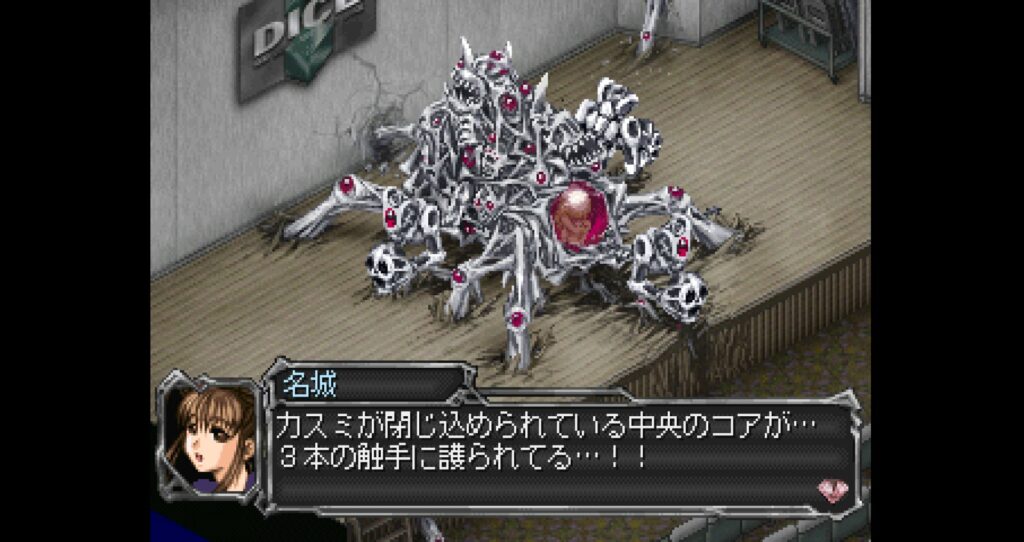
This seems like it would be a hard battle; the core has a lot of HP, and there are three surrounding things that reappear if you kill them, plus the core will sometimes cover itself with a shield that you just have to wait for it to go away. However, if you give Nashiro the Opus combination to let her use Meteo Fall R, she can use the move outside of the range of the boss, letting you beat it without the boss doing anything.
Afterwards we get the usual “building is collapsing, we have to escape” and then we get out. J.B. is still alive and uses some kind of explosion move targeting Touya, but it’s ambiguous whether he does that to kill them or to blow them out of danger — it’s also left slightly uncertain whether J.B. survived.
The end is just everyone going back to their lives.
Overall this is yet another game that has a lot of promise but has so many issues with implementation that it’s a tough game to play. I looked for some Japanese reviews and it seems like most people agreed with my criticisms (even the one about it being hard to follow because of all the weird terms for standard RPG elements like “CS” for “HP”).
Device Reign (デバイスレイン), released 2/25/1999, developed by Starlight Marry, published by MediaWorks
Second SRPG of 1999 is the last one released for the Saturn. By this time I think it was clear that the Playstation had beaten the Saturn, and Sega had already moved on to the Dreamcast which had been released in late 1998. From what I can see the two versions of this game are exactly the same so I played the Playstation one.
The opening is a short movie that shows researchers escaping from some kind of lab with valuable things. What is going on here is explained fairly soon — the woman is Utsugi Riko, who is working at DICE industries under Hellman Reinhart, who was researching “Augments”. He was killed suspiciously in a car accident, and Riko realized that Reinhart had refused to develop the Augments into weapons, and now DICE was going to take his research and go in that direction. Riko and her team get as many of the Augments and associated resources and escape, scattering themselves to avoid detection.
Riko was asked by Hellman to find and protect his half-Japanese daughter, Kasumi. For an unknown reason DICE would be after her to continue their research.
Kasumi is a high school student, who often spends time with her friends Seishiro, and the main character Touya (who doesn’t have a voice actor — the other characters are all voiced by pretty well known people). After bumming around for a while, in front of Kasumi’s house they see a strange zombie-like creature.
Riko appears, telling them this is a “dissonant.” She vanishes and when she reappears, the Dissonant is gone. They go into Kasumi’s house so Riko can explain the situation.
The “Augments” that Kasumi’s dad developed are based on the power of ideas — essentially if enough people have a certain thought or idea about an object, the power of those thoughts/ideas can be harnessed as energy. The augments are form from “Opus”, created by copying these objects — the main Opus becomes the “core brain” and then there are 8 surrounding Opus that add additional powers. For instance, Riko’s “Heaven’s Key” augment is a copy of the key that Jesus gave Peter to signify his leadership role in the church. It’s not clear to me whether the game is literally saying that this key exists in the vatican vault, or whether the fact that there’s some object people *believe* to be that key is enough to give it the power.
While they are talking, the house is surrounded by Dissonants along with one of Dice’s augument users, Kiryuu. In order to protect Kasumi, Seishiro and Touya have to accept two of Riko’s augments, permanently binding to them.
The fights are done in something called “SC space”, which stands for Schrodinger’s Cat space — the explanation is kind of technobabble, but the effect is that the fights all occur in this separate dimensional space. What would normally be HP are a value that represents your ability to stay conscious in the space. What makes Kasumi special is that she can also exist in that space, at least in terms of perceiving what happens (although she has no physical presence).
Before the first fight we can look at the system. It’s surprisingly opaque; as I type this I’m at the end of chapter 6 out of 10 and I still don’t really understand how it works. The problem is that they are trying for a complicated system but they’re still bogged down in the old idea that you can’t really give the player all the information they need but that they’re supposed to explore and figure out the game for themselves. I can appreciate that on the one hand, but there are so many game-specific terms (as you can see in the above: BT-SP, Dis, Res, RR, SCE, ABT, etc.), and I feel like I never have any idea of whether a move will do 2 or 20 damage because it seems to depend on not only those stats but also elemental affinities of both the enemies and players, and the information either is not available or is not easy to see. This is still well before the period of SRPGs where they finally realize that it’s fine to show the player a damage prediction before the attack, even though some games are already doing that.
Anyway, the idea is that you have the 9 slots in your augment. The middle one is the core Opus that can’t be changed. The other slots you can put Opus in and it will create abilities depending on the colors of the gems in each line (vertical and horizontal). You can have up to 6 abilities although certain combinations of Opus will not result in anything. The abilities include ones that just up your stats, healing, buff, debuff, and damage.
The SCE is the power and ABT is the wait time after the move. You can also see the range and area of effect, and what it does, although the descriptions can be vague. Each opus has a PEC value which represents the rarity of the Opus. These affect the power of the ability (although not directly, it has to do with the “rank” of the opus). It also has to do with the other thing you can do with the Opus — “absort”, which is the way you level up. There’s no XP or items or equipment of any kind, everything is done with the Opus. You can put them in your Augment for the abilities, or “absort” them to level up the Augment.
There are two types of enemies you fight. The Dissonant are essentially artificial creatures created from core Opus, once you beat them you can get the Opus they were made from. The other enemies are enemy Augment users.
The battles work on a time-based system; everyone’s BT goes down gradually and when they hit 0 the character can act. It’s in real-time so you need to be quick to get to the character you want to move or the enemies may go first. I think they did this because the CE (magic points) recover gradually, so you may not want to take a character’s turn at the first opportunity. But it gets annoying when you are hitting R and L to try to select a character who just became eligible, and right when you hit the circle button to do the turn an enemy preempts you.
You can move, and then do one of the 6 possible actions, change Opus, or wait. As I said, you don’t get any information about what your attack is actually going to do.
The game is divided into 10 chapters (called “processes”).
1st process basically just introduces the setting and early characters, and has one battle against Kiryuu, one of the DICE augment users. It’s not very hard.
Starting in 2nd process you can travel around Tokyo to various places.
Some of the places you go, you can fight free battles to gain additional Opus. Sometimes it’s clear where you are supposed to go next, but sometimes it’s not, and then you just wander around getting yelled at for wasting time.
In the 2nd process, a strange priest called Bishop joins; he got his augment rather randomly. There’s another person called Joker who also has an augment but he’s rather touchy and doesn’t really join the group. On the enemy side, there’s a mummy-like figure named Utsuro and an assassin called Mibu, but we don’t learn much more about what’s going on.
In the 3rd process we go into a hospital that is a front for DICE, and defeat Mibu. A new pseudo-ally joins called Saeki, she has different colored eyes and is out for vengeance against Utsuro and someone called J.B. who apparently works for DICE.
Afterwards, Kasumi is able to use her special SC-space powers to heal Mibu’s daughter, who had some kind of strange psychological illness. This makes Mibu later join us.
In the 4th process, Touya and Seishiro’s casual attitude towards everything going on results eventually in Kasumi getting kidnapped by DICE.
5th process we continue on the attack against DICE. We learn about two factions within DICE that both seem to have their own goals but it’s still not clear entirely what those are (and especially how Kasumi fits into it). Unfortunately we don’t find Kasumi.
6th process reveals the rift between the parts, as J.B. tries to kill one of the other DICE members and takes Kasumi from him.
There’s more to the story than this, especially with some side characters (high school friends of the MCs and such) but that’s the main outline. The majority of the dialogue is voiced, which is a nice touch.
I think that if the interface were a bit friendlier this would be a better game, but it’s certainly not bad. There is a library with all the Opus and their backgrounds; collecting all the Opuses is somewhat difficult (you have to do some optional things as well as defeat some enemies that are strong but do not have to be defeated to win the battles).