Phantasy Star (ファンタシースター), released 12/20/1987, developed and published by Sega
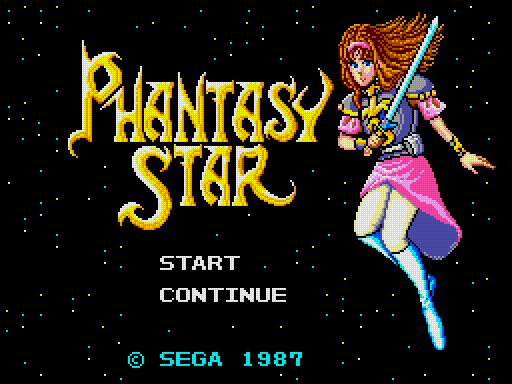
This is the only exclusive Sega Master System RPG. I never played it since I was always a Nintendo rather than Sega person, but I had friends who liked the later games in the series. The game was apparently made to compete with the Famicom’s lineup of RPGs, especially Dragon Quest. The English wikipedia article says there were a number of women on the design team, which might account for the woman protagonist.
CRPGAddict played this, surprisingly, as did Zenic Reverie.
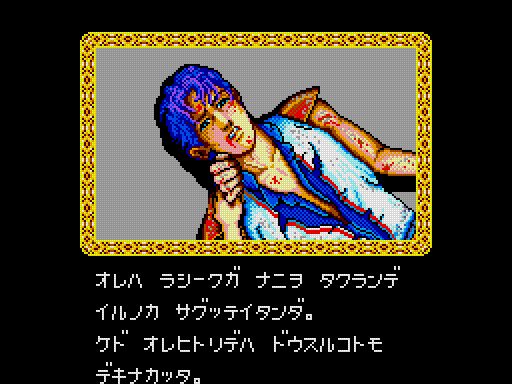
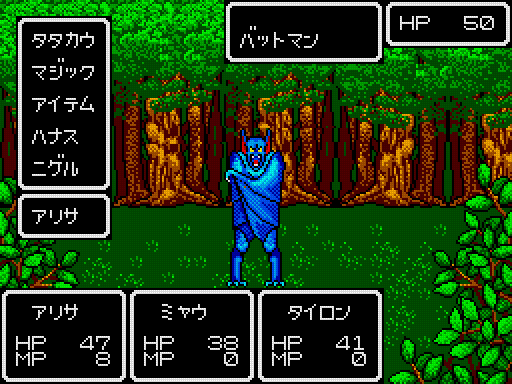
The text is all in katakana, which is rather difficult to read. I stopped talking to the town NPCs because of this. On the whole, the graphics seem to be better than those of the Famicom. The game was advertised as having a 4 megabit cart, fairly large for the time, and it also had music that was enhanced by an expansion chip to the Japanese system (which wasn’t available in the US). The English wikipedia article indicates that a lot of work was put into every part of the game, although ultimately the result was quite expensive. It looks like it was well reviewed both here and in Japan. In the US it came out before Dragon Warrior and Final Fantasy.
(It does seem a bit weird that they put so much effort into the graphics and music but they couldn’t get hiragana in the game’s text)
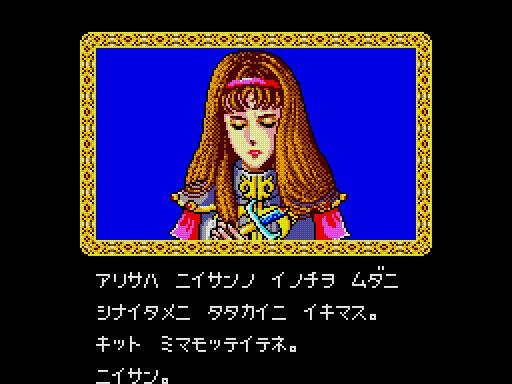
The story involves 15 year old Alisa, who sees her brother Nero killed by the forces of the evil King Lassic. She takes his sword and vows to get revenge. The setting is a mix of fantasy and sci-fi; a fairly early example of this kind of thing. It’s interesting that the game feels no need to justify characters fighting with swords, but also having spaceships. This is a standard “just accept this” feature of almost all these sci-fi/fantasy mix games, but I wonder where it started. The examples I know of from SF literature have a justification for why the mix exists, but games usually don’t bother.
As is expected from a game of this age, there are few plot developments in the game. Several more characters join, but their backstories and characterization is pretty thin. I’m not faulting the game for this since I don’t expect a huge amount of story out of a 1987 game; I’m just taking note.
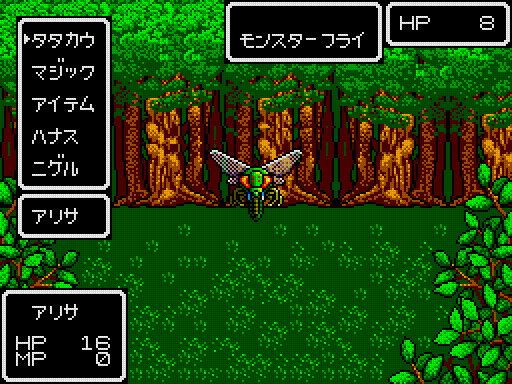
The battle system is your normal basic early RPG system. There is a “talk” command that you can use, although I never actually did this much because it didn’t seem to work often enough to bother. I think the only effect it can have is make the enemies leave you alone.
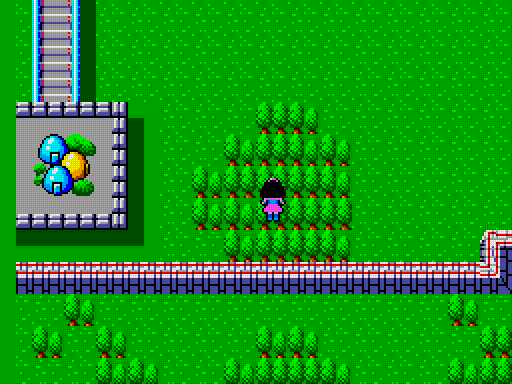
The game starts off pretty difficult. You just have Alisa by herself, and most encounters will result in a game over. You can save anywhere, but if you get a party wipe you have to reload your save. Basically the beginning of the game is dying a lot (if you can’t run from the harder fights) and using the free heal near the beginning until you’ve built a few levels and can buy some better equipment, then you can start venturing out further afield.
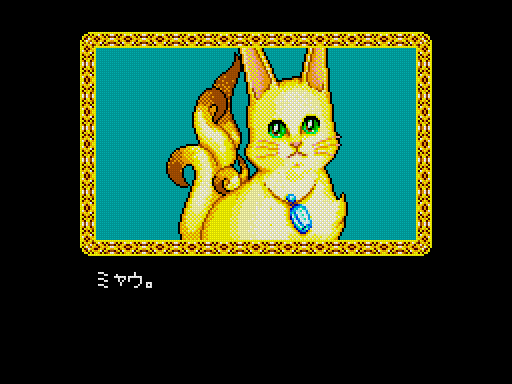
One issue that CRPGAddict ran into is that you sometimes have to talk to people multiple times to get them to do what you want. He didn’t like that, and I don’t much like it either. To progress early in the game you have to try to buy a “secret” item; the first two times the shopkeeper will yell at you that you can’t buy it, but then the third time he lets you buy it. There are several other instances of this in the game, but it’s annoying without some kind of clue. Once you get the passport you can go to another planet and get the cute little cat character Myau, your second unit. We also start learning some spells.
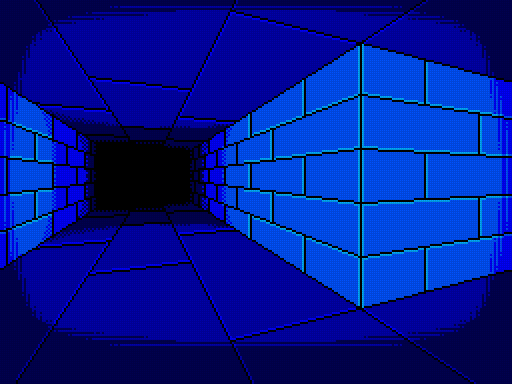
The caves and dungeons are all first person. There is no map and sometimes the way the screen moves is a bit confusing. Most of the chests in the dungeon are also a waste of time — the designer later said he didn’t know how to make an RPG, and you do wonder about some of these early RPGs when a dungeon has 10 chests, 8 of which are basically useless.
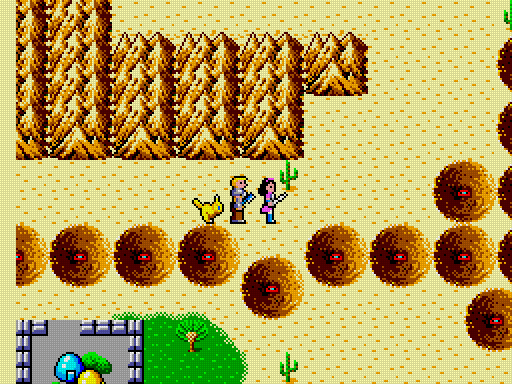
There are three total planets, a desert one, a winter one, and the one you start on.
I think I played about half of the game. Compared to the other 1987 RPGs of this type, I think it holds its own. The graphics and music are better, the first-person dungeons are a nice touch, and I don’t think it noticeably more grindy than Final Fantasy or the Dragon Quests. The English wikipedia article has a lot of detail on the background of the game, which is worth reading.
I don’t recall ever seeing or playing this game as a kid. I vaguely remember one friend had a Sega Master System but we didn’t play it much. The later games on the Genesis I do remember; I never had a Genesis so I didn’t play them, but I was aware of the series.
“I wonder where it started” — of course there are many literary “science fantasy” precursors in the 40s and 50s, but for video games the influential Ultima 1 sees the heroes head to the spaceport and shoot down TIE Fighters in the sky when they get tired of swinging their swords at monsters in dungeons.
Yeah I’m familiar with stuff like Pern and earlier examples — I think my question was more about including both elements but not even bothering to justify it, like having one guy in your party use swords and another one use a laser gun. But that may just be the general simplification and “we don’t care” attitude that a lot of game development had, especially in early series. And by the time people did start caring more, it was such an established trope that you no longer had to explain it.
Definitely one of the most important JRPGs here in Europe. Imagine playing this in 1987, it was head and shoulders above everything else in terms of presentation… and the only big JRPG series available here for a long while (until FF 7, that is). Fascinating, in hindsight, but it is what it is. JRPGs were too much of a gamble in terms of ROI back then, so most of them just weren’t released elsewhere; funny how now it’s almost required.
if you play the game in the Phantasy Star Collection on Saturn, ps2, or ps3 you can use hiragana
Oh yes, Phantasy Star… In Europe, it was truly pioneering work when it came to JRPGs. Sega took a risk, and NES players waited in vain for Final Fantasy and Dragon Quest. Moreover, it was a major driving force for the genre in Japan itself. Along with Dragon Quest, Final Fantasy, and the first Megami Tensei, it truly defined genre conventions. Phantasy Star was probably the first encounter with JRPGs for many here in Europe. I didn’t have a Master System back then and was too young to understand the gameplay of even moderately complex RPGs. Later, however, I became aware of the Phantasy Star series as a teenager. I read about it from time to time, partly because Phantasy Star Online was eventually released for the GameCube. I found the setting particularly fascinating. At the time, I was very into science fiction. Unfortunately, I didn’t have the opportunity to play these games myself for a long time. In fact, I didn’t finally get around to playing Phantasy Star 4 until 2025. I now also own Phantasy Star 1 in the Sega Ages Edition for the Switch and it’s on my list.
People where talking about how Phantasy star was very important in Europe, but I would also like to point it out that was very import in Brazil as well, it was the first and for a long time alongside it’s sequel, one of the few JRPG you could play in Portuguese.
I am aware of a few stories of how this game was fondly remember by the Brazilian children who first played it.