Summon Night (サモンナイト), released 1/6/2000, developed by Flight Plan, published by Banpresto
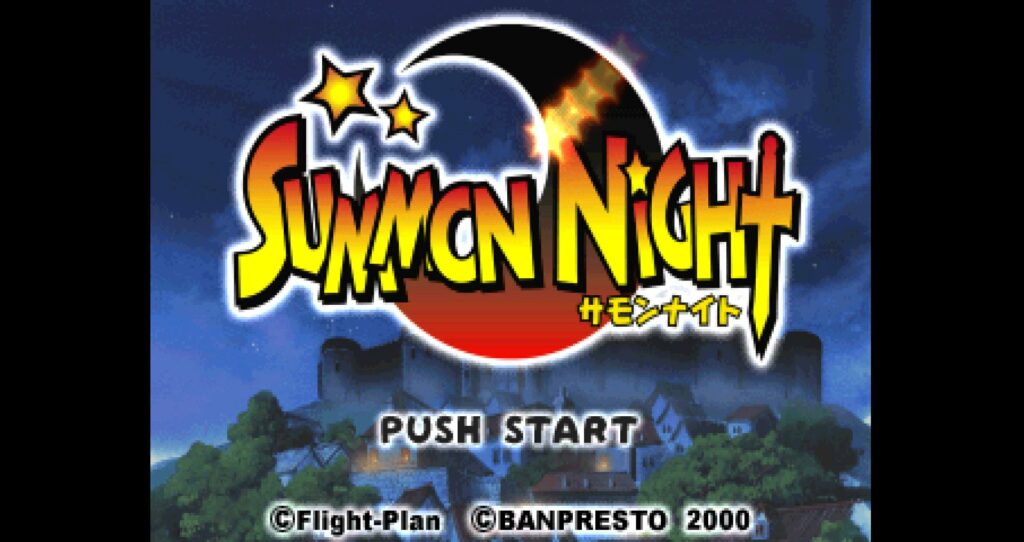
This is Flight Plan’s other major SRPG series after Black/Matrix. It basically consists of 6 core games plus a bunch of spinoff titles. Summon Night 3 was the game that really made me an SRPG fan rather than just a Final Fantasy Tactics fan. Before that I had tried Fire Emblems, Tactics Ogre (plus gaiden), and FFT Advance, but I was never able to get into any of them. Then when I lived in Japan I randomly picked up Summon Night 3 from the local game store; I had never heard of the series and could barely find any information about it online but the cover looked interesting. We’ll get to SN3 later, for now, let’s look at the first game in the series.
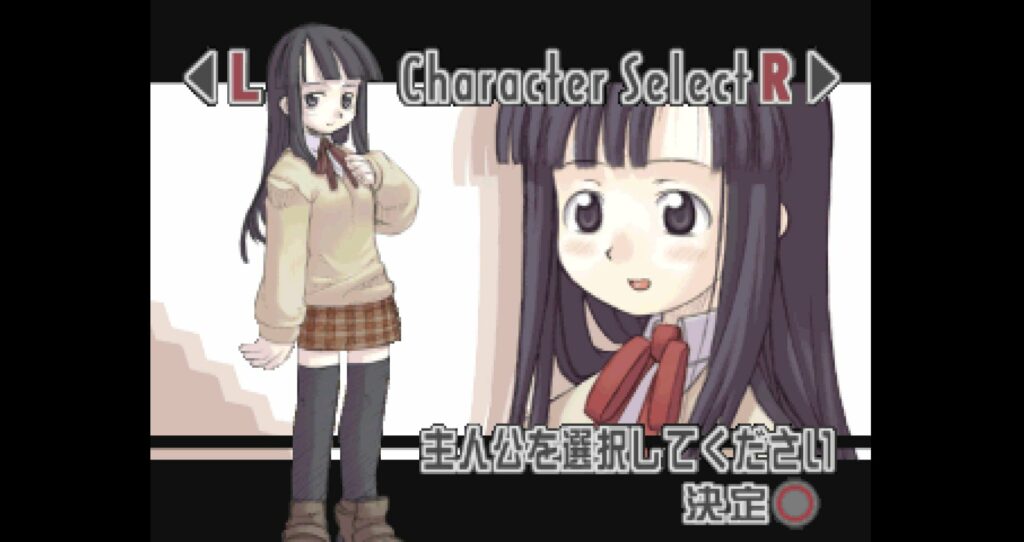
In contrast to the dark, complex world of Black/Matrix, the tone of Summon Night is a bit more “cute” and friendly, although the storylines themselves usually have a fair amount of seriousness and dark stuff in them. As usual for the series you begin by choosing your main character, with a choice of 2 men and 2 women. The first game’s main character is a Japanese high school student who is accidentally summoned into Linbaum, the world of the game. As far as I know this is the only game in the series that uses this trope.
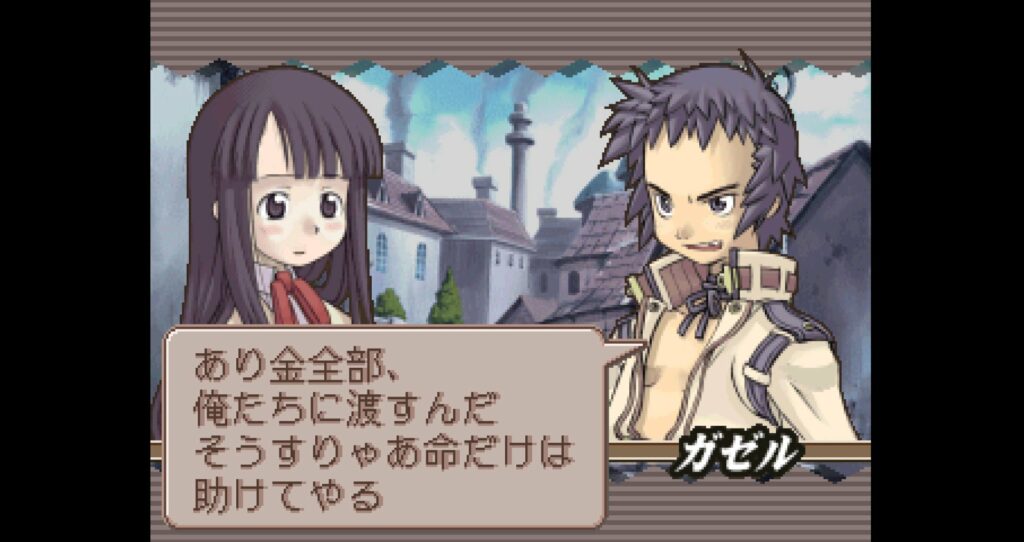
The element of the game that drew in the most fans was the detailed and distinctive character designs, along with the fully voiced dialogue. After arriving in Linbaum, the MC is accosted by this kid Gazel who tries to steal her money, but eventually joins their house, where a bunch of kids live. We learn that the city is controlled by some rich people and there is a huge income inequality in the city.
It turns out that the MC was summoned to the world by some kind of botched summoning attempt. The first part of the game involves her trying to figure out why she was summoned there and hopefully find a way home, and then of course she gets swept into a larger plot that eventually involves the fate of the world.
The “summoners” in the world are people that can use a “rite of contract” to use Summonite Stones of five different colors on certain objects. This gives either an item, a “miss”, or a summon creature. The creature will then be bound to an item which can be equipped by anyone to use the spell. These summoners are associated with various factions (such as the “blue” or “colorless” faction). For this game, only the MC can do the rite, as a product of whatever botched ritual brought her to the world.
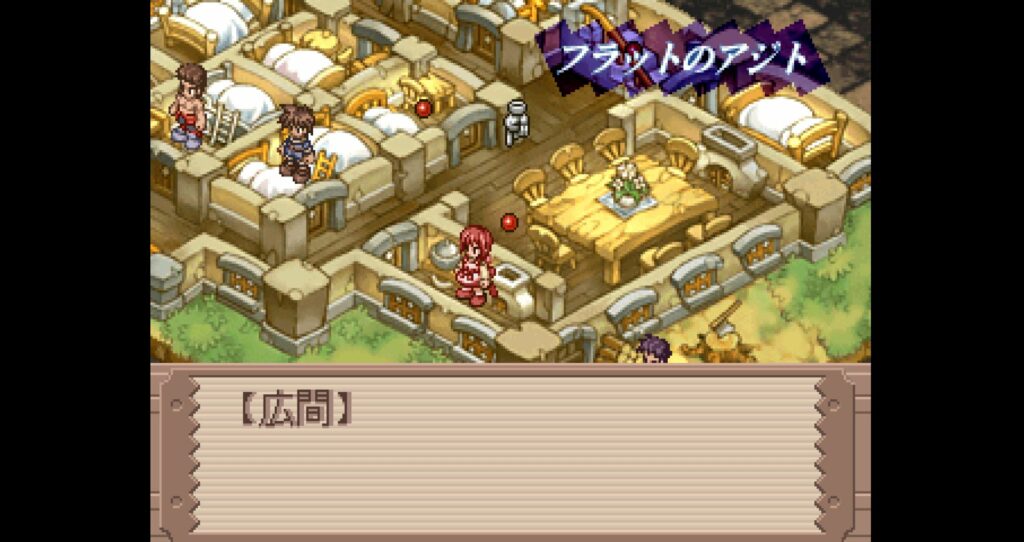
During the “adventure part”, you can move to various locations. If there is a character there, you will have a conversation. The ones that move the plot along are marked EVENT. From time to time there will be a space that has no character but has some kind of secret event; most of these involve optional characters and such.
On the whole, this is the strongest part of the game — the characters are memorable and interesting, and there’s a good mix of lighthearted character development and more serious plot stuff.
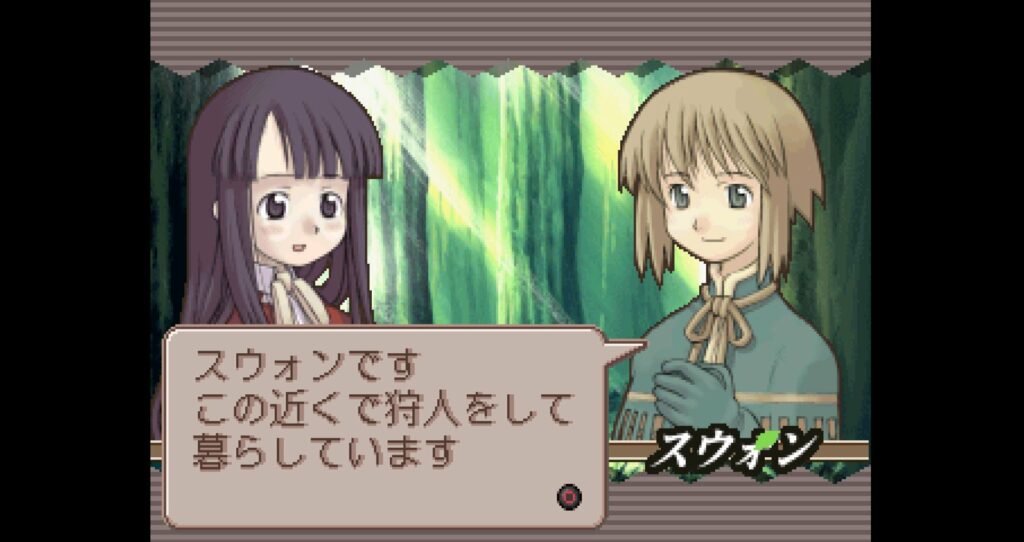
You can experience some boredom because all of the story is done through these sequences like in the image above, with any “action” being done just by sound effects or description. It’s a visual novel style that isn’t to everyone’s taste. But I like it fine. Also the text is done in a nice, readable font.
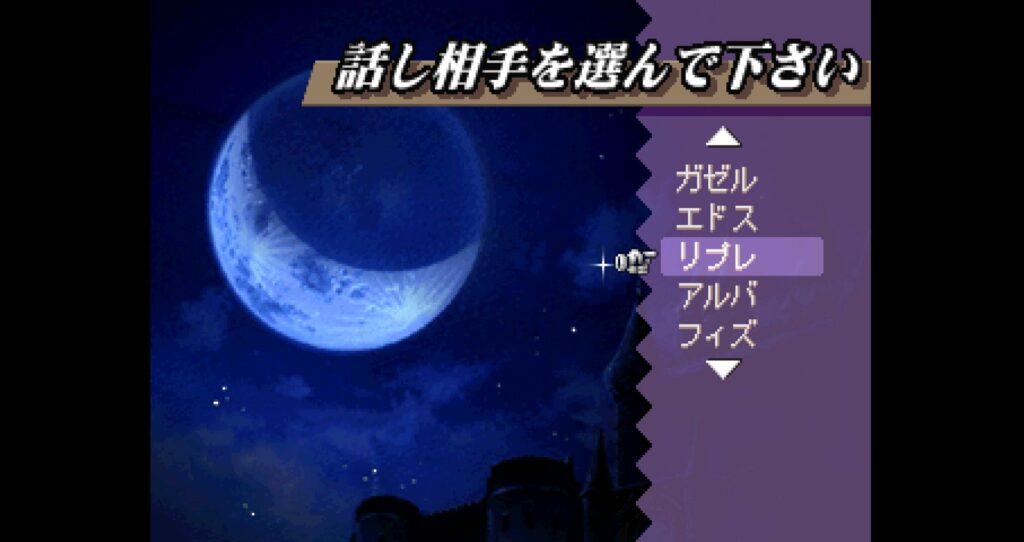
Most of the chapters end with a “night conversation” where you can talk to someone and increase their friendship level. There are a few different endings that are at least partly based on the level, although it seems to be less restrictive than the later titles.
Now for the battle gameplay. The first game is basically the same as 2-4 in terms of overall play.
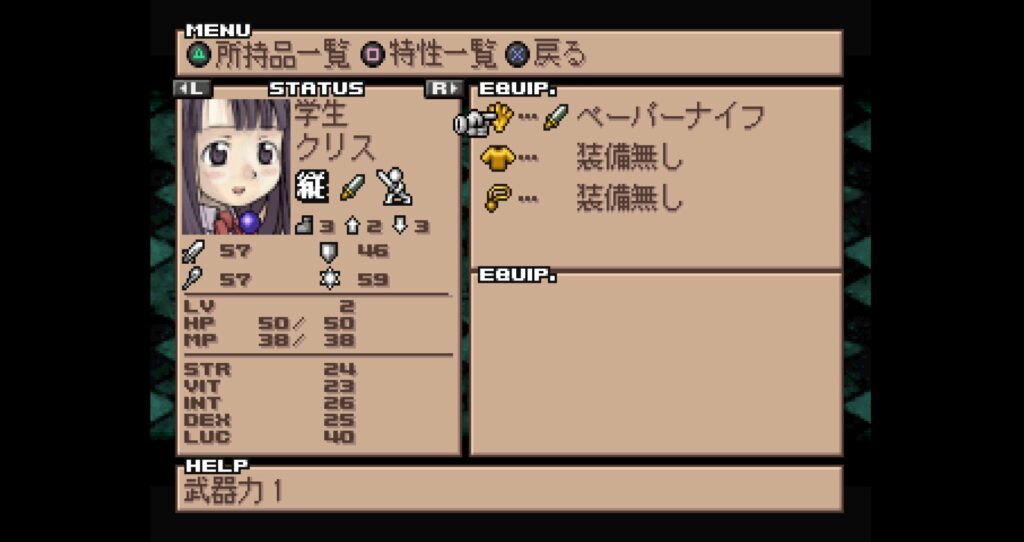
Each character has a class, and several upgrades they get when they reach a certain level. The class determines what weapon you can equip, and what kind of summon stones you can equip (out of the 5 colors). There are three equipment slots.
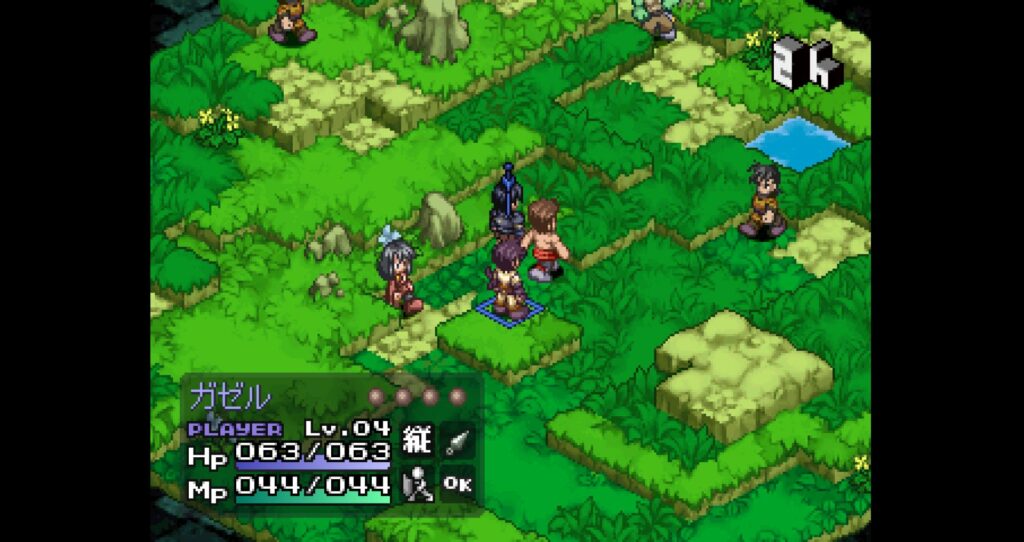
The battles are done with height and facing, on a player turn-enemy turn basis. For counterattacks, you can freely switch between “block” or “counter” at any time on your turn (for any character). Later games add additional reactions, but this game only has the two.
If a character reaches 0 hp they are removed from the battle. There is no immediate penalty, but like the other games, there is a hidden value that increases when you make bad choices or when people die in battle. If it gets high enough, you get a bad ending. From what I saw in a walkthrough, the bad ending value is high enough that you are unlikely to get this ending if you aren’t losing your whole party in each battle.
One of my favorite things about this series is that the XP is not awarded individually to characters. Instead, at the end of the battle you get a lump sum which is then spent to level up members.
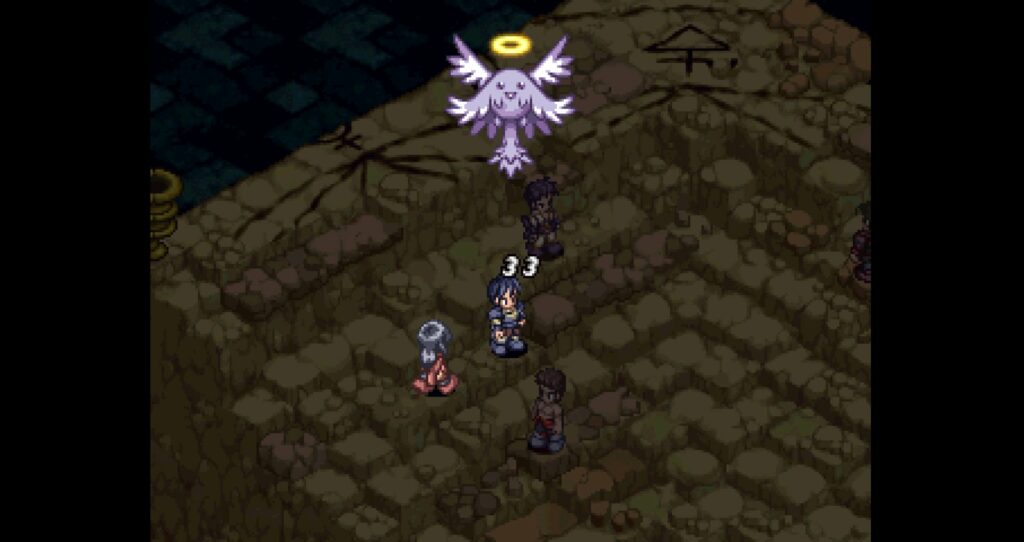
There are free battles you can do in addition to the event battles. This allows you to build up money and XP but also to use your Summonites to get new summon gems. There are also additional rewards for clearing free battles (like equipment or accessories you can’t get any other way).
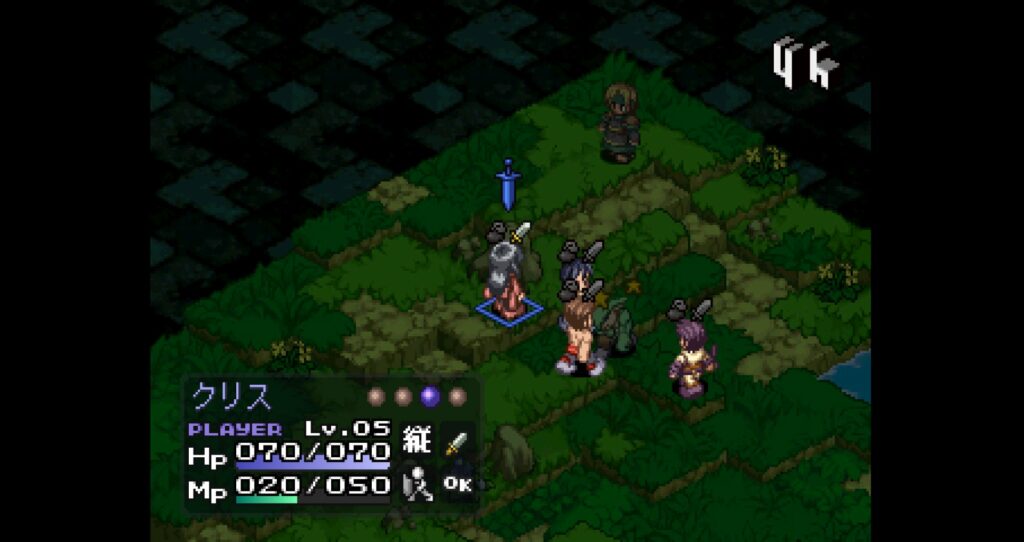
The battle system has good points and it’s fundamentally the same system as the other games, but there is a big problem in the balance, which they didn’t fix until the third game.
This game has very sharp stat or level scaling in its combat formula, so that just 2 or 3 levels of difference can make it hard for a character to be effective. This means on the one hand that if you put all your experience into 2-3 characters, you can clear the whole game with very little trouble. The game gives you a lot of characters, though, and if you want to play with a full party of 8 (plus using the new characters that come in), the game does not give you enough XP through the story battles to make this viable. And the free battles give you so little XP that you will have to do a ton of grinding to make this effective.
Summonite stones are also pretty hard to get, making it difficult to experiment with the items to find the various spells you can learn.
This is a problem in Summon Night 2 also, but they addressed it in 3 by making it easier to earn XP and money through the free battles, and also putting in a system in the game that rewards you for not overlevelling. This system was put into the DS remakes of 1 and 2.
There is a button combo you can press that lets you put in various names for your MC to change things, and one of them (おっさん) gives you x2 xp. This is probably the best thing to do if you actually want to try to preserve any challenge or skill in the game, but as it is, unless you’re willing to spend a ton of time grinding free battles, it’s better to just enjoy the story and make a super main character.
There are some optional characters, a few side events, and some minigames, but a lot of the replayability that the series is known for didn’t come in until the later titles.
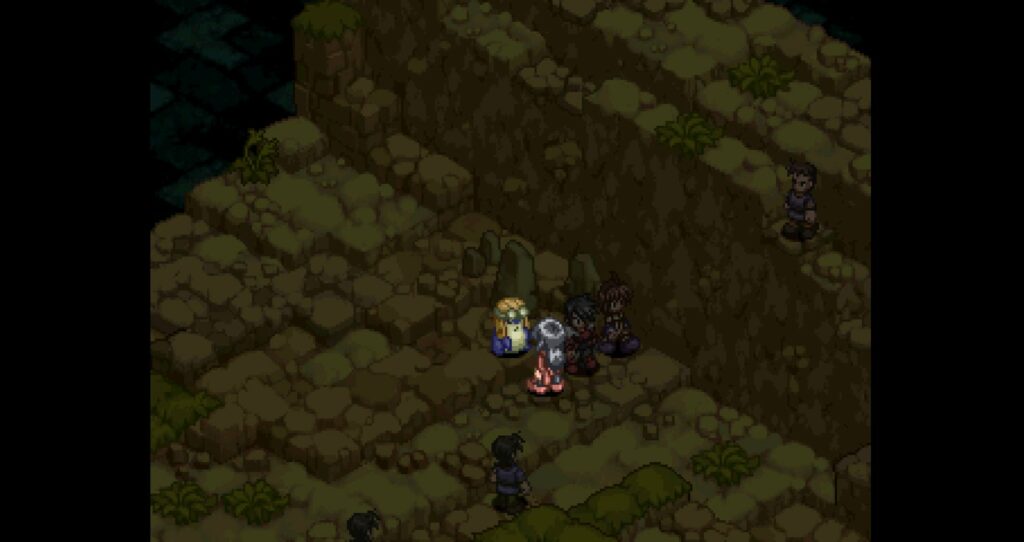
So while this is a decent start to the series, it’s unfortunate that the first two games are more fun as visual novels than actual games.
I’ve heard about this series, but never played any of the games. I wonder how it’s perceived in Japan, in Europe it’s largely completely unknown, as one might expect; only a couple entries were translated, so that’s one of the most likely reasons as to why.
I’m not sure how well the series sold, but I think that at least 2-4 were fairly popular. I think 5 and 6 were less well received; a long time passed between those releases and people felt that 5 and 6 didn’t really capture the feeling of the old ones.